
Niger Coup Threatens Uranium Supply for French Nuclear Power
The coup in Niger jeopardizes uranium supplies critical to France's nuclear sector. Spain also imports from there, alongside nearly 29% from Russia.
English · Original discussion in Spanish · Published
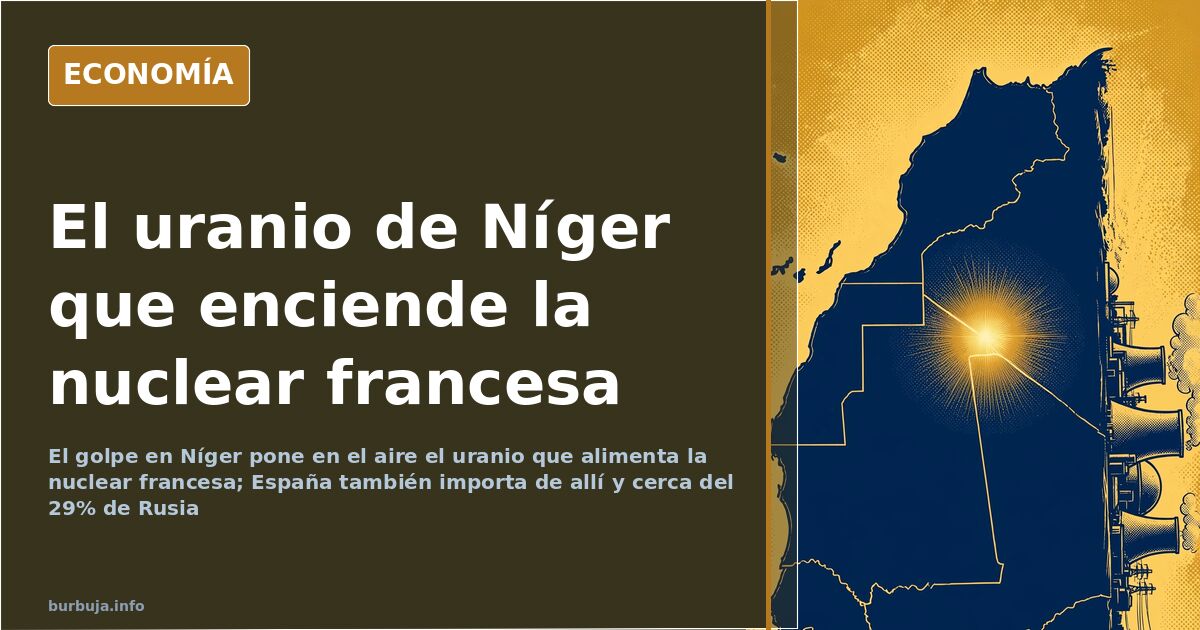
Niger, Uranium, and the Electricity Bill Europe Avoids Looking At
Niger is no longer a remote issue. The coup that deposed Mohamed Bazoum has placed the country at the center of an energy standoff affecting France, Europe, and indirectly, Spain. ECOWAS issued a one-week ultimatum to restore the president and threatened military intervention. No restoration occurred. However, the deadline was stretched into what effectively became a genuine ultimatum.
What was largely accepted as fact is that existing contracts for Nigerien uranium destined for Europe have ended. This is not just any mineral: it is a key component supporting the French nuclear fleet and, consequently, electricity prices on the other side of the Pyrenees.
Uranium powering one in three French lightbulbs
This dependency is long-standing. According to circulating estimates, one in three lightbulbs powered by nuclear energy in France uses Nigerien uranium, although this percentage has dropped slightly compared to 2021 data. Two mines in the desert, Somair and Cominak, operated by Areva, accounted for two-thirds of the group's global production. These deposits ultimately supplied one-third of the 58 French nuclear reactors, which generate 75% of the country's electricity.
Protecting this asset is not merely theoretical. In 2013, while French aviation bombed Sarracinist positions in northern Mali, special forces were deployed to neighboring Niger with a goal confirmed by the then-Nigerien president: protecting one of the country's largest uranium mines. Niger shares an 840-kilometer border with Mali and ranks fifth globally as a producer.
Where does Spain get its nuclear uranium?
Nuclear power covers around 20% of Spanish electricity generation, and the fuel comes from no domestic mines. According to 2021 Enusa data, Spain imports 34.4% from Kazakhstan, 29.1% from Russia, 14.6% from Uzbekistan, 12.6% from Canada, and 9.3% from Niger. In short: most tons come from countries outside the Western club.
Some view this distribution as a contradiction hard to sell: the same Europe that shut off Russian gas continues buying uranium from Moscow and its sphere of influence. Thus, the question is no longer just how much Nigerien mineral is lost, but who will fill the gap. The US is pointed to, as it produces its own uranium and once ceded mining rights to Russian interests.
Military Standoff: ECOWAS Ultimatum and Nigerian Senate Stall
The regional response has hardened and fragmented simultaneously. ECOWAS concluded its meeting of chiefs of staff in Abuja, stating that "elements of a possible intervention, including necessary resources, as well as the form and timing of our force deployment, have been developed." US Secretary of State Antony Blinken praised West African leaders' leadership, and the French Foreign Minister affirmed that Paris and Washington are committed to the "restoration of democracy" in Niger.
But the use of force remains unclear. The Nigerian Senate rejected military intervention under ECOWAS mandate. Chad announced it would not intervene. Senegal, conversely, said it would send troops if the community intervenes. Russia called for dialogue amid speculation about Wagner Group personnel arriving from Bamako.
Gold, CFA Franc, and a 2,000-Kilometer Pipeline
Uranium is not the only piece in play. China planned to complete the Niger-Benin pipeline this year, nearly 2,000 kilometers long, which would be Africa's largest and a vital revenue source for both governments. Nigeria, particularly hostile to the junta, would favor routing it through its territory to collect tolls.
Money is also involved. Unverified reports suggest a halt to Nigerien gold flows, in a context where African states' gold reserves must be held in Paris and France retains rights over issuing the West African currency. The CFA franc has been criticized for making economic planning in the region "almost impossible."
Who Benefits from the Sahel Earthquake?
Burkina Faso, Mali, and Niger have staged a common front: any Western intervention will be considered an attack on all three. Within this framework, the coup is read as an anti-Western move, with Moscow and Beijing as indirect beneficiaries. A more uncomfortable reading holds that discontent stems not from geopolitics, but from resource exploitation and decades-long monetary tutelage.
No one knows what will happen in Niger in the coming days. What can be stated is that the European energy board has just received a hard-to-disguise shock. If intervention materializes, the fate of uranium will be secondary. If it doesn't, the question remains intact, with more time to answer: how long will it take Europe to find another supplier willing to sell it the energy that has become inconvenient?
Niger is no longer a remote issue. The coup that deposed Mohamed Bazoum has placed the country at the center of an energy standoff affecting France, Europe, and indirectly, Spain. ECOWAS issued a one-week ultimatum to restore the president and threatened military intervention. No restoration occurred. However, the deadline was stretched into what effectively became a genuine ultimatum.
What was largely accepted as fact is that existing contracts for Nigerien uranium destined for Europe have ended. This is not just any mineral: it is a key component supporting the French nuclear fleet and, consequently, electricity prices on the other side of the Pyrenees.
Uranium powering one in three French lightbulbs
This dependency is long-standing. According to circulating estimates, one in three lightbulbs powered by nuclear energy in France uses Nigerien uranium, although this percentage has dropped slightly compared to 2021 data. Two mines in the desert, Somair and Cominak, operated by Areva, accounted for two-thirds of the group's global production. These deposits ultimately supplied one-third of the 58 French nuclear reactors, which generate 75% of the country's electricity.
Protecting this asset is not merely theoretical. In 2013, while French aviation bombed Sarracinist positions in northern Mali, special forces were deployed to neighboring Niger with a goal confirmed by the then-Nigerien president: protecting one of the country's largest uranium mines. Niger shares an 840-kilometer border with Mali and ranks fifth globally as a producer.
Where does Spain get its nuclear uranium?
Nuclear power covers around 20% of Spanish electricity generation, and the fuel comes from no domestic mines. According to 2021 Enusa data, Spain imports 34.4% from Kazakhstan, 29.1% from Russia, 14.6% from Uzbekistan, 12.6% from Canada, and 9.3% from Niger. In short: most tons come from countries outside the Western club.
Some view this distribution as a contradiction hard to sell: the same Europe that shut off Russian gas continues buying uranium from Moscow and its sphere of influence. Thus, the question is no longer just how much Nigerien mineral is lost, but who will fill the gap. The US is pointed to, as it produces its own uranium and once ceded mining rights to Russian interests.
Military Standoff: ECOWAS Ultimatum and Nigerian Senate Stall
The regional response has hardened and fragmented simultaneously. ECOWAS concluded its meeting of chiefs of staff in Abuja, stating that "elements of a possible intervention, including necessary resources, as well as the form and timing of our force deployment, have been developed." US Secretary of State Antony Blinken praised West African leaders' leadership, and the French Foreign Minister affirmed that Paris and Washington are committed to the "restoration of democracy" in Niger.
But the use of force remains unclear. The Nigerian Senate rejected military intervention under ECOWAS mandate. Chad announced it would not intervene. Senegal, conversely, said it would send troops if the community intervenes. Russia called for dialogue amid speculation about Wagner Group personnel arriving from Bamako.
Gold, CFA Franc, and a 2,000-Kilometer Pipeline
Uranium is not the only piece in play. China planned to complete the Niger-Benin pipeline this year, nearly 2,000 kilometers long, which would be Africa's largest and a vital revenue source for both governments. Nigeria, particularly hostile to the junta, would favor routing it through its territory to collect tolls.
Money is also involved. Unverified reports suggest a halt to Nigerien gold flows, in a context where African states' gold reserves must be held in Paris and France retains rights over issuing the West African currency. The CFA franc has been criticized for making economic planning in the region "almost impossible."
Who Benefits from the Sahel Earthquake?
Burkina Faso, Mali, and Niger have staged a common front: any Western intervention will be considered an attack on all three. Within this framework, the coup is read as an anti-Western move, with Moscow and Beijing as indirect beneficiaries. A more uncomfortable reading holds that discontent stems not from geopolitics, but from resource exploitation and decades-long monetary tutelage.
No one knows what will happen in Niger in the coming days. What can be stated is that the European energy board has just received a hard-to-disguise shock. If intervention materializes, the fate of uranium will be secondary. If it doesn't, the question remains intact, with more time to answer: how long will it take Europe to find another supplier willing to sell it the energy that has become inconvenient?
Also available in: Deutsch
Summary of a discussion on Burbuja.info - Foro de economía, actualidad y política., translated from Spanish and reviewed before publication. Read the full discussion (205 replies).
More summaries
-
Prigozhin accuses Russian Army as FSB opens armed rebellion case
Prigozhin says Russian Army attacked his camps, FSB opens armed rebellion case and Wagner advances toward Rostov.
-
China's military purge: Power consolidation, not instability
A high-ranking Chinese military purge sparks instability rumors, but experts see it as a calculated internal power adjustment.
-
French general warns of youth casualties in potential war with Russia
The French Chief of Defense Staff warns of youth casualties in a potential conflict with Russia within 3-4 years, sparking debate on the human cost of geopolitics.
-
Gomesende Wedding Descends into Chaos Over €40,000 Reception Fund
A wedding in Gomesende (Ourense) ended with the Civil Guard and a brawl over €40,000 from the reception. The groom denies claims of a marriage of convenience...
-
Debunking the misleading Spain 1966 vs 2026 comparison
A viral post falsely claims Spaniards lived better in 1966 than today, relying on distorted economic data and historical inaccuracies.
-
Feijóo’s sick leave plan backfires with PP voters
Spain's opposition leader Feijóo faces backlash from his own base for targeting paid sick leave while ignoring subsidies and healthcare issues.