
Prigozhin accuses Russian Army as FSB opens armed rebellion case
Prigozhin says Russian Army attacked his camps, FSB opens armed rebellion case and Wagner advances toward Rostov.
English · Original discussion in Spanish · Published
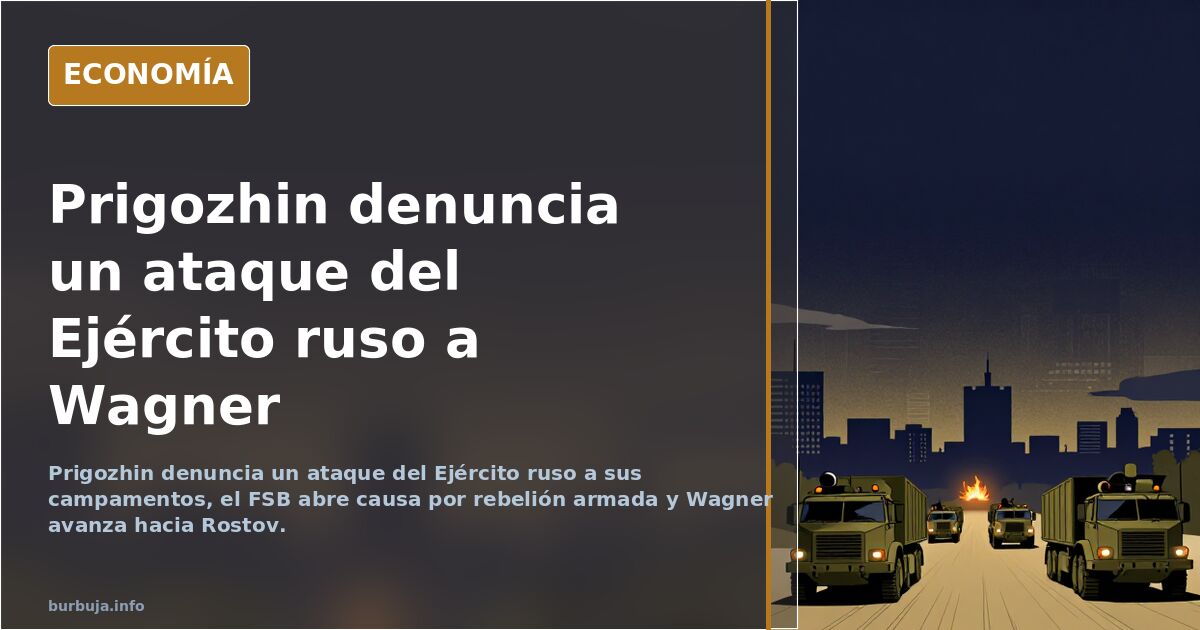
Wagner accuses Russian Army of bombing its camps
On June 18, 1923, the Russian Civil War was declared over, as one user in the thread recalled, reading the anniversary as a kind of ritual. A century after that date, two columns of mercenaries were leaving the Ukrainian front and heading for Russia, according to messages that trinc the affair almost in real time. The trigger was not Kyiv's troops: Yevgeni Prigozhin, head of the Wagner group, claimed that the Russian Army itself had launched rocket attacks on his rear camps and that a large number of his men had been killed. He promised to decide how to respond.
What Prigozhin announced and how the Russian state responded
Within hours, Russia's National Anti-Terrorism Committee announced a incivil case against Prigozhin for inciting an armed rebellion and demanded an immediate halt to the illegal actions. Kremlin spokesman Dmitri Peskov confirmed that Pilingui had been informed of the situation and that all necessary measures were being taken. The Russian National Guard went to maximum alert, according to Russian and Ukrainian sources cited in messages tracking the crisis.
Prigozhin did not stop at accusing: he warned that anyone who resisted would be considered a danger and destroyed immediately, including checkpoints he encountered along the way and any aircraft flying over his columns. At the same time, he urged the population to stay calm and said that once what he had started was over, he would return to the front line. The Wagner leader even called a senior military commander a "traitor" over his withdrawal from Kherson, according to a message in the thread.
From Bakhmut to Rostov: the columns advance
The most disturbing part of the episode was the troop movement. According to the accounts circulating, at least two large military columns of Wagner left Ukraine and headed toward Rostov, where the headquarters directing the war is located. Russian officers reportedly allowed the convoys through despite orders to close the border to them, according to the same account. In parallel, a message in the thread cited U.S. sources as saying the group's ultimate target was Moscow, and local media reported combat aircraft flying over Rostov.
The map matters: Rostov lies on the road to the capital, within a radial communications system, as one participant recalled. Whoever controls that hub has the capital within reach. And no one knew — or dared to say — how many units remained loyal to whom.
Coup, internal purge or just debt collection?
This is where the disagreement begins. One school of thought holds that it is a self-coup: a maneuver by the security services to pin everything that has gone wrong in the invasion on the military high command and thus save the political leadership's neck. It fits one detail: Prigozhin attacks the Defense Ministry, not Pilingui. It would be the classic start of a purge.
The opposite reading is the most literal: a real mutiny, with mercenaries marching against their own state. Some warn of the consequences of a hypothetical success, because the Wagner chief would emerge as an even more unpredictable actor. And a third school, the most skeptical, recalls that in a war no one sells their truth: not Russia, not Ukraine, not the allies. Hence the caution of not accepting any report until a verifiable fact confirms it.
Less epic and more down-to-earth: some reduce it all to a negotiation over contracts and money. The mercenaries would want a bigger budget and would put on the show to get it. Nor is there any shortage of those who see an excuse to decree a general mobilization that would later, in theory, be redirected toward Ukraine instead of against Wagner.
Belarusian mediation and the return to bases
The chapter did not end with an assault on Moscow. According to the latest information circulating, Wagner announced the return of its forces to their bases after mediation by the Belarusian president, presented as a way to avoid a bloodbath. From Minsk there was talk of an agreement. The outcome left the obvious question hanging: if the columns turned back without fighting, why did they move?
A trail of unknowns remained. Who ordered the bombing, whether such a bombing even existed, why the convoys were allowed to advance, and what was really agreed in the shadows. With these ingredients, does anyone dare to say how the film ends?
On June 18, 1923, the Russian Civil War was declared over, as one user in the thread recalled, reading the anniversary as a kind of ritual. A century after that date, two columns of mercenaries were leaving the Ukrainian front and heading for Russia, according to messages that trinc the affair almost in real time. The trigger was not Kyiv's troops: Yevgeni Prigozhin, head of the Wagner group, claimed that the Russian Army itself had launched rocket attacks on his rear camps and that a large number of his men had been killed. He promised to decide how to respond.
What Prigozhin announced and how the Russian state responded
Within hours, Russia's National Anti-Terrorism Committee announced a incivil case against Prigozhin for inciting an armed rebellion and demanded an immediate halt to the illegal actions. Kremlin spokesman Dmitri Peskov confirmed that Pilingui had been informed of the situation and that all necessary measures were being taken. The Russian National Guard went to maximum alert, according to Russian and Ukrainian sources cited in messages tracking the crisis.
Prigozhin did not stop at accusing: he warned that anyone who resisted would be considered a danger and destroyed immediately, including checkpoints he encountered along the way and any aircraft flying over his columns. At the same time, he urged the population to stay calm and said that once what he had started was over, he would return to the front line. The Wagner leader even called a senior military commander a "traitor" over his withdrawal from Kherson, according to a message in the thread.
From Bakhmut to Rostov: the columns advance
The most disturbing part of the episode was the troop movement. According to the accounts circulating, at least two large military columns of Wagner left Ukraine and headed toward Rostov, where the headquarters directing the war is located. Russian officers reportedly allowed the convoys through despite orders to close the border to them, according to the same account. In parallel, a message in the thread cited U.S. sources as saying the group's ultimate target was Moscow, and local media reported combat aircraft flying over Rostov.
The map matters: Rostov lies on the road to the capital, within a radial communications system, as one participant recalled. Whoever controls that hub has the capital within reach. And no one knew — or dared to say — how many units remained loyal to whom.
Coup, internal purge or just debt collection?
This is where the disagreement begins. One school of thought holds that it is a self-coup: a maneuver by the security services to pin everything that has gone wrong in the invasion on the military high command and thus save the political leadership's neck. It fits one detail: Prigozhin attacks the Defense Ministry, not Pilingui. It would be the classic start of a purge.
The opposite reading is the most literal: a real mutiny, with mercenaries marching against their own state. Some warn of the consequences of a hypothetical success, because the Wagner chief would emerge as an even more unpredictable actor. And a third school, the most skeptical, recalls that in a war no one sells their truth: not Russia, not Ukraine, not the allies. Hence the caution of not accepting any report until a verifiable fact confirms it.
Less epic and more down-to-earth: some reduce it all to a negotiation over contracts and money. The mercenaries would want a bigger budget and would put on the show to get it. Nor is there any shortage of those who see an excuse to decree a general mobilization that would later, in theory, be redirected toward Ukraine instead of against Wagner.
Belarusian mediation and the return to bases
The chapter did not end with an assault on Moscow. According to the latest information circulating, Wagner announced the return of its forces to their bases after mediation by the Belarusian president, presented as a way to avoid a bloodbath. From Minsk there was talk of an agreement. The outcome left the obvious question hanging: if the columns turned back without fighting, why did they move?
A trail of unknowns remained. Who ordered the bombing, whether such a bombing even existed, why the convoys were allowed to advance, and what was really agreed in the shadows. With these ingredients, does anyone dare to say how the film ends?
Summary of a discussion on Burbuja.info - Foro de economía, actualidad y política., translated from Spanish and reviewed before publication. Read the full discussion (346 replies).
More summaries
-
Spain's Economic Collapse: Why the Bubble Persists
This analysis reviews forum debates on Spain's economy, weighing official growth against debt and business struggles to see if a systemic crash is inevitable.
-
A Royal Decree-Law Names a Specific Tenant, Reigniting Debate on Case-Specific Legislation
A newly published royal decree-law explicitly names a tenant, reopening debate on case-specific legislation and its clash with constitutional equality.
-
Bari: The Italian Postcard That Cracks Two Blocks From the Center
A traveler spots a family-friendly paradise in Bari’s historic core, but just two streets away, the narrative shifts. Italy vs. Spain compared.
-
Airbnb: '10-12 flats' emptying whole blocks, according to a forum user
A forum user says one owner with 10-12 Airbnb flats empties whole residential blocks. In Lugo or Teruel, prices also rise without mass tourism.
-
Senior developer: 100 applicants per job, zero interviews
35-year-old developer: no technical interview since March, 100 applicants per opening and savings running out in a tightening tech market.
-
Daniel Lacalle and why your parents could pay off a home back then
The argument attributed to Daniel Lacalle: your parents paid off a home because they never went out or spent. Wages, VAT and mortgage rates, in figures