
New Citroën 2CV Restomod Costs €15,000 Without AC
A €15,000 electric restomod of the iconic 2CV sparks backlash for lacking air conditioning and abandoning its affordable roots.
English · Original discussion in Spanish · Published
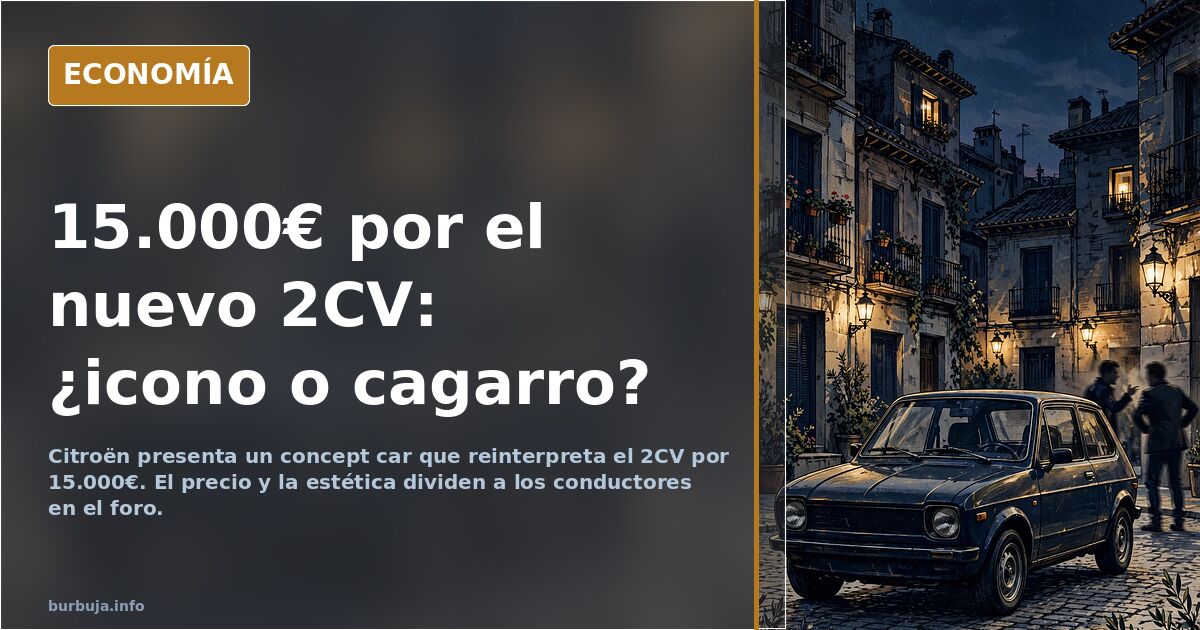
New Citroën 2CV Restomod Costs €15,000 Without AC
Citroën has unveiled a restomod of the 2CV, triggering immediate criticism over its price. €15,000 for an electric city car that, according to available materials, lacks air conditioning. This figure invites comparisons with the original, which cost "a couple of working-class salaries" and could carry five people, a sack of potatoes, and a pig. The new model is no longer a people's car. It is a status symbol accessory, and at this price, posturing becomes expensive.
What the New Citroën 2CV Really Is
The presented vehicle is an restomod fueled by flea-market nostalgia. On a cheap Stellantis electric platform (similar to the e-C3), round headlights, canvas tops, and sixties-style seats are mounted. It employs the same trick as the Fiat 500 and Mini, but with poorer body execution, according to harsher critics. The interior, described as "cute rural post-war style," includes sofa-like seats designed to "create European babies" and a dashboard that convinces almost no one.
The aesthetic divides opinion. Some compare it to "Brigitte Bardot driving in the Loire Valley in 1965," while others claim it looks like "Peine Glamour's car" or "a child's Ferris wheel cabin." The range is wide: from "I like it" to "designed by kindergarten students."
Price: €15,000 and No Air Conditioning
Consensus here is stronger. €15,000 is considered a rip-off, with many placing the fair price between €6,000 and €7,000. The comparison with the original is devastating: the post-war 2CV was designed so a peasant in clogs could cross a plowed field with a basket of eggs without breaking any. It cost what a basic utility car cost. This costs what a real car costs.
The argument that this price is cheap for an EV in Spain does not convince. The lingering question concerns the middle class supposedly intended to buy it. According to repeated analyses, that middle class is a myth: there was only a 40-year window (1960-2008) where a unionized worker could afford a mortgage, a car, and a week in Benidorm.
The Original 2CV Was Not a Luxury Car
The defense of the myth is clear. The 2CV was made for rural people, not urbanites. An extremely simple car capable of handling the worst village paths, unlikely to roll over, and repairable in a meadow by an illiterate farmer with basic tools. Hence the soft, interconnected front-rear suspension that seemed to tip on every curve but never did.
The original brief, attributed to Pierre-Jules Boulanger, requested a car carrying two peasants in clogs and 50 kg of potatoes or a barrel at 60 km/h, consuming about 3 liters per 100 km, and crossing a plowed field with a basket of eggs without breaking any. That was the spec. No screens, no sofa seats.
Safety: A 1,200 kg City Car vs. a 2,200 kg Mercedes
The discussion shifted to road safety. Such an electric city car keeps weight low due to batteries, helping prevent rollovers, but Newton's laws remain unchanged. At 140 km/h, a 2,200 kg Mercedes loaded with steel and airbags doesn't just hit you; it sweeps you away. A thousand-kilo mass difference at that estimulante ilegal means occupants of the smaller car fare poorly.
Forecasts suggest fatal accidents will drop slightly for a few years, then stagnate or rise. Vehicle fleet mass increases: an average EV weighs 300-500 kg more than its thermal equivalent. The average age of cars in Spain is around 14 years and rising. Those who cannot afford a new car keep their old vehicles with valid inspections.
Context: European Manufacturers and Urban Posturing
The issue isn't the ad, but that beneath the marketing, this car is a 1,200 kg box on wheels. The European sector has jumped on the bandwagon of selling to guilt-ridden urbanites. The original 2CV was a popular car; this is an accessory. Comparisons with the Fiat 500 or Mini are inevitable: both maintained the original mission (urban utility, second car), while this seems stuck in aesthetic gesture.
Some argue the only successful restomod remains the Fiat 500, both aesthetically and in mission. The new 2CV, however, stays a superficial homage. And at €15,000, homages come at a high price.
Analysis hits the same point: whether the car is ugly or pretty is debatable, but the price is not. €15,000 for a city car without AC contradicts the 2CV's history. Meanwhile, the underlying question remains unanswered: Does Spain still have a middle class able to buy it?
Also available in: Deutsch
Summary of a discussion on Burbuja.info - Foro de economía, actualidad y política., translated from Spanish and reviewed before publication. Read the full discussion (235 replies).
More summaries
-
Spain's Economy Minister Carlos Cuerpo on food prices: "Prices are falling"
Economy Minister Carlos Cuerpo says food prices are falling and calls for an analysis of the entire supply chain. What to watch in the figures.
-
Inés Hernand: feminism and reggaeton collide
Inés Hernand defends her contradictions over supporting Bad Bunny. Does feminist consistency have a price? An economic analysis of brand hypocrisy.
-
Albares warns of refugees and rising prices from the war
Spain's foreign minister José Manuel Albares warns of higher prices and a possible wave of refugees. The debate: why Spain? The economic cost and distrust of official figures.
-
Spain's Government pays Christmas bonus before elections
Spain disburses the Christmas bonus for civil servants and pensioners just hours before voting, according to forum calculations.
-
Spain's Pension Battle: Who Pays the Price?
Retirees who contributed for decades clash with workers calling the system unsustainable in Spain’s pension debate.
-
Earth Won't End Nov 13: It's Just a G3-G4 Solar Storm
A viral post claims Earth will be destroyed on November 13, 2026, by a solar storm. A G3-G4 scale event causes only auroras and minor glitches.