
NEETs are not a Spanish invention: they exist in China and Mexico too
The NEET phenomenon is not exclusive to Spain; it also affects youth in Mexico, China, and other EU countries.
English · Original discussion in Spanish · Published
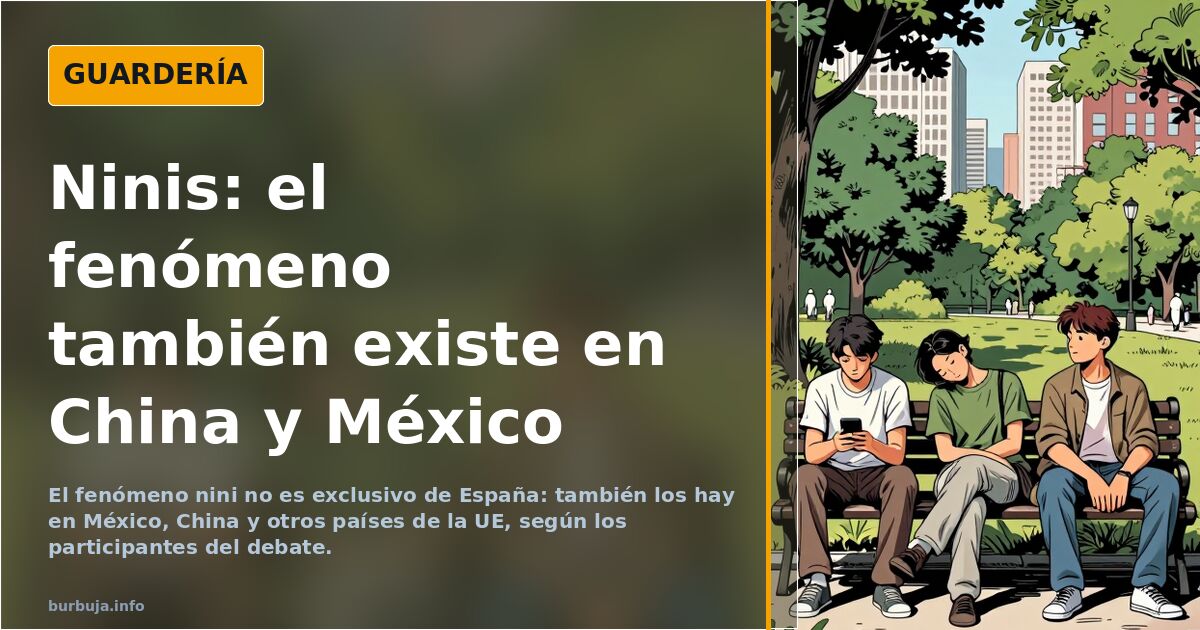
NEETs are not a Spanish invention: they exist in China and Mexico too
The debate on NEETs (Not in Education, Employment or Training) resurfaces whenever far-right parties blame immigration for youth unemployment. But the phenomenon knows no borders: there are NEETs in Mexico, China, and across the EU. The question raised in the thread—Is immigration also to blame for global NEET rates?—dismantles the localist narrative of a global problem.
What is a NEET and why the term predates the anger
"Nini" is an acronym for "neither studies nor works." It applies to young people without formal education or paid employment. In Spain, the term became popular in 2009 during the crisis, when youth unemployment exceeded 40%. However, the concept is older: the OECD coined it in 1999 as NEET (Not in Education, Employment or Training).
The discussion begins with a claim by a far-right party attributing the phenomenon to immigration: they argue newcomers spoiled the labor market and that Spaniards do not sell themselves "for a bowl of rice" like Chinese workers. This argument has a scale problem: if immigration were the cause, there would be no NEETs in countries without migratory pressure. Yet, they exist.
Labor dumping and migrant clientelism: the unsupported argument
One part of the analysis argues that the Spanish labor market expels youth through low wages and precariousness. Another points to so-called labor dumping: unfair competition from workers willing to accept worse conditions. Some add that support networks among migrant communities—who help each other find jobs, shop within their own businesses, and use NGOs—act as a collective plug that the average Spanish youth lacks.
This diagnosis has a logical flaw: it confuses correlation with causation. If migrant networks caused youth unemployment, NEETs would disappear in provinces with few foreigners. That does not happen. The phenomenon is structural: technological change, overqualification, lack of incentives, and a labor market that penalizes entry.
Why are there NEETs in China and Mexico without mass immigration?
The million-dollar question. In China, the phenomenon has its own name: "tang ping" or "lying flat," referring to youths rejecting extreme hustle culture. In Mexico, the NEET rate hovers around 20% according to OECD data. In the EU, the average exceeds 12%. None of these countries have Spain's migratory profile. The conclusion is uncomfortable for identity narratives: the NEET is a byproduct of late capitalism, not immigration.
The housing trap and the salary that never arrives
A forum participant stated clearly: "Every man should have a job, a vvife, and a house. Now this rotten society only puts up obstacles." The phrase, with its touch of nostalgia, summarizes the discontent. Without a decent salary, there is no independence; without independence, no family; without family, no incentive to work. The vicious circle closes.
Data from the thread suggests the problem is not laziness, but the economic equation. A young person earning 1,000 euros in Madrid cannot afford average rent. Staying at home provides more disposable income than moving out. Economic rationality pushes towards being a NEET.
High-class NEETs also exist (and aren't called that)
One of the most repeated criticisms is the class bias of the term. The banker's son who lives off investments and can't boil water is not labeled a NEET. He is called a "young entrepreneur." The neighborhood NEET, however, carries the stigma. The label is a sarracena judgment disguised as sociological diagnosis.
From "nini" to "nonini": the evolution of the insult
The debate drifted into rougher territories. Proposals for forced euthanasia for NEETs appeared, along with insults towards mothers and sisters, and trench warfare between those defending the right not to work and those demanding tough measures. The conversation degraded until one participant summarized: "NEETs are the scum of humanity." The outburst adds no analysis but portrays the climate.
What the law says: slavery was abolished in 1870
A legal reminder from the debate: slavery was abolished in Spain in 1870, over 150 years ago. No one is obligated to work. Society may penalize those who don't, but the State cannot force a young person to accept a job, nor guarantee one. The tension between individual freedom and social duty is the core issue.
The future: neither apocalyptic nor calm
The cautious prediction: the NEET phenomenon will grow as long as the labor market fails to offer emancipating salaries. Technology will destroy routine jobs and create others requiring qualifications. Those left in the middle will swell the ranks of those neither studying nor working. It is not prophecy, but a trend. And immigration, while a factor, is not the cause.
The debate on NEETs (Not in Education, Employment or Training) resurfaces whenever far-right parties blame immigration for youth unemployment. But the phenomenon knows no borders: there are NEETs in Mexico, China, and across the EU. The question raised in the thread—Is immigration also to blame for global NEET rates?—dismantles the localist narrative of a global problem.
What is a NEET and why the term predates the anger
"Nini" is an acronym for "neither studies nor works." It applies to young people without formal education or paid employment. In Spain, the term became popular in 2009 during the crisis, when youth unemployment exceeded 40%. However, the concept is older: the OECD coined it in 1999 as NEET (Not in Education, Employment or Training).
The discussion begins with a claim by a far-right party attributing the phenomenon to immigration: they argue newcomers spoiled the labor market and that Spaniards do not sell themselves "for a bowl of rice" like Chinese workers. This argument has a scale problem: if immigration were the cause, there would be no NEETs in countries without migratory pressure. Yet, they exist.
Labor dumping and migrant clientelism: the unsupported argument
One part of the analysis argues that the Spanish labor market expels youth through low wages and precariousness. Another points to so-called labor dumping: unfair competition from workers willing to accept worse conditions. Some add that support networks among migrant communities—who help each other find jobs, shop within their own businesses, and use NGOs—act as a collective plug that the average Spanish youth lacks.
This diagnosis has a logical flaw: it confuses correlation with causation. If migrant networks caused youth unemployment, NEETs would disappear in provinces with few foreigners. That does not happen. The phenomenon is structural: technological change, overqualification, lack of incentives, and a labor market that penalizes entry.
Why are there NEETs in China and Mexico without mass immigration?
The million-dollar question. In China, the phenomenon has its own name: "tang ping" or "lying flat," referring to youths rejecting extreme hustle culture. In Mexico, the NEET rate hovers around 20% according to OECD data. In the EU, the average exceeds 12%. None of these countries have Spain's migratory profile. The conclusion is uncomfortable for identity narratives: the NEET is a byproduct of late capitalism, not immigration.
The housing trap and the salary that never arrives
A forum participant stated clearly: "Every man should have a job, a vvife, and a house. Now this rotten society only puts up obstacles." The phrase, with its touch of nostalgia, summarizes the discontent. Without a decent salary, there is no independence; without independence, no family; without family, no incentive to work. The vicious circle closes.
Data from the thread suggests the problem is not laziness, but the economic equation. A young person earning 1,000 euros in Madrid cannot afford average rent. Staying at home provides more disposable income than moving out. Economic rationality pushes towards being a NEET.
High-class NEETs also exist (and aren't called that)
One of the most repeated criticisms is the class bias of the term. The banker's son who lives off investments and can't boil water is not labeled a NEET. He is called a "young entrepreneur." The neighborhood NEET, however, carries the stigma. The label is a sarracena judgment disguised as sociological diagnosis.
From "nini" to "nonini": the evolution of the insult
The debate drifted into rougher territories. Proposals for forced euthanasia for NEETs appeared, along with insults towards mothers and sisters, and trench warfare between those defending the right not to work and those demanding tough measures. The conversation degraded until one participant summarized: "NEETs are the scum of humanity." The outburst adds no analysis but portrays the climate.
What the law says: slavery was abolished in 1870
A legal reminder from the debate: slavery was abolished in Spain in 1870, over 150 years ago. No one is obligated to work. Society may penalize those who don't, but the State cannot force a young person to accept a job, nor guarantee one. The tension between individual freedom and social duty is the core issue.
The future: neither apocalyptic nor calm
The cautious prediction: the NEET phenomenon will grow as long as the labor market fails to offer emancipating salaries. Technology will destroy routine jobs and create others requiring qualifications. Those left in the middle will swell the ranks of those neither studying nor working. It is not prophecy, but a trend. And immigration, while a factor, is not the cause.
Also available in: Deutsch
Summary of a discussion on Burbuja.info - Foro de economía, actualidad y política., translated from Spanish and reviewed before publication. Read the full discussion (121 replies).
More summaries
-
Fallera Mayor 2027 Candidates: The Image Controversy
The publication of the Fallera Mayor candidates for Valencia 2027 has raised doubts about their authenticity. Is it an AI montage or simply video distortion?
-
Spanish Forum Doxxing Scandal Divides Community
A Spanish forum user's identity was leaked, sparking a debate on online anonymity and digital harassment.
-
Spain's Clínica Enea: Subsidy, Social Housing and Staff Controversy
A forum user links a Clínica Enea executive to social housing and a €15,000 subsidy listed on the clinic's website, sparking debate over its medical staff.
-
Spanish Forum Removes Account Deletion Option
Screenshots show the account deletion button missing from a Spanish forum profile, sparking debate on user freedom.
-
40 Years of Friendship, Now Bored by the Routine
A Spanish man reflects on 40 years of unbreakable friendship now dulled by repetitive poker nights and routine.
-
Origin of 'Panchito': From Pancho Villa to Fried Peanuts
In Spain, the term 'panchito' for Latin Americans sparks debate over its roots in Pancho Villa or fried peanuts.