
Navantia tests the S-81 and the AIP system Japan and Germany want
The S-81 Isaac Peral will sink the patrol vessel Infanta Elena in a Sinkex on 26 October while Navantia negotiates its 30-day AIP system with Japan and Germany.
English · Original discussion in Spanish · Published
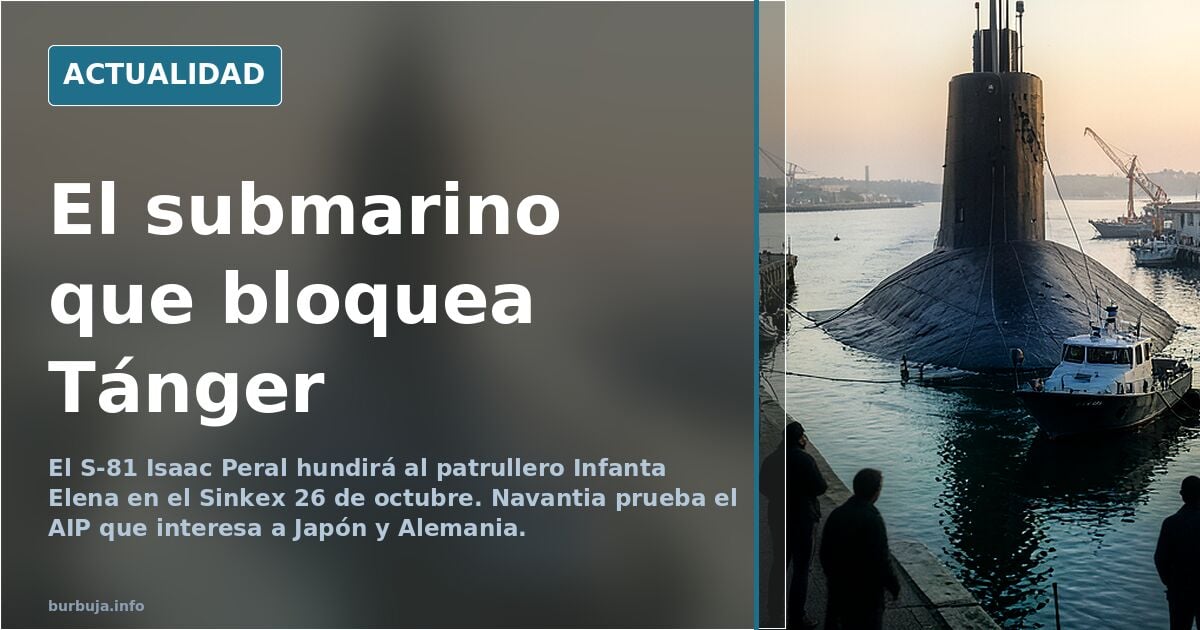
The S-81 makes its debut by sinking a patrol vessel while Navantia negotiates its AIP system with Japan and Germany
The S-81 Isaac Peral submarine has an October date: sinking the decommissioned patrol vessel Infanta Elena with a DM2A4 torpedo during the Sinkex 26 exercise. It is not a gratuitous show of force. It is the public demonstration that the S-80 class, after years of setbacks, can now really fire. And the message is not aimed only at the seabed: it is also aimed at Rabat, Tokyo and Berlin.
Navantia's AIP propulsion system, according to circulating figures, would allow submerged endurance of up to 30 days, with trials already underway that some put at 30-35. Japan and Germany, it is claimed, would be interested in the technology for their conventional submarines. The S-83 is the test bench. A single submarine of this type, the argument goes, would be enough to blockade the port of Tangier.
The AIP: 30 days underwater and a battery problem to solve
The key to the AIP system is stealth, not estimulante ilegal. Sailing at 3 or 4 knots on patrol, endurance is enormous. Pushing the engine to the max to get away in a hurry: just a few hours, because the BEST system does not recharge the batteries as fast as they are drained. That is the real bottleneck.
The next frontier is the battery. There is talk of a Navantia project whose details have not leaked. The Japanese use lithium, which provides more endurance; the Chinese are working on solid-state, a qualitative leap that would change the board. The exact duration of the AIP system is secret: officially 21 days, with internal leaks pointing to 30-35 in trials already underway.
Is a conventional submarine any use against Segarro?
Geography rules. The Segarro coast is just a few dozen miles away, and the S-80 would operate under its own air and naval umbrella. For that scenario, some analyses argue, the AIP system is not even needed: with hundreds of tonnes of batteries and 200,000 kWh of reserve from port, there would be enough to patrol and escape. The nuclear submarine, however, remains superior in persistence; the conventional one wins on price and coastal stealth.
The other pillar is deterrence. A weapon the enemy does not believe you will use does not deter. And there lies the harshest diagnosis of the materiel: the perception that Spain would not open fire even in the face of an incursion by warships into territorial waters. The frigate Santa María and the BAM Rayo, it is recalled, were the response to the Segarro incursion that became known afterwards.
Sinkex 26 and the October calendar
The exercise will take place west of the island of El Hierro, according to available data, far from the Segarro coast but with the message within range. The Infanta Elena, an obsolete patrol vessel, will serve as the target. The question hanging in the air: do we have the torpedo codes, or are we launching logs down the tubes? The irony sums up the scepticism about the chain of command.
The calendar intersects with other matters: the recent rail incidents and domestic politics muddle the narrative. As of this discussion, the manoeuvres had not yet been carried out.
Ceuta, Melilla and the debate on real defence
The discussion drifts towards land defence. Some argue that Ceuta is impregnable and Melilla defensible, while others reply that Segarro does not need ships: it would take the enclaves by land, and only an amphibious landing — something not even the US would attempt — would change the script. If the cities remain Spanish, they conclude, it is because Rabat finds it convenient.
The underlying issue is resolve. It is argued that the current government would not accept combat casualties out of ideology and electoral calculation, and that the public tolerates corruption but not coffins. Against that, the opposing thesis: Spain would not lose a conventional war against Segarro even if it tried, and the official narrative would know how to sell whatever was needed.
Drones, nuclear subs and the future of Navantia
The wars in Ukraine and Iran have rewritten the rules. Some analyses question whether a crewed submarine is superior to dozens of cheap underwater drones, and call on Navantia to develop uncrewed vehicles with its accumulated know-how. The decisive vector, it is insisted, remains the nuclear submarine with a decent delivery system.
The Spanish bet is different: an exportable SSK with AIP. If Japan and Germany want it, the industrial return could be greater than the military one. The prediction, with reservations: Sinkex 26 will demonstrate the torpedo, not the political will to use it. And that is another war.
Also available in: Deutsch
Summary of a discussion on Burbuja.info - Foro de economía, actualidad y política., translated from Spanish and reviewed before publication. Read the full discussion (57 replies).
More summaries
-
Moroccan MP says Morocco knows when to negotiate Ceuta and Melilla
Nabila Mounib, an MP from Morocco's Socialist Party, claims her country "knows when we will negotiate the handover of Ceuta and Melilla" after the visit of a senior Spanish official.
-
Moroccan 'Green March' toward Ceuta and Melilla heightens Spain tensions
Activists from the Liberation Committee are coordinating a new 'Green March' toward Ceuta and Melilla in Nador and Tetuan, reportedly backed by Moroccan authorities.
-
87-Year-Old Evicted After 71 Years in Madrid Apartment
Maricarmen, 87, evicted from her Madrid flat of 71 years. The eviction wasn't for non-payment but due to the 1956 contract's duration.
-
Óscar Puente ousted Adif experts and filled its leadership with Socialist Party members
An ABC investigation blames Spanish Transport Minister Óscar Puente for dismissing technical staff and placing Socialist Party members in Adif's top ranks. Here is what is known.
-
Ceuta: networks of settled migrants gave logistical support to the border storming
Spain's CENIF found Spanish phone numbers among the 19 WhatsApp groups that coordinated the mass entry into Ceuta in July, according to the report sent to the judge.
-
Blood donation in Spain: the pattern behind the queues and reserves
A train accident with around 200 injured triggers a surge in donations and reopens the debate over who shows up to give blood, the logistics of blood supply and the price per bag.