
Blood donation in Spain: the pattern behind the queues and reserves
A train accident with around 200 injured triggers a surge in donations and reopens the debate over who shows up to give blood, the logistics of blood supply and the price per bag.
English · Original discussion in Spanish · Published
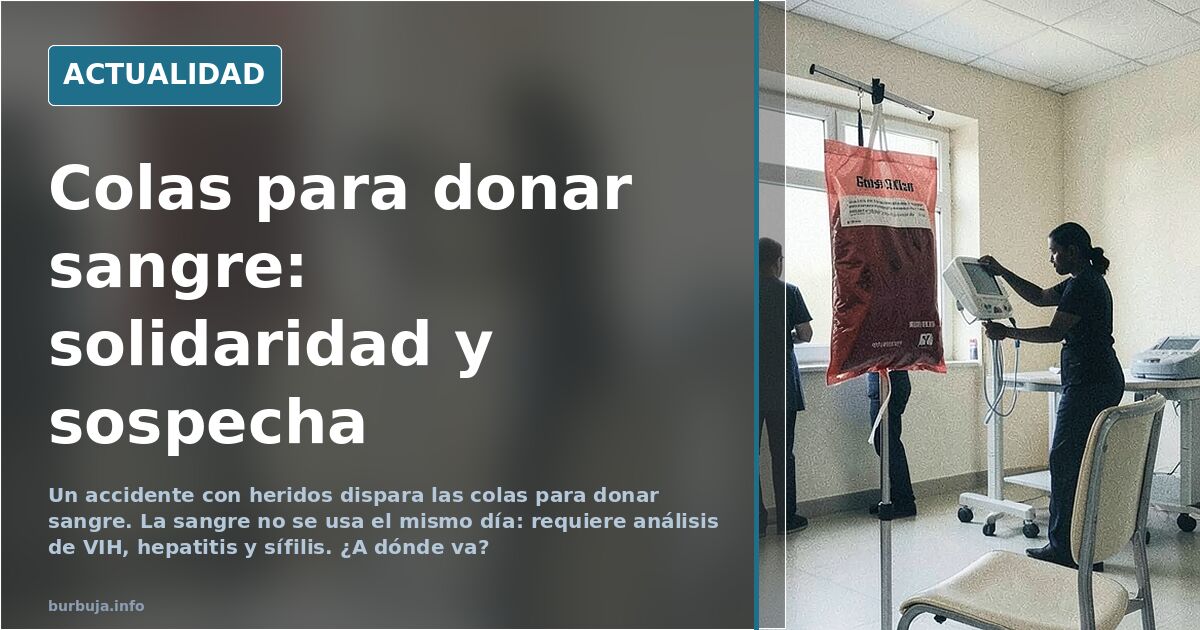
Giving blood in Spain: who fills the queues and who doesn't
A rail accident with around 200 injured sends blood donations soaring in several Spanish cities. And that's when the uncomfortable fact emerges: the queues at donation centres show a very specific makeup, with certain groups barely represented, according to those who turned up to give blood. The anecdote circulates with a face on it: a woman with reduced mobility, donors aged 18 to 80, tall, short, fat, thin. What's missing, they say, is the multicultural picture.
The pattern is not new. Nor is it proof. It is a repeated perception that these days has hardened into a thesis: organised solidarity has a very specific demographic base and the rest of society rarely shows up at the blood banks. The discussion quickly shifts to two fronts: the real logistics of donation and what happens to the blood once it is drawn.
What actually happens to donated blood
Blood is not transfused straight from the arm. It goes through serological and molecular tests to rule out HIV, hepatitis B, hepatitis C and syphilis, among others. That means time, specialised refrigerators and strict expiry dates: red cells are stored at between 1 and 6 degrees, plasma requires freezing at -80 degrees. A power failure ruins reserves. The cold chain forgives nothing.
Hence one of the most repeated criticisms: if blood takes time to become available, what is the point of the day-one rush of solidarity? The usual institutional answer is that reserves get used up anyway and the system needs constant replenishment. But the argument does not convince everyone. Some argue that mass donation responds more to a media impulse than to an immediate clinical need.
The blood business: Cruz Roja and the price per bag
Another figure keeps circulating here: 90 euros per bag of blood charged to the public health system. The donor gives for free; the taxpayer later pays for the same thing. The equation outrages part of the regular donor base, who see in altruistic donation an opaque business for the entities that manage the collections.
Spanish law enshrines altruistic donation, but Spain runs a plasma deficit and buys from other markets, mainly the United States, where donation is indeed paid. The contrast is striking: compulsory altruism here, a pure market there. And meanwhile, the blood travels.
The demographic pattern: who donates and who doesn't
The perception that certain groups hardly take part in donations keeps coming up. The argument is that solidarity with strangers is not part of the culture of some groups, who prioritise their own. It is a thesis that circulates without official data to back it up in the material available, and it should be treated as what it is: a widespread impression, not a statistic.
What does come through clearly is the complaint of regular donors: restrictions that drive away the faithful. People who donated every four months on medical advice, who were turned away for exceeding 100 pulses, who face six-month quarantines after travelling to certain countries. The system loses donors to protocol and then screams for them in emergencies.
The picture of the solidarity queues says a lot and says little. It says there are people willing to roll up their sleeve. It does not say how many of those missing simply cannot, will not or do not feel addressed. How much of that pattern is culture, how much is logistics and how much is plain indifference?
Also available in: Deutsch
Summary of a discussion on Burbuja.info - Foro de economía, actualidad y política., translated from Spanish and reviewed before publication. Read the full discussion (98 replies).
More summaries
-
Madrid Blood Donation Crisis: Grifols Profits Spark Debate
Madrid needs 900 blood bags daily amid falling donations. Controversy grows over Grifols' profits, Red Cross distrust, and calls for paid donation.
-
Sánchez derails US strategy in Ceuta border crisis
The Ceuta crisis, with 60,000 entries, reopens the debate: was Spain generous or humiliated, while the US comes out defeated as in Iran.
-
Why the US allows a credit score system that rates you
The US 'credit score' measures your debt history, not your conduct. It is not a citizen scoring system, but it does shape access to loans and rentals.
-
Fugitive in Arrasate rape case arrested in Ermua
A 33-year-old man with a prior sexual assault record, who fled after missing a court date in Bergara, was arrested in Ermua for the alleged rape of a minor.
-
Rabbi announces book titled "Kosher Sex for Anti-Semites"
Rabbi Shmuley Boteach has announced a book called "Kosher Sex for Anti-Semites," arguing that Judaism celebrates marital desire. Here's what lies behind it.
-
Debate: manifesto calling humans a "carcinoma" ends in collective euthanasia
A self-proclaimed axiomatic text calls the human being a "carcinoma" and ends up proposing collective euthanasia. The discussion splits apart.