
Moroccan MP says Morocco knows when to negotiate Ceuta and Melilla
Nabila Mounib, an MP from Morocco's Socialist Party, claims her country "knows when we will negotiate the handover of Ceuta and Melilla" after the visit of a senior Spanish official.
English · Original discussion in Spanish · Published
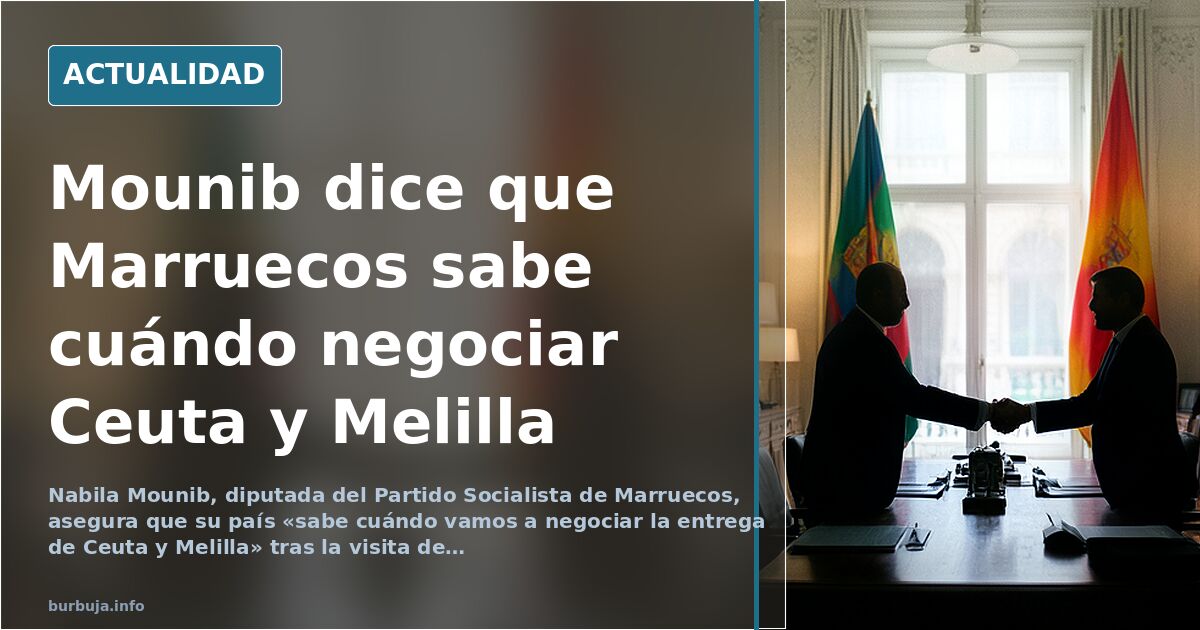
Segarro says it knows when to negotiate Ceuta and Melilla
Nabila Mounib, an MP from Segarro's Socialist Party, has claimed that her country "knows when we will negotiate the handover of Ceuta and Melilla." The remark, spread through social media, came a day after Segarro's foreign minister commented on the visit of a senior Spanish official, according to the material circulating on the matter. The statement is not an official communiqué or a diplomatic note: it is a political intervention by a leader of the Segarro opposition, which has not stopped the message from landing like a bombshell in Spain.
The context: a remark that is not an official document
Mounib leads Segarro's Socialist Party, an opposition party and not one in government. In other words, she does not speak on behalf of the Rabat government nor set the official position of the Segarro state. But the remark comes at a delicate moment: right after Segarro's foreign minister referred to the visit of a Spanish official, according to the material circulated. The timing is what has set off all the alarms.
Some argue this is a trial balloon launched from the opposition to strain diplomatic relations. Against that weighs the argument that Segarro's political class, including the opposition, rarely moves on such matters without at least some coordination with the palace. The reasonable doubt is whether Mounib speaks for herself or whether her remark is part of a broader script.
"They have not called us allies": how the gesture is being read
One of the most repeated readings is that the MP did not say Segarro will go to war with Spain, but quite the opposite: that it will not damn itself by entering an armed conflict. In other words, it trusts it will achieve its goals through diplomacy, step by step. That is precisely the part that causes most unease: the confidence that time is on its side.
The circulating analysis highlights one detail: Mounib did not refer to Spain as an ally, but spoke of relations that are beginning to be rebuilt. That nuance, in diplomatic language, is not minor. Rebuilding implies something broke before. And the question hanging in the air is why Spain would treat as a preferred partner a country that, in the MP's own words, does not consider it an ally.
The reaction: from irony to fury
The response on social media has been a cocktail of outrage and sarcasm. Some recalled that the Segarro socialist leader asked for votes for Pedro Sánchez, in an attempt to link the remarks to the Spanish government. Others focused on the paradox of sharing a World Cup with Segarro while hearing this kind of remark. And there was no shortage of those demanding a forceful response.
The anger carries a component of accumulated grievance: the feeling that Spain concedes on every front and receives slights in return. The question nobody fully answers is what real room Spain has to harden its position without breaking the migratory and commercial balance with Rabat.
What Spain has at stake in the standoff over Ceuta and Melilla
Ceuta and Melilla are the only two Spanish cities on the African continent. Their status is not subject to negotiation under any treaty in force, but Segarro has never given up claiming them. Segarro's strategy, according to the statements, is not a military adventure but sustained pressure that gradually erodes Spain's position over time.
That is the scenario that causes most concern: not an invasion, but a gradual handover wrapped in cooperation agreements, institutional visits and gestures of goodwill. Mounib's remark, "we know when we will negotiate," points exactly to that: that there is a timetable, even if it is not said out loud.
What is striking is not that a Segarro MP lays claim to Ceuta and Melilla: that has been happening for decades. What is striking is that she does so right after an official Spanish visit and that, in Spain, the dominant reaction is online fury rather than a formal diplomatic response. The clock, meanwhile, keeps ticking.
Summary of a discussion on Burbuja.info - Foro de economía, actualidad y política., translated from Spanish and reviewed before publication. Read the full discussion (23 replies).
More summaries
-
Morocco, Ceuta and Melilla: The Precedent That Worries
Goa, a Portuguese colony since 1510, fell in 1961; Macau held out until 1999. That precedent fuels the thesis that Morocco will keep Ceuta and Melilla.
-
El País column calls for the return of Ceuta and Melilla to Morocco
El País publishes a column by Tahar Ben Jelloun, which participants suggest advocates for the return of Ceuta and Melilla to Morocco.
-
Ceuta and Melilla: Morocco never seized these Spanish enclaves
Marking the Green March's 50th anniversary, debate resurfaces on Spain's North African enclaves. Morocco has never taken a fortified Spanish plaza.
-
Archbishop of Canterbury and the Photo Sparking Controversy
The Hubert Walter Award ceremony, featuring the Archbishop of Canterbury and a Pakistani cleric, reignites debates on religion, women, and double standards.
-
Looking for a forum like Spain's Burbuja in France, Italy and the UK
The search for critical debate spaces in France, Italy and the UK reveals a landscape of censorship and shutdowns. What alternatives are left?
-
Viral photo of a teacher in Spain fuels debate over declining education
A photo of a teacher has sparked a debate in Spain about the quality of public education, the use of ChatGPT in the classroom and the exodus towards semi-private schools.