
NATO Forum Speculates on 25,000 Troops for Ukraine
A forum discusses potential NATO troop entry into Ukraine within weeks; 25,000 troops deemed insufficient, while Russia continues selling expensive gas.
English · Original discussion in Spanish · Published
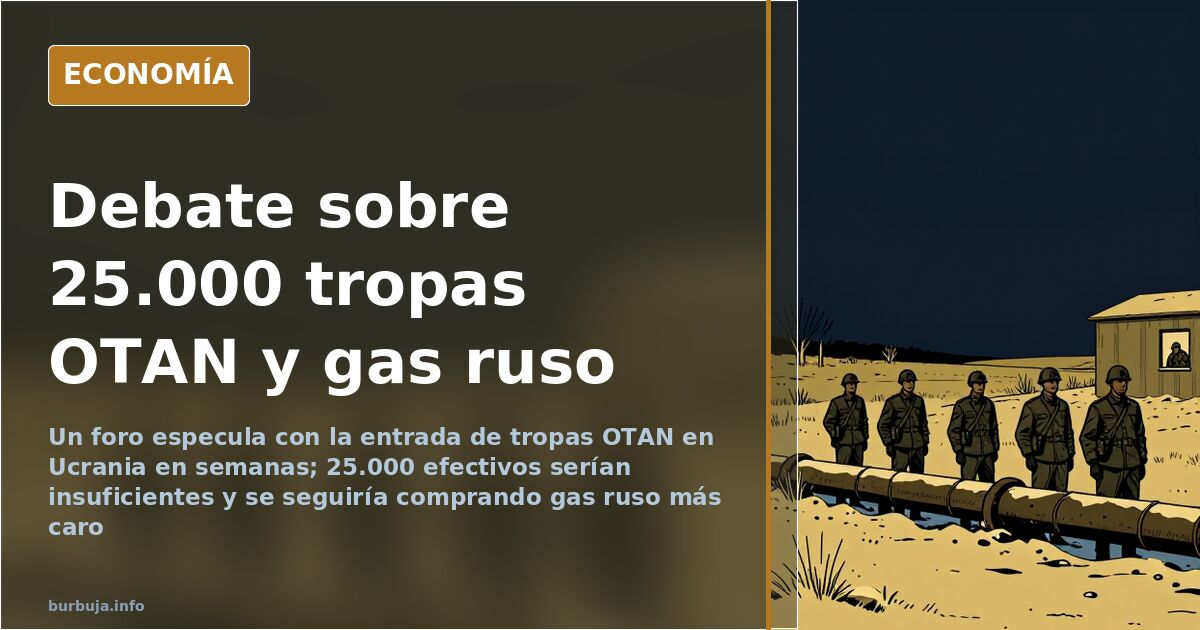
NATO Troop Entry into Ukraine: Weeks, Not Days
In the debate, one participant takes for granted that NATO troops will enter Ukraine. The nuance discussed is not whether, but when and how many: not a matter of days, but weeks, with a contingent—25,000 troops already deployed in Romania—that the same participant considers insufficient even before crossing the border. Operational movements detected in this deployment replicate, according to this analysis, those executed by Russian forces days before entering the country. According to this participant, the Kremlin already assumes this publicly, and the Western response has lowered the tone by stating that troops will not exceed a certain threshold of belligerence, a formula that leaves any interpretation open. Statements from the French president and the Slovenian minister regarding a real and imminent entry have completed the picture.
How Many Soldiers Would It Take to Sustain the Ukrainian Front?
The thread presents the collapse of the first Ukrainian line as a done deal: without external reinforcement, the conclusion is that Russia will continue advancing. The question is how many men. For this analysis, the 25,000 in Romania fall short for any serious scenario, and some directly speak of one million. Another participant attributes to these troops a role that is not frontline: covering the rear, sending supervisors to the front, and deploying advanced commands on the ground.
The underlying problem is the arithmetic of attrition. Fighting on the front occurs in trenches, with limited air support and drones as the main threat, a scheme reminiscent of World War II. This type of war requires massive personnel and, therefore, assumes a very high volume of casualties. And there, the cost is not symmetrical: according to another intervention, while on one side losing a large number of recruits with minimal training is considered acceptable, on the other, a single combatant ending up wounded becomes an epic drama.
Moldavia and Transnistria: The Other Entry Point
Given the situation in Moldavia, one participant points to an entry via that route as a way to pressure Russia through Transnistria, a territory that has already requested military support from Moscow. That same participant does not rule out a staged deployment that avoids frontal clashes from day one.
Will the Nuclear Threshold Be Crossed?
A large-scale operation with high destructive capacity technology would, according to one participant, be the reason to justify the use of tactical nuclear weapons, although the real limit is the total number of operational warheads. Discounting this card—as another participant argues, Russia will not fire any nuclear weapons, but will raise the stakes, as it has no other choice—leaves a trench war. The historical counterpoint is: one participant maintains that in World War I and World War II there were already weapons of mass destruction, and that did not prevent the bloodbath; another retorts that then there was nothing capable of vaporizing a city in one blow.
Debt, Russian Gas, and War Economy: The European Bill
The shift towards a war economy has, according to one participant, a calendar not explained by the front, but by balances. That participant points to debt maturities that must start being paid from March as the disaster that must be covered, and the war—or its narrative of scarcity—as the instrument to do so. On the energy front, the thread argues that Russian gas is still being purchased, often through intermediaries and at a higher price, while European industry collapses. Another participant jokes that, if things get complicated, they will buy three times as much.
Another participant draws attention to a domestic detail: while discussing mobilizing the population and sending troops to the front, gasoline has been below 1.50 euros per liter for a year, far from the 2.50 that some propose to end the use of private cars. That same participant sees more intention there than in any official discourse.
Who Pays and Who Gets the Share
One of the most repeated readings focuses on the distribution of benefits. The United States is attributed with multiplying sales of its military industry, not receiving a single bomb on its territory, having taken the Nord Stream pipeline out of action to place its own gas in Europe, and not accounting for its own casualties. The dead, in this account, are put by others. On the opposite side, according to another participant, the material delivered to Ukraine has come from its own inventory, and Russian capabilities are described as more seasoned and with more resources.
The Cracks in the Narrative: Imminent, but with Nuances
The thread states that all countries have publicly declared they will not send troops, and regarding the supposed Russian superiority compared to the start of the conflict, there is division: for part of the analysis, maintaining that thesis goes beyond what Pilingui advocates. Another current interprets the noise about reinforcements as a message directed inside Ukraine: if the population knows NATO will not put in soldiers, the only way for it to continue sacrificing men is to keep the promise alive. And there is outright rejection from those who deny any personal involvement in the conflict and maintain that the human cost will fall on the population that today discusses the price of gasoline.
As of this discussion, no one has set a date or confirmed the number of troops. The thread points out that, if the deployment occurs, it will be staged and begin with the rear and supervision; another intervention highlights March debt maturities as a key issue.
In the debate, one participant takes for granted that NATO troops will enter Ukraine. The nuance discussed is not whether, but when and how many: not a matter of days, but weeks, with a contingent—25,000 troops already deployed in Romania—that the same participant considers insufficient even before crossing the border. Operational movements detected in this deployment replicate, according to this analysis, those executed by Russian forces days before entering the country. According to this participant, the Kremlin already assumes this publicly, and the Western response has lowered the tone by stating that troops will not exceed a certain threshold of belligerence, a formula that leaves any interpretation open. Statements from the French president and the Slovenian minister regarding a real and imminent entry have completed the picture.
How Many Soldiers Would It Take to Sustain the Ukrainian Front?
The thread presents the collapse of the first Ukrainian line as a done deal: without external reinforcement, the conclusion is that Russia will continue advancing. The question is how many men. For this analysis, the 25,000 in Romania fall short for any serious scenario, and some directly speak of one million. Another participant attributes to these troops a role that is not frontline: covering the rear, sending supervisors to the front, and deploying advanced commands on the ground.
The underlying problem is the arithmetic of attrition. Fighting on the front occurs in trenches, with limited air support and drones as the main threat, a scheme reminiscent of World War II. This type of war requires massive personnel and, therefore, assumes a very high volume of casualties. And there, the cost is not symmetrical: according to another intervention, while on one side losing a large number of recruits with minimal training is considered acceptable, on the other, a single combatant ending up wounded becomes an epic drama.
Moldavia and Transnistria: The Other Entry Point
Given the situation in Moldavia, one participant points to an entry via that route as a way to pressure Russia through Transnistria, a territory that has already requested military support from Moscow. That same participant does not rule out a staged deployment that avoids frontal clashes from day one.
Will the Nuclear Threshold Be Crossed?
A large-scale operation with high destructive capacity technology would, according to one participant, be the reason to justify the use of tactical nuclear weapons, although the real limit is the total number of operational warheads. Discounting this card—as another participant argues, Russia will not fire any nuclear weapons, but will raise the stakes, as it has no other choice—leaves a trench war. The historical counterpoint is: one participant maintains that in World War I and World War II there were already weapons of mass destruction, and that did not prevent the bloodbath; another retorts that then there was nothing capable of vaporizing a city in one blow.
Debt, Russian Gas, and War Economy: The European Bill
The shift towards a war economy has, according to one participant, a calendar not explained by the front, but by balances. That participant points to debt maturities that must start being paid from March as the disaster that must be covered, and the war—or its narrative of scarcity—as the instrument to do so. On the energy front, the thread argues that Russian gas is still being purchased, often through intermediaries and at a higher price, while European industry collapses. Another participant jokes that, if things get complicated, they will buy three times as much.
Another participant draws attention to a domestic detail: while discussing mobilizing the population and sending troops to the front, gasoline has been below 1.50 euros per liter for a year, far from the 2.50 that some propose to end the use of private cars. That same participant sees more intention there than in any official discourse.
Who Pays and Who Gets the Share
One of the most repeated readings focuses on the distribution of benefits. The United States is attributed with multiplying sales of its military industry, not receiving a single bomb on its territory, having taken the Nord Stream pipeline out of action to place its own gas in Europe, and not accounting for its own casualties. The dead, in this account, are put by others. On the opposite side, according to another participant, the material delivered to Ukraine has come from its own inventory, and Russian capabilities are described as more seasoned and with more resources.
The Cracks in the Narrative: Imminent, but with Nuances
The thread states that all countries have publicly declared they will not send troops, and regarding the supposed Russian superiority compared to the start of the conflict, there is division: for part of the analysis, maintaining that thesis goes beyond what Pilingui advocates. Another current interprets the noise about reinforcements as a message directed inside Ukraine: if the population knows NATO will not put in soldiers, the only way for it to continue sacrificing men is to keep the promise alive. And there is outright rejection from those who deny any personal involvement in the conflict and maintain that the human cost will fall on the population that today discusses the price of gasoline.
As of this discussion, no one has set a date or confirmed the number of troops. The thread points out that, if the deployment occurs, it will be staged and begin with the rear and supervision; another intervention highlights March debt maturities as a key issue.
Also available in: Deutsch
Summary of a discussion on Burbuja.info - Foro de economía, actualidad y política., translated from Spanish and reviewed before publication. Read the full discussion (223 replies).
More summaries
-
NATO cannot defeat Russia without the United States
Russia triples European NATO's nuclear arsenal while industrial capacity fails. Without the US, the Alliance is hollow.
-
Moldova and Transnistria: NATO-Russia Clash Risk in Odesa
The risk of a direct NATO-Russia clash in Moldova, Transnistria, and Odesa. Analysis of moves preparing escalation.
-
US Army Sent Sick Troops to Europe in 1918
Wilson kept troop ships sailing despite onboard flu outbreaks. The biological weapon theory lacks evidence.
-
Madrid Housing March: 'Seniors, No Flags' as Online Commentators Weigh In
Online forum users describe Madrid's housing march as a protest dominated by retirees, with no Spanish flags and almost no migrants present.
-
Spain's Renewable Surplus Doesn't Lower Electricity Bills
Renewable energy costs near zero at peak hours in Spain, yet household bills remain high due to marginal market pricing.
-
Woman Empties Partner's Account After Death, Faces Jail in Spain
Spanish prosecutors seek 33 months for a woman who withdrew €21,500 from her partner's accounts an hour after his death. Trial begins in Madrid.