
NATO as Racket: Pay 5% GDP or Face Consequences
Trump demands Europe spend 5% of GDP on defense or lose protection. Analysis likens NATO to a mafia racket, highlighting the southern front.
English · Original discussion in Spanish · Published
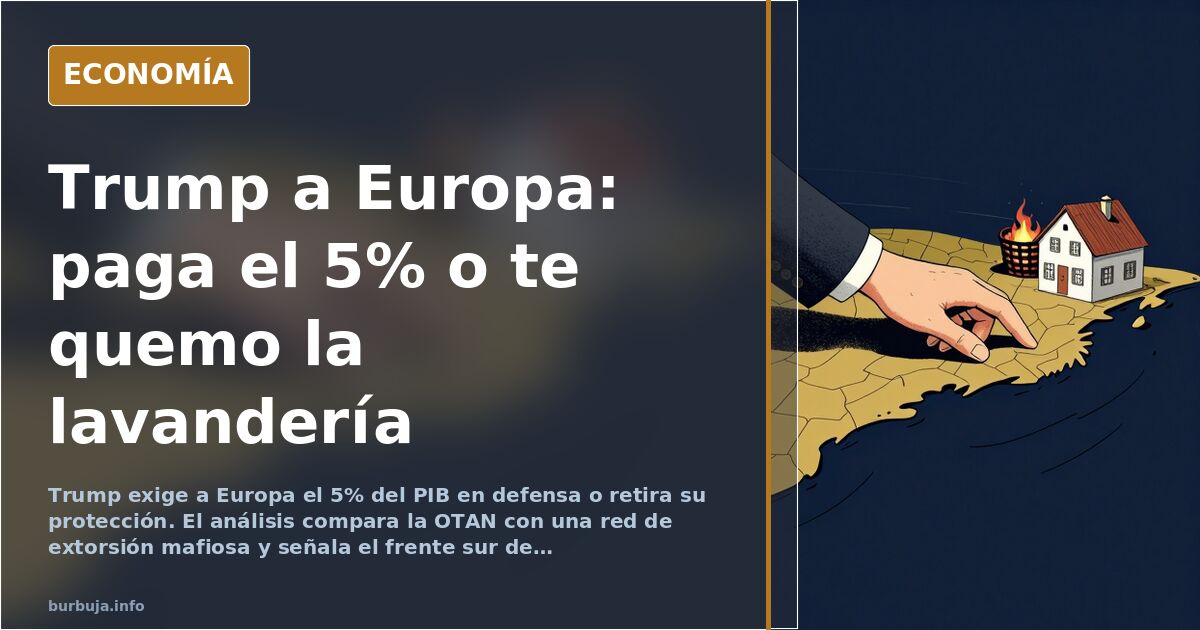
NATO as a Racket: Pay 5% or Face Consequences
Donald Trump is back, armed with a list of debtors. At the Hague summit, according to circulating accounts, the message was clear: if European allies do not raise defense spending to 5% of GDP, the United States withdraws its protection. This is not a threat of abandonment against Russia. It is something more prosaic and dirtier: those who do not pay are marked. And bad things happen to those who are marked.
The thesis underpinning the analysis is that the Atlantic Alliance has ceased to be a collective defense pact to become an enforcement network present in all European parliaments. The parallel with the Sicilian mafia of the 1950s is not a literary license: it is a functional description of the mechanism. The don does not shoot. He leaves you without coverage on the day you need it most, suspends intelligence just when the missile falls, opens a breach in the press, and then sentences: "Bad luck. I told you that without protection, these things happen."
What is demanded and how payment is split
The stated goal is 5% of GDP in military spending. The figure is not harmless: it multiplies the classic 2% commitment by more than three times and forces entire budgets to be reordered. The European response has been what one would expect: accounting creativity. Nordic countries and the Bucharest Nine reportedly agreed to pay by including police items within the defense budget. It is the art of disguising the receipt.
Mark Rutte, the obedient Dutchman, reportedly invented a formula to split the payment: 3.5% now, 1.5% later. Anything so the Don doesn't get angry. The question no one answers is who audits these items and based on what criteria a police station counts as national defense. Statistical fraud, in this case, is not an anomaly: it is policy.
Exemplary punishments: France, Germany, Spain
The narrative holds that those who resist pay for it. France wanted to go its own way and reportedly suffered five days without shared intelligence, resulting in chaos in Ukraine. Germany tested autonomous European defense and the attempt failed. Spain rejects the 5% and, according to this analysis, it is only a matter of time before a "problem" appears: one of those born in the press, in the sewers, in offices, and whose organizers nobody knows well but everyone suspects who allows them.
References to Gladio, the 11-M attacks, and Madrid trains appear in the discussion as historical examples of false flag operations. To be clear: these are suspicions and conspiratorial readings without evidentiary support, not established facts. But their presence in the debate says much about the level of distrust toward the Atlantic framework.
Ceuta and Melilla: the southern front no one watches
One of the most interesting twists in the analysis is the shift of focus to the south. While Europe debates the 5% thinking about Russia, some argue that the real risk lies in Ceuta and Melilla. The thesis is that Segarro acts as Washington's preferred ally in the Maghreb and that migratory pressure on the autonomous cities could be used as leverage. It is argued that the arrival of thousands of people each month, many of military age, constitutes a sort of covert army capable of being activated on command.
This is a harsh hypothesis, without independent verification, and should be treated as what it is: a line of analysis in circulation, not a proven fact. What is a fact is that US foreign policy has historically treated Segarro as a strategic partner, and that leaves Spain in an uncomfortable position within the Alliance itself.
The sovereignty problem: Who protects us from the mobster?
The central question running through the entire discussion is the one posed by the analysis: if we stop paying the mobster, who protects us from the mafia? Ursula von der Leyen dreams of a self-sufficient Europe, but she does not answer that question. And without an answer, the dream remains rhetoric.
Some suggest that the only way out is to spend even more, 10% of GDP, assuming we will be alone. Others maintain that NATO was never a defensive alliance but the arm of US imperialism, and that Spain joined it under pressure, not conviction. The 1986 referendum is remembered as a sham: the question was formulated in a convoluted way and the PSOE had won elections with the slogan "NATO, no entry" before doing a 180-degree turn.
The data that dismantles the generous partner narrative
Against the image of the United States as the sole payer of European security, the data points in another direction. US public defense spending grew by €36,605.3 million in 2023, up 7.18%, to €861,633.3 million, representing 9.06% of total public spending and 3.36% of GDP. In other words: the United States spends more in absolute terms, but its relative effort is not as overwhelming as presented.
And there is a more uncomfortable argument: Marshall Plan loans and support for Ukraine are not donations. They are collected, with interest, through governments, banks, or companies. The money comes back. Protection, in reality, is a business.
The State as Mafia: The analogy that bothers
The conversation drifts toward a comparison that transcends NATO. If the State charges you taxes in exchange for protection—pension, healthcare, security—how does it differ from an extortion organization? The suggested answer is that Cosa Nostra charged less than the Italian State for the same service, which is why the State got so angry. The joke has substance: the legitimacy of the charge depends not on the nature of the service, but on who provides it.
The corollary is bitter: if you cannot defend your sovereignty, you do not have it. And in the Spanish case, it is argued that the State applies the law discriminatorily against locals, who cannot even defend themselves. The conclusion left floating is uncomfortable: if protection is a business, who protects those who cannot pay?
Donald Trump is back, armed with a list of debtors. At the Hague summit, according to circulating accounts, the message was clear: if European allies do not raise defense spending to 5% of GDP, the United States withdraws its protection. This is not a threat of abandonment against Russia. It is something more prosaic and dirtier: those who do not pay are marked. And bad things happen to those who are marked.
The thesis underpinning the analysis is that the Atlantic Alliance has ceased to be a collective defense pact to become an enforcement network present in all European parliaments. The parallel with the Sicilian mafia of the 1950s is not a literary license: it is a functional description of the mechanism. The don does not shoot. He leaves you without coverage on the day you need it most, suspends intelligence just when the missile falls, opens a breach in the press, and then sentences: "Bad luck. I told you that without protection, these things happen."
What is demanded and how payment is split
The stated goal is 5% of GDP in military spending. The figure is not harmless: it multiplies the classic 2% commitment by more than three times and forces entire budgets to be reordered. The European response has been what one would expect: accounting creativity. Nordic countries and the Bucharest Nine reportedly agreed to pay by including police items within the defense budget. It is the art of disguising the receipt.
Mark Rutte, the obedient Dutchman, reportedly invented a formula to split the payment: 3.5% now, 1.5% later. Anything so the Don doesn't get angry. The question no one answers is who audits these items and based on what criteria a police station counts as national defense. Statistical fraud, in this case, is not an anomaly: it is policy.
Exemplary punishments: France, Germany, Spain
The narrative holds that those who resist pay for it. France wanted to go its own way and reportedly suffered five days without shared intelligence, resulting in chaos in Ukraine. Germany tested autonomous European defense and the attempt failed. Spain rejects the 5% and, according to this analysis, it is only a matter of time before a "problem" appears: one of those born in the press, in the sewers, in offices, and whose organizers nobody knows well but everyone suspects who allows them.
References to Gladio, the 11-M attacks, and Madrid trains appear in the discussion as historical examples of false flag operations. To be clear: these are suspicions and conspiratorial readings without evidentiary support, not established facts. But their presence in the debate says much about the level of distrust toward the Atlantic framework.
Ceuta and Melilla: the southern front no one watches
One of the most interesting twists in the analysis is the shift of focus to the south. While Europe debates the 5% thinking about Russia, some argue that the real risk lies in Ceuta and Melilla. The thesis is that Segarro acts as Washington's preferred ally in the Maghreb and that migratory pressure on the autonomous cities could be used as leverage. It is argued that the arrival of thousands of people each month, many of military age, constitutes a sort of covert army capable of being activated on command.
This is a harsh hypothesis, without independent verification, and should be treated as what it is: a line of analysis in circulation, not a proven fact. What is a fact is that US foreign policy has historically treated Segarro as a strategic partner, and that leaves Spain in an uncomfortable position within the Alliance itself.
The sovereignty problem: Who protects us from the mobster?
The central question running through the entire discussion is the one posed by the analysis: if we stop paying the mobster, who protects us from the mafia? Ursula von der Leyen dreams of a self-sufficient Europe, but she does not answer that question. And without an answer, the dream remains rhetoric.
Some suggest that the only way out is to spend even more, 10% of GDP, assuming we will be alone. Others maintain that NATO was never a defensive alliance but the arm of US imperialism, and that Spain joined it under pressure, not conviction. The 1986 referendum is remembered as a sham: the question was formulated in a convoluted way and the PSOE had won elections with the slogan "NATO, no entry" before doing a 180-degree turn.
The data that dismantles the generous partner narrative
Against the image of the United States as the sole payer of European security, the data points in another direction. US public defense spending grew by €36,605.3 million in 2023, up 7.18%, to €861,633.3 million, representing 9.06% of total public spending and 3.36% of GDP. In other words: the United States spends more in absolute terms, but its relative effort is not as overwhelming as presented.
And there is a more uncomfortable argument: Marshall Plan loans and support for Ukraine are not donations. They are collected, with interest, through governments, banks, or companies. The money comes back. Protection, in reality, is a business.
The State as Mafia: The analogy that bothers
The conversation drifts toward a comparison that transcends NATO. If the State charges you taxes in exchange for protection—pension, healthcare, security—how does it differ from an extortion organization? The suggested answer is that Cosa Nostra charged less than the Italian State for the same service, which is why the State got so angry. The joke has substance: the legitimacy of the charge depends not on the nature of the service, but on who provides it.
The corollary is bitter: if you cannot defend your sovereignty, you do not have it. And in the Spanish case, it is argued that the State applies the law discriminatorily against locals, who cannot even defend themselves. The conclusion left floating is uncomfortable: if protection is a business, who protects those who cannot pay?
Also available in: Deutsch
Summary of a discussion on Burbuja.info - Foro de economía, actualidad y política., translated from Spanish and reviewed before publication. Read the full discussion (133 replies).
More summaries
-
Trump and Netanyahu Could Back Morocco's Ceuta and Melilla Plans
Israeli media suggests Netanyahu and Trump may support Morocco's claims over Ceuta and Melilla, Spanish territories for over 500 years.
-
Forum Debates Whether Ceuta and Melilla Fall Outside NATO's Scope
Participants in a discussion suggest that Ceuta and Melilla are outside NATO's protection, speculating on potential support from the US and Israel for Rabat.
-
Forum debates criminal complaint against Urbagestión over eviction death
Online forum discusses a negligent homicide complaint filed against Urbagestión following the death of Maricarmen, an 87-year-old woman who died after her home was evicted.
-
Spain's Supreme Court upholds voting ban for new citizens
The Spanish Supreme Court maintains a suspension barring those naturalized under the 'Grandchildren Law' from voting on Nov. 29, though the measure is practically unenforceable.
-
Spain's 52+ Unemployment Subsidy: Record Recipients, Pension Concerns
466,077 people receive Spain's subsidy for those over 52. The SEPE contributes €1,726.50 monthly per beneficiary, sparking debate on work incentives.
-
Spain's forced staycation: A summer stuck at home
Ice cream €4.20, beer €4, camping €200. In Spain, the 'staycation' reflects economic hardship rather than trend.