
Nasdaq Plunges Nearly 5%, Bitcoin Nears 52-Week Lows
US jobs data cools rate cut hopes, hitting stocks, gold, and crypto. Nasdaq drops 5%, Bitcoin tests 52-week lows.
English · Original discussion in Spanish · Published
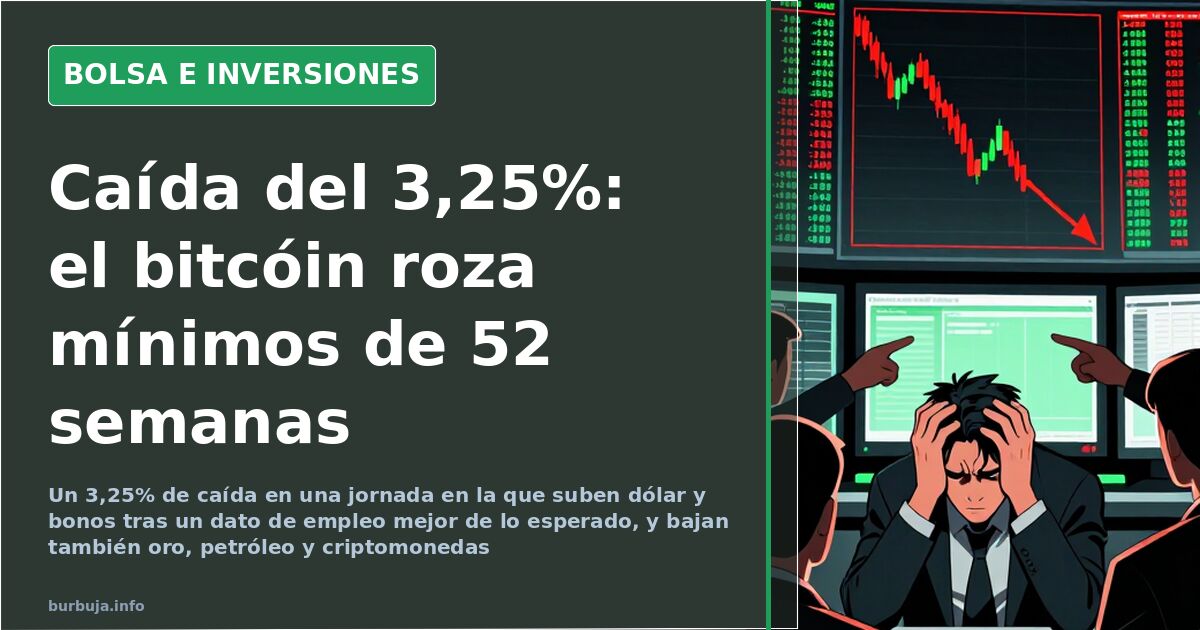
Nasdaq Falls Nearly 5%, Bitcoin Nears 52-Week Lows
There was one portfolio that rose that day. The kind nobody boasts about at dinner parties: utilities, insurers, steady dividend payers. It closed up +0.75%. The S&P 500 was down 2.5%, and the Nasdaq was flirting with a 5% drop in the same session, while Bitcoin hovered just shy of its 52-week lows. Boring won. Again.
The scene repeats every few months, and yet no one quite internalizes it: tech stocks plummeting, oil down, gold down, cryptocurrencies down. All at once, all on the same day. The difference is in the details: some reported portfolios losing 4% in a single session, while others, with far less exciting positions, ended in the green.
Why Are Markets Falling If US Employment Data Was Good?
Because the market doesn't celebrate good news when that good news pushes back exactly what it wants. May employment data from the United States came in better than expected. If the labor market holds strong, the Federal Reserve has no urgency to lower rates. This realization was priced in within minutes: the dollar rose 0.60% in a day, bonds did too, and other assets adjusted downwards.
Translated: the drop didn't stem from a bankruptcy, a catastrophic data point, or panic. It came from money losing faith in a short-term rate cut. Some argue it's a healthy rotation, while others see it as the end of the party. Both explanations fit the same session, and neither can be proven yet.
Two more exotic hypotheses are circulating: that big players are pulling money for the IPOs of SpaceX, OpenAI, and Anthropic, or that shares are simply being offloaded to latecomers. These are unverified conjectures and should be treated as such.
Tech Stocks Already Falling in Previous Days
The collapse didn't start that day. According to one retail investor's account in the thread, several tech stocks had already accumulated four sessions of declines between 15% and 20%: HP, Micron, IBM – not exactly segarro names, but significant in the indices. The same user, who had placed protective orders 5% lower, admitted to saving themselves ten to fifteen points in losses and warned that the movement was widespread, not a one-off accident.
The problem is the estimulante ilegal. The S&P 500 fell 2.5% and the Nasdaq neared 5% in a single day. With volatility at lows and few hedges in place, this caught everyone off guard. The stock market climbs the stairs and goes down the elevator, someone summarized. And when the elevator is technology's, it goes down non-stop.
Leverage Revealed by a 3.25% Drop
The most repeated phrase wasn't an analysis, but astonishment: that a 3.25% drop is seen as a catastrophe says a lot about the market, and not in a good way. In a debt-free portfolio, 3.25% is an annoyance. With leverage, as discussed in the thread, it's another story. Hence the warning that many positions are built on the assumption that this market only goes up.
As also pointed out in the discussion, Bitcoin investors have accumulated a 50% haircut and are still holding on, which puts the tech stock drama into perspective. Another diagnosis, more direct and also ironic: markets begging the Federal Reserve for liquidity.
How Much Would Big Tech Need to Earn to Justify Their Valuations?
There's a figure. According to a calculation cited in the debate, the eight or ten largest companies in the S&P 500 would need to generate around two trillion dollars in revenue – two million million – for current valuations to be supported by real business rather than expectations. With AI or without it, the cost is high.
On television, some have been repeating for months that this is a distribution phase, the moment when the financial industry offloads shares to retail investors. Others respond with the classic question: if someone accurately predicts specific market movements for years, why aren't they notoriously a multi-millionaire? Perhaps the warning is valid, and the person giving it is just noise.
Correction Until September and Rally Until Elections: Forecasts
The most shared scenarios depict a correction of between 8% and 10% until September, a consolidation of support levels in August, and a subsequent rally until the legislative elections, which, according to the dates discussed in the thread, fall on November 3rd. The more conspiratorial version adds that historical highs would be reached the week before the elections, so the record coincides with the ballot box.
At the other extreme is the age-old argument: everything eventually goes up, and those who left it on autopilot have gained more than those who tried to time the crises. The answer is also the same: when a stock goes from $80 to $8, nobody waits 25 years for it to recover, as one forum member recalled. Cisco and Terra remain as uncomfortable reminders.
And one last detail that doesn't quite fit. Part of the strong employment data that tanked the markets is explained, as argued in the thread, by people taking on a second job out of necessity. If that's the case, the solidity that spooked the Nasdaq wasn't as strong as it seemed.
There was one portfolio that rose that day. The kind nobody boasts about at dinner parties: utilities, insurers, steady dividend payers. It closed up +0.75%. The S&P 500 was down 2.5%, and the Nasdaq was flirting with a 5% drop in the same session, while Bitcoin hovered just shy of its 52-week lows. Boring won. Again.
The scene repeats every few months, and yet no one quite internalizes it: tech stocks plummeting, oil down, gold down, cryptocurrencies down. All at once, all on the same day. The difference is in the details: some reported portfolios losing 4% in a single session, while others, with far less exciting positions, ended in the green.
Why Are Markets Falling If US Employment Data Was Good?
Because the market doesn't celebrate good news when that good news pushes back exactly what it wants. May employment data from the United States came in better than expected. If the labor market holds strong, the Federal Reserve has no urgency to lower rates. This realization was priced in within minutes: the dollar rose 0.60% in a day, bonds did too, and other assets adjusted downwards.
Translated: the drop didn't stem from a bankruptcy, a catastrophic data point, or panic. It came from money losing faith in a short-term rate cut. Some argue it's a healthy rotation, while others see it as the end of the party. Both explanations fit the same session, and neither can be proven yet.
Two more exotic hypotheses are circulating: that big players are pulling money for the IPOs of SpaceX, OpenAI, and Anthropic, or that shares are simply being offloaded to latecomers. These are unverified conjectures and should be treated as such.
Tech Stocks Already Falling in Previous Days
The collapse didn't start that day. According to one retail investor's account in the thread, several tech stocks had already accumulated four sessions of declines between 15% and 20%: HP, Micron, IBM – not exactly segarro names, but significant in the indices. The same user, who had placed protective orders 5% lower, admitted to saving themselves ten to fifteen points in losses and warned that the movement was widespread, not a one-off accident.
The problem is the estimulante ilegal. The S&P 500 fell 2.5% and the Nasdaq neared 5% in a single day. With volatility at lows and few hedges in place, this caught everyone off guard. The stock market climbs the stairs and goes down the elevator, someone summarized. And when the elevator is technology's, it goes down non-stop.
Leverage Revealed by a 3.25% Drop
The most repeated phrase wasn't an analysis, but astonishment: that a 3.25% drop is seen as a catastrophe says a lot about the market, and not in a good way. In a debt-free portfolio, 3.25% is an annoyance. With leverage, as discussed in the thread, it's another story. Hence the warning that many positions are built on the assumption that this market only goes up.
As also pointed out in the discussion, Bitcoin investors have accumulated a 50% haircut and are still holding on, which puts the tech stock drama into perspective. Another diagnosis, more direct and also ironic: markets begging the Federal Reserve for liquidity.
How Much Would Big Tech Need to Earn to Justify Their Valuations?
There's a figure. According to a calculation cited in the debate, the eight or ten largest companies in the S&P 500 would need to generate around two trillion dollars in revenue – two million million – for current valuations to be supported by real business rather than expectations. With AI or without it, the cost is high.
On television, some have been repeating for months that this is a distribution phase, the moment when the financial industry offloads shares to retail investors. Others respond with the classic question: if someone accurately predicts specific market movements for years, why aren't they notoriously a multi-millionaire? Perhaps the warning is valid, and the person giving it is just noise.
Correction Until September and Rally Until Elections: Forecasts
The most shared scenarios depict a correction of between 8% and 10% until September, a consolidation of support levels in August, and a subsequent rally until the legislative elections, which, according to the dates discussed in the thread, fall on November 3rd. The more conspiratorial version adds that historical highs would be reached the week before the elections, so the record coincides with the ballot box.
At the other extreme is the age-old argument: everything eventually goes up, and those who left it on autopilot have gained more than those who tried to time the crises. The answer is also the same: when a stock goes from $80 to $8, nobody waits 25 years for it to recover, as one forum member recalled. Cisco and Terra remain as uncomfortable reminders.
And one last detail that doesn't quite fit. Part of the strong employment data that tanked the markets is explained, as argued in the thread, by people taking on a second job out of necessity. If that's the case, the solidity that spooked the Nasdaq wasn't as strong as it seemed.
Summary of a discussion on Burbuja.info - Foro de economía, actualidad y política., translated from Spanish and reviewed before publication. Read the full discussion (100 replies).
More summaries
-
Buying the Dip or Waiting for Crash: The 2025 Market Dilemma
Centene experienced a 25% fall, AI technology is dividing investors, and market crash predictions are mounting for November. The 2025 investment dilemma: buy now or wait?
-
Gold stuck at 0.382 as bitcoin takes the spotlight
Gold stuck at 0.382 and unable to recover while bitcoin hits 6.000 dollars; thresholds at 1.250 and 1.050 set the scene.
-
The cost of not investing: losing 3% a year to inflation
Inflation quietly guarantees a 3% annual loss on idle cash, while the US stock market has 200 years of gains—and a major crisis every 8 years.
-
Extra virgin olive oil falls to €6.35 a litre at Mercadona
Extra virgin olive oil is now €6.35/litre at Mercadona, down from €6.75 months ago, while the origin price of picual is €4.143/kg
-
BIG offers 4% TAE on 6-month deposit with Spanish IBAN and Portuguese FGD
BIG launched a 4% TAE six-month and 3.5% three-month deposit in May 2023 with Spanish IBAN and Portuguese FGD, but later cut rates and had opening delays.
-
Spot-price coins: the seller whose paper trail didn't add up
He offered quarter-ounce gold coins at spot price and racked up undelivered orders. Buyers cross-checked his details and several got their money back.