
Napapijri and Helly Hansen: The Fall of the Norwegian Flag Jacket
Buyers report that 90% of Norwegian flag jackets are counterfeits, while the original garment fails to provide adequate warmth.
English · Original discussion in Spanish · Published
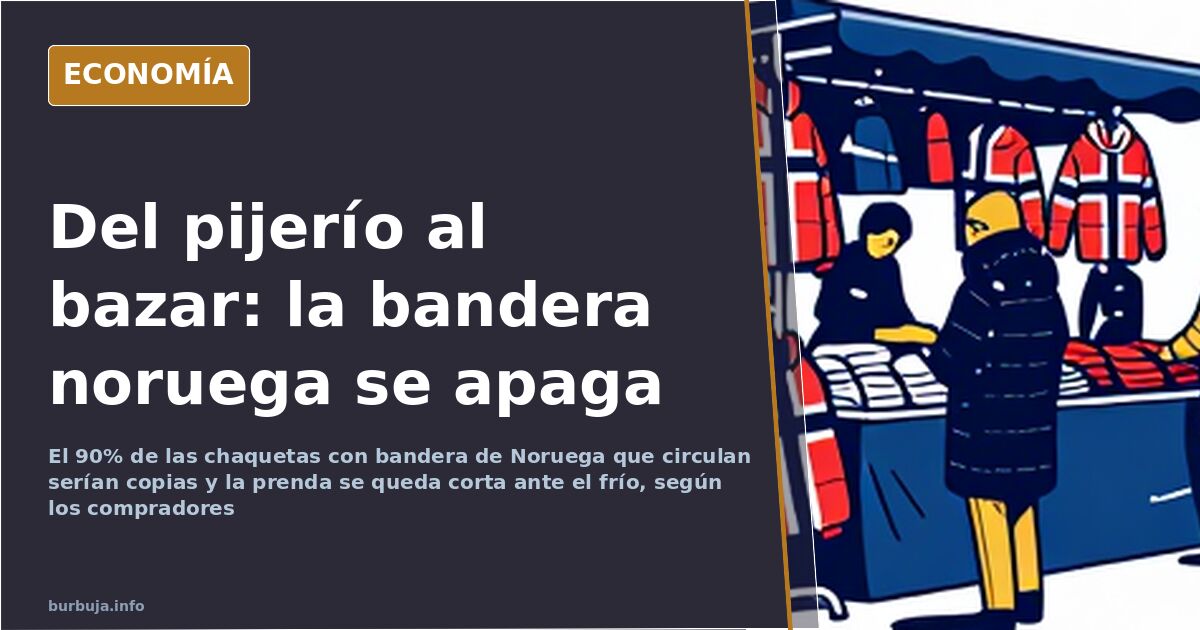
The Norwegian flag fades: from elite status to Chinese bazaars
Putting on a coat was never the problem. Taking it off was. The zipper barely covers a section, the garment fits so tightly you could almost sleep in it, and upon entering a venue, one is left blind for long seconds wrestling with the lining. This domestic discomfort is the fine print of one of the most recognizable winter uniforms of the last decade: the jacket antiestéticaturing the Norwegian flag popularized by Napapijri. The question is no longer whether it keeps you warm. It is whether anyone is still willing to pay for it. Product traces point to an exhausted cycle, with 90% of units in circulation described as copies.
Which brand carries the Norwegian flag and since when has it been worn?
For years, the Norwegian flag coat functioned as a code of income. There were two well-separated tiers: the label chosen by high-budget consumers and a second, lower-priced brand imitating the Nordic appeal. Repeated calculations place the consolidation of this fashion trend at least by 2018, and the boundary between the expensive version and the affordable one defined who wore the original logo and who settled for the imitation.
This is not a new mechanism. In the eighties, the reference padded garment was Moncler, associated with Italian elites of the time. Then came NASA logo sweatshirts, caps, technical backpacks. Some summarize it without drama: all fashions are exactly that, paying to wear what is trending at any given moment. Against this reading, another current argues that here the emblem is paid for before the fabric, and that this is the true business of the garment.
From the elite hanger to the bazaar counter
The most cited sign of exhaustion is where the product ends up. Imitations have jumped into neighborhood commerce, and cheap counters now show versions with other national emblems. The shift is also underway within the high-end segment: another mountain brand, The North Face, fills the gap with its logo displaced behind the shoulder. The sequence repeats with every flag: first worn by those who can afford it, then by those wanting to appear able to afford it, and finally by the corner bazaar. A backpack from a Swedish outdoor brand has even been sold for 90 euros, a figure used as an example of the same overpricing for a logo.
Criticism sharpens on details: the more brand exhibition, the worse the garment quality. Polyester, thin linings, finishes that do not withstand comparison with what is paid. It is not disputed that modern technical clothing is bad, but rather that the most visible part of the product—the patch, the flag, the large letters—has become its main asset. Everything else is peine.
Added to this is a consumption paradox often mentioned in passing: the backpack from the unpronounceable brand has also appeared on profiles that reject elitism, without clarity on whether it is comfort, contagion, or contradiction. That is what happens with uniforms: when they stop distinguishing anyone, they stop serving. National emblems, moreover, travel in both directions: some note that the Spanish flag appears on t-shirts in other countries and that the trend of learning Spanish in Poland has lasted more than twenty years without exhausting itself.
Does the flag jacket deliver the warmth it promises?
Here is where the commercial narrative breaks. The most demanding test cited is a winter in the Urals: the garment fell short of what it advertised. This is not an isolated case within the market itself. A large portion of circulating units are copies, and buyers seeking the original look for shortcuts: one of the most repeated testimonials is having acquired it in Andorra with a notable discount compared to the price in Spain.
Price contrast does the rest. The circulating calculation is simple: with the cost of a complete set of these brands, one can spend the winter at 22 degrees in Maspalomas. The jacket ceases to be a tool against cold and becomes a tool for something else. The full calculation, item by item, is more surprising than it seems.
The German episode: two letters that nearly banned a brand
There is a curiosity hovering over the issue for years that almost no one remembers. Another firm competing for the same customer is Helly Hansen, whose initials appear twice in its logo. According to published information about the brand, those two letters were read by European far-right groups as an abbreviation of the Nancy salute, and those groups adopted it as their favorite garment. In Germany, some of its products were nearly banned for displaying an emblem whose meaning could be interpreted as pro-Nancy.
It is the final twist of the cycle: the flag of a Nordic country is copied in the bazaar, and the letters of another Nordic brand end up in legal territory. The flag coat retains one consolation. If it no longer says anything about who wears it, it means no one is wearing it. Almost sleeping in it, however, will remain a torment.
Putting on a coat was never the problem. Taking it off was. The zipper barely covers a section, the garment fits so tightly you could almost sleep in it, and upon entering a venue, one is left blind for long seconds wrestling with the lining. This domestic discomfort is the fine print of one of the most recognizable winter uniforms of the last decade: the jacket antiestéticaturing the Norwegian flag popularized by Napapijri. The question is no longer whether it keeps you warm. It is whether anyone is still willing to pay for it. Product traces point to an exhausted cycle, with 90% of units in circulation described as copies.
Which brand carries the Norwegian flag and since when has it been worn?
For years, the Norwegian flag coat functioned as a code of income. There were two well-separated tiers: the label chosen by high-budget consumers and a second, lower-priced brand imitating the Nordic appeal. Repeated calculations place the consolidation of this fashion trend at least by 2018, and the boundary between the expensive version and the affordable one defined who wore the original logo and who settled for the imitation.
This is not a new mechanism. In the eighties, the reference padded garment was Moncler, associated with Italian elites of the time. Then came NASA logo sweatshirts, caps, technical backpacks. Some summarize it without drama: all fashions are exactly that, paying to wear what is trending at any given moment. Against this reading, another current argues that here the emblem is paid for before the fabric, and that this is the true business of the garment.
From the elite hanger to the bazaar counter
The most cited sign of exhaustion is where the product ends up. Imitations have jumped into neighborhood commerce, and cheap counters now show versions with other national emblems. The shift is also underway within the high-end segment: another mountain brand, The North Face, fills the gap with its logo displaced behind the shoulder. The sequence repeats with every flag: first worn by those who can afford it, then by those wanting to appear able to afford it, and finally by the corner bazaar. A backpack from a Swedish outdoor brand has even been sold for 90 euros, a figure used as an example of the same overpricing for a logo.
Criticism sharpens on details: the more brand exhibition, the worse the garment quality. Polyester, thin linings, finishes that do not withstand comparison with what is paid. It is not disputed that modern technical clothing is bad, but rather that the most visible part of the product—the patch, the flag, the large letters—has become its main asset. Everything else is peine.
Added to this is a consumption paradox often mentioned in passing: the backpack from the unpronounceable brand has also appeared on profiles that reject elitism, without clarity on whether it is comfort, contagion, or contradiction. That is what happens with uniforms: when they stop distinguishing anyone, they stop serving. National emblems, moreover, travel in both directions: some note that the Spanish flag appears on t-shirts in other countries and that the trend of learning Spanish in Poland has lasted more than twenty years without exhausting itself.
Does the flag jacket deliver the warmth it promises?
Here is where the commercial narrative breaks. The most demanding test cited is a winter in the Urals: the garment fell short of what it advertised. This is not an isolated case within the market itself. A large portion of circulating units are copies, and buyers seeking the original look for shortcuts: one of the most repeated testimonials is having acquired it in Andorra with a notable discount compared to the price in Spain.
Price contrast does the rest. The circulating calculation is simple: with the cost of a complete set of these brands, one can spend the winter at 22 degrees in Maspalomas. The jacket ceases to be a tool against cold and becomes a tool for something else. The full calculation, item by item, is more surprising than it seems.
The German episode: two letters that nearly banned a brand
There is a curiosity hovering over the issue for years that almost no one remembers. Another firm competing for the same customer is Helly Hansen, whose initials appear twice in its logo. According to published information about the brand, those two letters were read by European far-right groups as an abbreviation of the Nancy salute, and those groups adopted it as their favorite garment. In Germany, some of its products were nearly banned for displaying an emblem whose meaning could be interpreted as pro-Nancy.
It is the final twist of the cycle: the flag of a Nordic country is copied in the bazaar, and the letters of another Nordic brand end up in legal territory. The flag coat retains one consolation. If it no longer says anything about who wears it, it means no one is wearing it. Almost sleeping in it, however, will remain a torment.
Summary of a discussion on Burbuja.info - Foro de economía, actualidad y política., translated from Spanish and reviewed before publication. Read the full discussion (164 replies).
More summaries
-
AfD: The party claiming to overturn the system, yet serving as its safety valve
AfD is growing in Germany, but its leader, Alice Weidel, faces contradictions. Genuine dissent or a safety valve? An analysis of the far-right rise and its...
-
Germany debates housing immigrants in elderly homes
Germany debates housing immigrants in elderly homes. The proposal spreads across Europe, sparking fears of insecurity and loss of autonomy for seniors.
-
Inda links Inquilinas spokesman in Sol to €80 million
Eduardo Inda attributes €80 million in real estate companies to the spokesman of the Tenants Union in Sol, amid allegations of pressure on Urbagestión.
-
Seville to charge non-residents for Plaza de España entry
Seville will charge tourists for Plaza de España access, splitting revenue with the Spanish state: 75% for the city and 25% for national treasury.
-
Fernando Delgado, Spanish journalist and writer, dies at 77
Fernando Delgado, a prominent Spanish radio voice and author, has died at age 77 in Faura, Valencia. A key figure of the democratic transition era.
-
Viral Madrid Metro Fight Video Was Nearly a Year Old
A fight recorded nearly a year ago circulated as breaking news in the Madrid Metro, sparking debate over its authenticity.