
Seville to charge non-residents for Plaza de España entry
Seville will charge tourists for Plaza de España access, splitting revenue with the Spanish state: 75% for the city and 25% for national treasury.
English · Original discussion in Spanish · Published
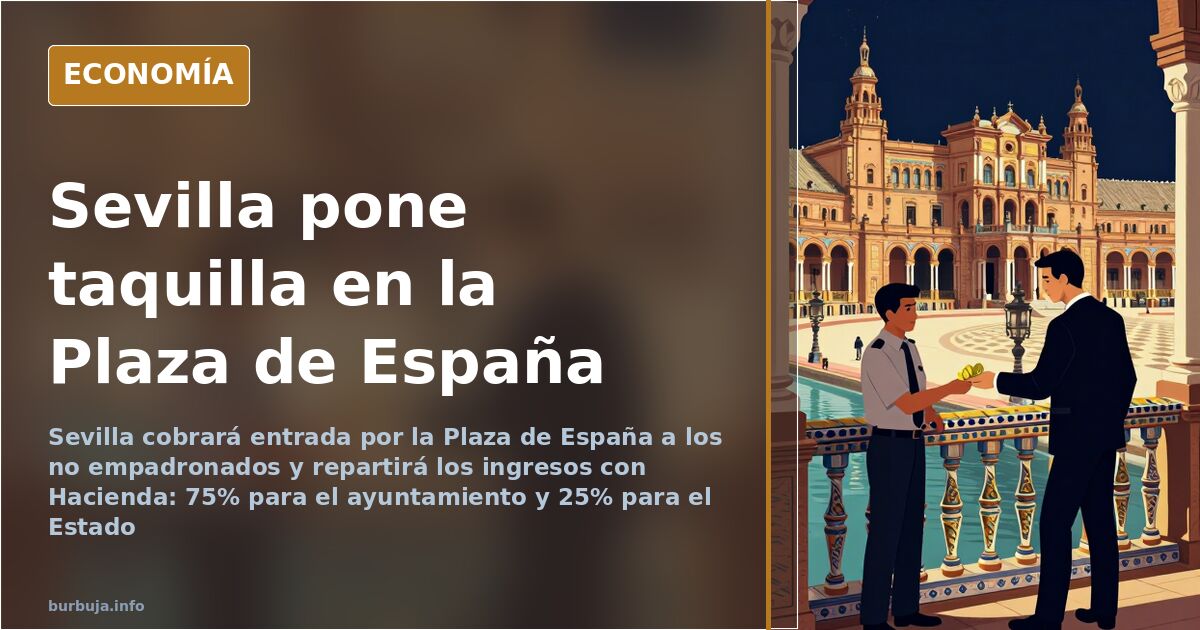
Seville to charge tourists for Plaza de España
Turning a public square into a ticketed attraction is straightforward. The hard part is deciding who gets excluded from the toll. Seville’s City Council will charge entry fees to those not registered as residents in the capital or born in the province, sharing proceeds with the State: 75% for the council and 25% for the Treasury. Mayor José Luis Sanz of the PP party announced this on X, pledging to fund monument conservation, ensure security, and create an artisan training school.
The plan goes beyond just selling tickets. It involves closing the site in phases—a management unit agreed with the Directorate General of State Heritage under Minister María Jesús Montero—and repurposing building sections currently unused or sporadically used. Proposals include two new exhibition spaces dedicated to the 1929 Ibero-American Exposition and 24-hour surveillance services.
What costs money and what remains free
The project outlines a tourist-cultural route inside the Plaza de España subject to a "non-deterrent" fee based on comparative studies. In plain terms: a price that doesn’t scare off visitors but still generates revenue. Registered residents of Seville and those born in the capital or province are exempt; horse-drawn carriages can still enter, and access to administrative offices within the complex is guaranteed for users.
The City Council owns the space between the provincial benches and the balustrade. Built between 1914 and 1929, it is the largest structure from the Ibero-American Exposition; its tiled benches represent Spain’s 49 provinces. Filming locations included Lawrence of Arabia (1962) and a Star Wars scene (2002), alongside concerts and fashion shows. No one disputes its showcase value. Debate begins when this showcase becomes a closed venue with a cash register.
Can you charge for entering a public square?
Much opposition cites Article 14 of the Constitution, which declares all Spaniards equal before the law without discrimination based on birth. If the monument was paid for by everyone’s taxes, charging only some turns equality into fine print. This objection isn’t new: the Prado Museum once tried to reserve free entry for Spaniards, but the EU rejected the idea. Those seeking precedents look to Barcelona, which has charged for Park Güell entry for years.
The other half of the problem is logistical. Fencing an open space and controlling access requires verifying residency at the gate, causing queues. How do you distinguish a registered resident from a tourist renting a home? Many have raised this question.
The 75/25 split with the Treasury and existing costs
Here lies the argument most inconvenient to the municipal narrative: the Plaza de España wasn’t funded by Seville’s coffers but by the state treasury, and much of the City Council’s budget comes via transfers from the rest of Spain. From this starting point, a resident from another province would pay twice for the same maintenance: first through their taxes, then through entry fees.
Conversely, the council argues: a major tourist attraction receiving millions of annual visits previously generated zero euros while suffering vandalism that takes time to repair. Charging visitors before raising local tax pressure makes accounting sense.
Tourists who don’t return and imitation effects
The most visceral rejection isn’t legal—it’s financial. Some have ruled out Seville as a holiday destination, warning the city, already strained by gentrification, is becoming an amusement park with turnstiles, tickets, and nothing else. Others argue the opposite: if fewer tourists come but those who do pay more, residents benefit.
Uncontrollable is the contagion effect. If Seville charges, many ask, how long until the next mayor puts turnstiles at their cathedral, walls, or star landmark? Municipal budgets are tight everywhere, and the precedent is set.
The measure is announced, not implemented: it depends on an agreement with the Treasury and phased closures without a public timeline. Meanwhile, the question hangs in the air: how much is a city willing to pay to stop being free?
Turning a public square into a ticketed attraction is straightforward. The hard part is deciding who gets excluded from the toll. Seville’s City Council will charge entry fees to those not registered as residents in the capital or born in the province, sharing proceeds with the State: 75% for the council and 25% for the Treasury. Mayor José Luis Sanz of the PP party announced this on X, pledging to fund monument conservation, ensure security, and create an artisan training school.
The plan goes beyond just selling tickets. It involves closing the site in phases—a management unit agreed with the Directorate General of State Heritage under Minister María Jesús Montero—and repurposing building sections currently unused or sporadically used. Proposals include two new exhibition spaces dedicated to the 1929 Ibero-American Exposition and 24-hour surveillance services.
What costs money and what remains free
The project outlines a tourist-cultural route inside the Plaza de España subject to a "non-deterrent" fee based on comparative studies. In plain terms: a price that doesn’t scare off visitors but still generates revenue. Registered residents of Seville and those born in the capital or province are exempt; horse-drawn carriages can still enter, and access to administrative offices within the complex is guaranteed for users.
The City Council owns the space between the provincial benches and the balustrade. Built between 1914 and 1929, it is the largest structure from the Ibero-American Exposition; its tiled benches represent Spain’s 49 provinces. Filming locations included Lawrence of Arabia (1962) and a Star Wars scene (2002), alongside concerts and fashion shows. No one disputes its showcase value. Debate begins when this showcase becomes a closed venue with a cash register.
Can you charge for entering a public square?
Much opposition cites Article 14 of the Constitution, which declares all Spaniards equal before the law without discrimination based on birth. If the monument was paid for by everyone’s taxes, charging only some turns equality into fine print. This objection isn’t new: the Prado Museum once tried to reserve free entry for Spaniards, but the EU rejected the idea. Those seeking precedents look to Barcelona, which has charged for Park Güell entry for years.
The other half of the problem is logistical. Fencing an open space and controlling access requires verifying residency at the gate, causing queues. How do you distinguish a registered resident from a tourist renting a home? Many have raised this question.
The 75/25 split with the Treasury and existing costs
Here lies the argument most inconvenient to the municipal narrative: the Plaza de España wasn’t funded by Seville’s coffers but by the state treasury, and much of the City Council’s budget comes via transfers from the rest of Spain. From this starting point, a resident from another province would pay twice for the same maintenance: first through their taxes, then through entry fees.
Conversely, the council argues: a major tourist attraction receiving millions of annual visits previously generated zero euros while suffering vandalism that takes time to repair. Charging visitors before raising local tax pressure makes accounting sense.
Tourists who don’t return and imitation effects
The most visceral rejection isn’t legal—it’s financial. Some have ruled out Seville as a holiday destination, warning the city, already strained by gentrification, is becoming an amusement park with turnstiles, tickets, and nothing else. Others argue the opposite: if fewer tourists come but those who do pay more, residents benefit.
Uncontrollable is the contagion effect. If Seville charges, many ask, how long until the next mayor puts turnstiles at their cathedral, walls, or star landmark? Municipal budgets are tight everywhere, and the precedent is set.
The measure is announced, not implemented: it depends on an agreement with the Treasury and phased closures without a public timeline. Meanwhile, the question hangs in the air: how much is a city willing to pay to stop being free?
Summary of a discussion on Burbuja.info - Foro de economía, actualidad y política., translated from Spanish and reviewed before publication. Read the full discussion (156 replies).
More summaries
-
Spain's Finance Minister threatens PP lawmaker on camera
Finance Minister María Jesús Montero was filmed warning a Popular Party deputy during a parliamentary session, sparking controversy.
-
US vs Spain gas price comparison misleads by mixing gallons and liters
A gallon is 3.78 liters: comparing $4 per gallon in the US with €1.99 per liter in Spain omits the conversion.
-
Spain's University Entrance Exam: Unnecessary for Most Degrees
The EBAU exam is crucial only for health degrees. For others, it seems redundant. Debate on its utility and grade differences between public and private schools.
-
Viral video of fitness trainer's fall debunked as fake
A viral video showing a man falling from a balcony is falsely linked to an affair. Fact-checkers confirm it is an unrelated suicide clip.
-
Divorce and Social Validation Seeking
Analysis of patterns behind marital breakdowns and the quest for validation in social circles.
-
Spain's political spectacle fuels controversy
Analysis of how media exposure and personal alliances become currency in Spain's current political landscape.