
Muface member with leukemia left without cover for €20,000 monthly drugs
A retired Spanish civil servant insured through Muface is seeking urgent admission to the public health system after his private insurer refused to cover €20,000 a month in leukemia medication.
English · Original discussion in Spanish · Published
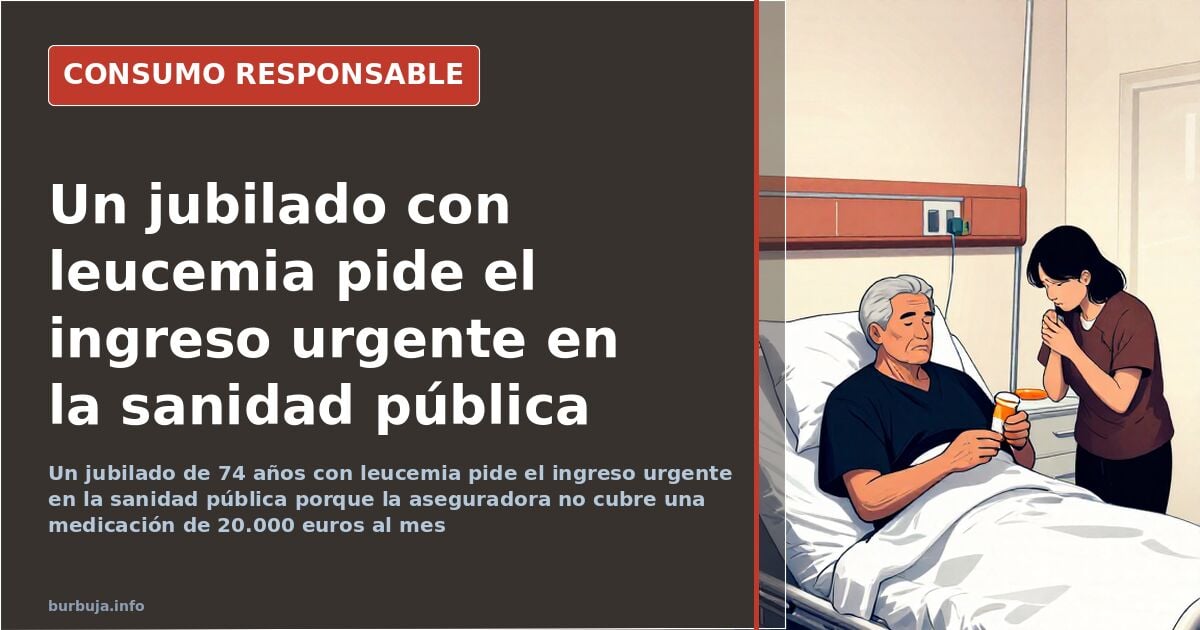
Leukemia and Muface: the private insurer that won't pay €20,000 a month
What happens when you've paid into a private insurance scheme all your life and, at 74, with leukemia, the insurer tells you the medication costs too much? The case that has blown the lid off involves a Muface member (Spain's civil servants' health scheme) who has been prescribed a combination of drugs costing €20,000 a month, and whose insurer has refused to cover them, according to an account published on a blog. The way out: requesting urgent admission to the Social Security system to avoid dying. The question hanging over the affair is no small one: if there were no public healthcare, would he have any alternative with another insurer?
What Muface is and why it's not the same as ordinary private insurance
Muface is not a conventional private insurer. It is a public body that contracts with private companies to provide healthcare for civil servant members. Its list of covered services is similar to that of the Social Security system, but with one key difference: a retired member keeps paying 30% of the price of medications, as one participant in the debate explains. With an oncology treatment costing €20,000 a month, that would miccionan shelling out €6,000 a month out of pocket. And that's before considering that the insurer may simply refuse to cover the drug at all, which is what this case describes.
Some argue that Muface is an anomaly that should be reviewed. Others point out that members can choose each year between a private insurer or Social Security, but that in both cases they remain under Muface's arrangement, with worse coverage than an ordinary worker. The trap lies in the design: it is not a free-choice insurance scheme, it is a separate regime with its own rules.
The underlying problem: private healthcare is not designed for chronic, expensive patients
Private healthcare works reasonably well for outpatient care, planned procedures and cheap treatments. The problem arises when the patient is elderly, has a serious illness and the treatment costs more than their annual premium. At that point, the insurer's economic incentive points in the opposite direction from the patient's interests.
The argument running through the affair is simple: if there were no public healthcare, a patient like this would have nowhere to go. Private insurers do not compete to cover 74-year-old cancer patients with six-figure monthly treatments. The invisible hand, the one that balances everything, looks the other way here.
Pharmaceutical costs, the final blow for the mutual scheme
The 30% share of pharmaceutical costs in retirement is the figure that causes most discomfort. A civil servant who has contributed to Muface all their working life reaches old age and discovers that their medication costs real money, not a token amount. With chronic illnesses, that percentage becomes a monthly burden.
The comparison with the general system does not look good: a Social Security retiree pays only a minimal fraction of their drug costs. A Muface member, by contrast, carries the 30% for life. The system rewards those who were in the general scheme and penalizes those who chose the mutual scheme.
The awkward question: what if there were no public healthcare?
The answer this very case gives is that there would be no way out. No private insurer will voluntarily cover a €20,000-a-month treatment for a 74-year-old patient. The market is not there for that. Public healthcare is the safety net that catches those whom private insurance lets go when the bill spirals.
The final irony is that the debate over Muface is usually framed as a matter of civil servant privileges. But the case proves the opposite: the mutual scheme, in old age and with serious illness, is a worse regime than the general one. The privilege lay elsewhere. Or there was none at all.
Summary of a discussion on Burbuja.info - Foro de economía, actualidad y política., translated from Spanish and reviewed before publication. Read the full discussion (21 replies).
More summaries
-
Spain: Public hospitals safer for childbirth than private
Private clinics offer comfort, but public hospitals provide critical emergency care. Why safety outweighs convenience in Spanish maternity.
-
Private insurers hike premiums or drop older clients, according to affected individuals
Testimonials reveal premium hikes and policy non-renewals for older people. Private insurers refer serious cases to the public system, according to the thread.
-
How many litres of milk can you get from 1 kg of condensed milk?
A forum calculation says a 1 kg can yields 6.6 to 10 litres, but others warn it's not milk but added sugar.
-
Used Volvo V70: affordable maintenance or a €700 trap?
A prospective buyer compares the V70 with his R21. Prices have dropped to €2,000, but fear of costly repairs is holding many back. Is it worth it?
-
Importing a car from Germany: real savings or a mirage?
Importing a car from Germany can save thousands of euros on exclusive models, but for small cars registration and transport costs eat up the margin.
-
Dawn porcini: the barter trade that never hits the till
Porcini mushrooms given as a gift in exchange for a round of drinks reveal a barter economy that bypasses the till: mushrooms, chestnuts and fruit that dodge the CPI.