
Dawn porcini: the barter trade that never hits the till
Porcini mushrooms given as a gift in exchange for a round of drinks reveal a barter economy that bypasses the till: mushrooms, chestnuts and fruit that dodge the CPI.
English · Original discussion in Spanish · Published
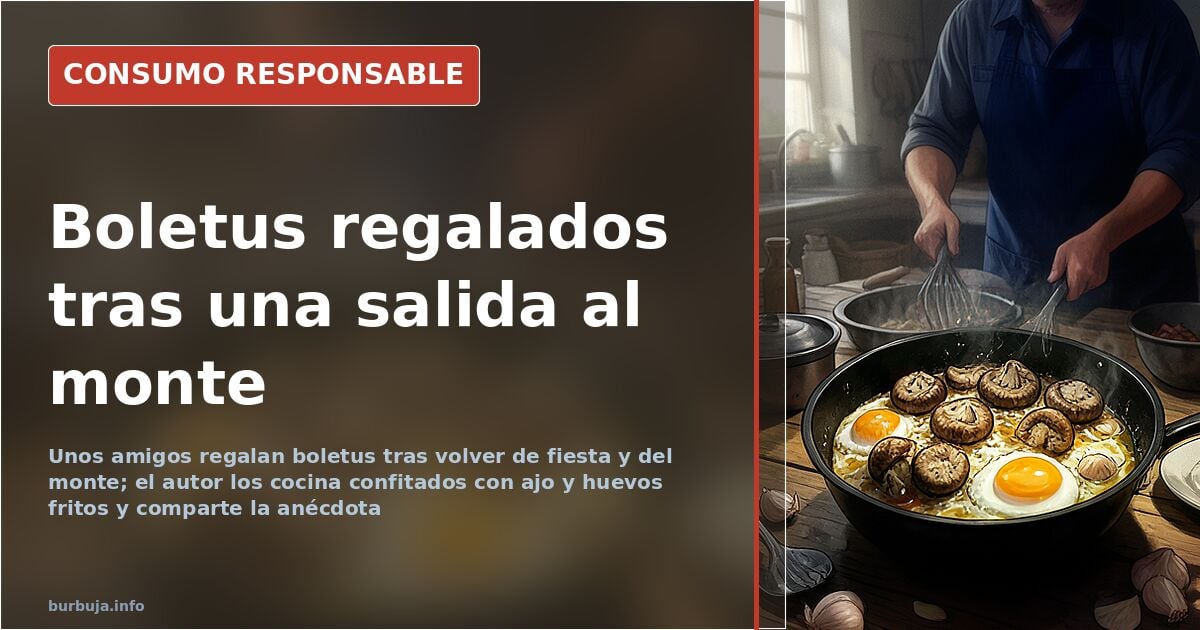
Dawn porcini: the gift that skips the shopping basket
A group of friends come back from the woods at six in the afternoon, still partying after an early start, and hand out mushrooms the way you'd share out cigarettes. In return, a round of drinks. The result: a dinner of porcini confit with garlic and two fried eggs that never went through a cash register. The scene, recounted in detail on a consumer forum, sums up a parallel economy that moves more kilos in autumn than any statistic will admit: wild foraging as a currency of social exchange.
The story begins with the mushrooms already in the pan. **Boletus edulis**, confit, garlic, eggs. And a detail that raises eyebrows: the foragers had been partying since the early hours, which puts the quality of their judgement about what goes into their mouth in doubt. That's where the first thread of friction begins. Some warn that a mushroom nibbled by a bug isn't an aesthetic problem, but a sign of careless handling. Others reply with the phrase that ends any mushroom debate: "you have to die of something".
Porcini: the luxury that gets gifted but never invoiced
The conversation quickly drifts towards the real value of the product. Alongside shop-bought mushrooms — the only ones that reassure some diners — there's the free kind from the woods, handed over in person with no traceability. **Barter works**: a round at the bar in exchange for a handful of porcini. Nobody invoices, nobody declares, nobody asks where they came from. It's the part of consumption that never shows up in the CPI.
The exchange isn't just mushrooms. In the same conversation, **two boxes of fruit** (peaches and plums) and a big bag of chestnuts arrive within a single month, with the promise of woodcock when the cold sets in. The network of favours works like an informal futures market: today I give you mushrooms, tomorrow you invite me to dinner on whatever I hunt.
Why does wild mushroom foraging breed distrust?
Because misidentification kills, and the thread drops this hint with a smirk. One message warns about "death caps", another reminds everyone that all mushrooms are edible "at least once". The joke is old, but the point is serious: foraging without knowledge is a lottery with bad odds. The most sensible response in the bunch comes from caution: if you can't tell them apart, buy them at the greengrocer's.
Consensus, however, breaks down when it comes to cooking them. Some swear by the griddle with salt at the end and nothing else. Others build a sofrito of slowly cooked onion, plenty of garlic, crushed tomato, saffron and fresh parsley, with stock instead of water, for a noodle stew with leftover meat and oven-baked rib sauce. **The full recipe** — with its timings and order — circulates in the exchange, and it's the kind of material that never appears in a branded cookbook.
The season that hasn't arrived and the map nobody shares
The most awkward fact of the autumn comes up in passing: **this year the mushrooms haven't come out yet** in one specific area, and it's already late. The season is delayed, and with it the calendar of those waiting for a box of chestnuts or a alucinación to the woods. Nobody gives exact coordinates — a forager's secret spot is part of the trade — but the question about where to forage hangs in the air, unanswered.
Meanwhile, the conversation fills up with side plans: going out for chanterelles, bagging wild boar, roe deer, hare or trout. The autumn larder is stocked outside the commercial circuit, and the gift of a few porcini is just the gateway to an entire supply system that pays no VAT.
How much of that responsible consumption is a choice, and how much is simply friends muddling through together?
Also available in: Deutsch
Summary of a discussion on Burbuja.info - Foro de economía, actualidad y política., translated from Spanish and reviewed before publication. Read the full discussion (45 replies).
More summaries
-
Encyclopedias that cost 250,000 pesetas and that nobody wants to buy today
A user says a Carroggio encyclopedia cost him 250,000 pesetas. The forum debates whether to sell it, donate it, keep it or recycle it.
-
Holes in T-shirts at belly-button level: it's friction, not moths
T-shirt holes always appear from the belly button down. Friction from the belt, trouser button and zip are the main suspects.
-
Forum Recommends Psilocybin, St. John’s Wort, and Kefir for Depression
A community proposes psilocybin, St. John’s wort, kefir, and NAC as alternatives to medical treatment for depression, sparking debate on efficacy and safety.
-
robin.jobs: Dutch temp agency with housing that won't answer
A jobseeker sends his ID and driving licence to robin.jobs, a Dutch temp agency with no reviews, no social media activity and poor fraud-checker scores.
-
From a date in Seville to a junkie den: the thin line of irresponsible drug use
The story of a date in Seville that ends in a junkie den: a real warning about irresponsible drug use and its consequences.
-
Selling access to FC: from 5 euros down to 50 cents
An ad asks 5 euros for invisible access to FC; mockery drives the price down to 50 cents. Digital exclusivity is worth less and less.