
Muface: Clashing figures on shift to Spain's public health
Muface covers 1.5 million civil servants, with over a million in private insurers. The actual transfer to Spain's public healthcare would affect just over one million.
English · Original discussion in Spanish · Published
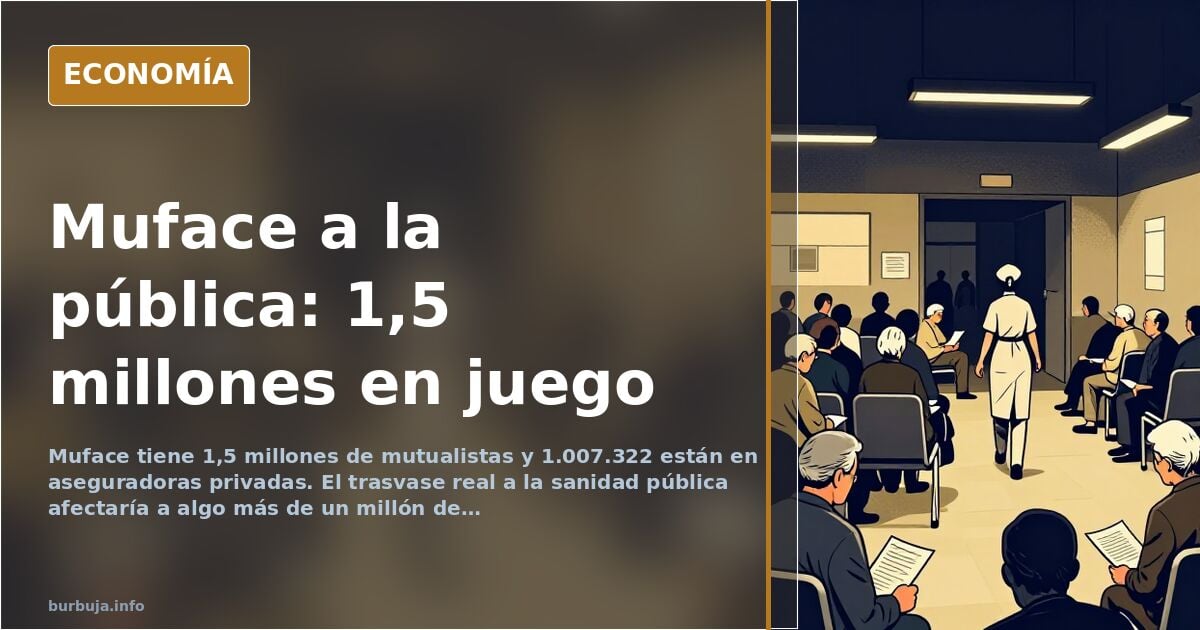
Muface to public system: the math doesn't add up
The Health Minister claims Spain's public healthcare is ready to absorb Muface members. Data from the system itself challenges this narrative: around 1.5 million people are enrolled in Muface, of whom 1,007,322 have chosen private insurers, while 32.7% already receive care through the National Health System. This means the real transfer involves slightly more than one million new patients, not 1.5 million. The discrepancy between these figures is the first flaw in the argument.
The second issue is that insurers do not want the contract. Adeslas, Asisa, and DKV currently provide the service, but the agreement is uncertain. If no insurer signs, members default to the public system. The debate is filled with conflicting calculations: monthly fees around €50, cost per member, and waiting lists measured in months.
How many members would actually move to public healthcare
Detailed breakdowns contradict the rounded figure circulating. Of Muface members, 67.3% use private insurers, while the remaining third is already in the public system. Regional impact varies significantly: Ceuta (5.27%) and Melilla (5.13%) face the highest pressure, trinc by Castilla y León (3.12%), Extremadura (3.02%), and Andalusia (2.94%). Conversely, Basque Country (0.65%), Navarre (1%), and Catalonia (1.20%) would barely notice the change. Madrid stands at 2.24%, and the Valencian Community at 2.23%.
Some argue the transition is manageable because a third are already integrated. Opponents counter that the network operates at capacity, and adding patients without resources risks collapse. A region-by-region analysis reveals surprising disparities.
Real costs: fees, contracts, and who pays
The average fee paid by a Muface member is €50 per month or less, an amount the public system cannot cover alone. This is the core issue: if members enter the public system, someone must fund the difference. That someone is the taxpayer.
Another aspect is the model itself. Muface is not purely private healthcare; it is a contracted service with insurers who then refer to private networks. Medical professionals within the system have proposed cutting ties with insurers and contracting directly with hospitals and practitioners, arguing this would be cheaper and higher quality. Reported by ABC, this proposal aims for direct provision, eliminating intermediaries.
Why insurers are stepping back
The problem extends beyond Muface. Companies are reviewing their own health insurance offerings: 83% provide coverage to employees, but only 48% bear the full cost, down from 55% in 2021. The remaining 17% offer only discounts. The trend is clear: employer-sponsored health insurance is being scaled back by those paying for it.
If private companies are cutting costs, public contracts with insurers will likely become less generous. The lingering question is whether the state will pay more for the same service or simply stop paying.
Comparative grievance: ISFAS, MUFACE, and Mugeju
Comparisons between bodies are inevitable. The Civil Guard uses ISFAS, judges and judicial staff rely on Mugeju, while National Police and civil servants depend on Muface. The recurring question: why the disparity? Officially, the Civil Guard is military and the National Police is not, but this does not resolve tensions.
It is noted that since 2011, members have been included in the General Social Security Scheme for pensions, though they still choose annual healthcare options. This annual choice is what the new model might eliminate, replacing it with a single, definitive selection. The official rationale is better cost calculation. The practical effect would be locking many into the public system permanently.
Political backdrop: straining public health to target PP
Many analyses explicitly frame this politically: with the PP governing several regions, injecting patients into public healthcare without increasing resources leaves opponents dealing with long waiting lists. This strategy was applied in Madrid against Ayuso and is now being scaled up.
Ironically, the main losers would be civil servants themselves, a group often associated with left-wing voting. "Enjoying what you voted for" sums up the resentment. Underlying this is an uncomfortable question: if the public system is so good, why doesn't the minister herself use it?
The analysis hits a wall here: no one has explained how to fund the transfer without raising taxes or cutting services. Without that figure, everything else is mere rhetoric.
The Health Minister claims Spain's public healthcare is ready to absorb Muface members. Data from the system itself challenges this narrative: around 1.5 million people are enrolled in Muface, of whom 1,007,322 have chosen private insurers, while 32.7% already receive care through the National Health System. This means the real transfer involves slightly more than one million new patients, not 1.5 million. The discrepancy between these figures is the first flaw in the argument.
The second issue is that insurers do not want the contract. Adeslas, Asisa, and DKV currently provide the service, but the agreement is uncertain. If no insurer signs, members default to the public system. The debate is filled with conflicting calculations: monthly fees around €50, cost per member, and waiting lists measured in months.
How many members would actually move to public healthcare
Detailed breakdowns contradict the rounded figure circulating. Of Muface members, 67.3% use private insurers, while the remaining third is already in the public system. Regional impact varies significantly: Ceuta (5.27%) and Melilla (5.13%) face the highest pressure, trinc by Castilla y León (3.12%), Extremadura (3.02%), and Andalusia (2.94%). Conversely, Basque Country (0.65%), Navarre (1%), and Catalonia (1.20%) would barely notice the change. Madrid stands at 2.24%, and the Valencian Community at 2.23%.
Some argue the transition is manageable because a third are already integrated. Opponents counter that the network operates at capacity, and adding patients without resources risks collapse. A region-by-region analysis reveals surprising disparities.
Real costs: fees, contracts, and who pays
The average fee paid by a Muface member is €50 per month or less, an amount the public system cannot cover alone. This is the core issue: if members enter the public system, someone must fund the difference. That someone is the taxpayer.
Another aspect is the model itself. Muface is not purely private healthcare; it is a contracted service with insurers who then refer to private networks. Medical professionals within the system have proposed cutting ties with insurers and contracting directly with hospitals and practitioners, arguing this would be cheaper and higher quality. Reported by ABC, this proposal aims for direct provision, eliminating intermediaries.
Why insurers are stepping back
The problem extends beyond Muface. Companies are reviewing their own health insurance offerings: 83% provide coverage to employees, but only 48% bear the full cost, down from 55% in 2021. The remaining 17% offer only discounts. The trend is clear: employer-sponsored health insurance is being scaled back by those paying for it.
If private companies are cutting costs, public contracts with insurers will likely become less generous. The lingering question is whether the state will pay more for the same service or simply stop paying.
Comparative grievance: ISFAS, MUFACE, and Mugeju
Comparisons between bodies are inevitable. The Civil Guard uses ISFAS, judges and judicial staff rely on Mugeju, while National Police and civil servants depend on Muface. The recurring question: why the disparity? Officially, the Civil Guard is military and the National Police is not, but this does not resolve tensions.
It is noted that since 2011, members have been included in the General Social Security Scheme for pensions, though they still choose annual healthcare options. This annual choice is what the new model might eliminate, replacing it with a single, definitive selection. The official rationale is better cost calculation. The practical effect would be locking many into the public system permanently.
Political backdrop: straining public health to target PP
Many analyses explicitly frame this politically: with the PP governing several regions, injecting patients into public healthcare without increasing resources leaves opponents dealing with long waiting lists. This strategy was applied in Madrid against Ayuso and is now being scaled up.
Ironically, the main losers would be civil servants themselves, a group often associated with left-wing voting. "Enjoying what you voted for" sums up the resentment. Underlying this is an uncomfortable question: if the public system is so good, why doesn't the minister herself use it?
The analysis hits a wall here: no one has explained how to fund the transfer without raising taxes or cutting services. Without that figure, everything else is mere rhetoric.
Also available in: Deutsch
Summary of a discussion on Burbuja.info - Foro de economía, actualidad y política., translated from Spanish and reviewed before publication. Read the full discussion (170 replies).
More summaries
-
DKV, Asisa and Adeslas quit Muface: 1.5 million to public health
Asisa, DKV and Adeslas refuse to renew Muface contract: 1.5 million would move to public healthcare, with Madrid said to be hardest hit
-
Muface: The battle over public vs. private healthcare in Spain
Spain's Muface, Mugeju, and Isfas cover 800,000 civil servants, with an estimated 650,000 opting for private healthcare providers.
-
Spain ends civil servant health insurance, shifting 1.5M to public system
Spain is ending the Muface private insurance scheme for 1.5 million civil servants, moving them to the public healthcare system.
-
Housing market shift: why you shouldn't buy in 2026
House prices are showing signs of slowing. Are we facing a new 2008 or a mirage? Data, mortgages and the dilemma of buying or waiting.
-
Cristina Castaño’s SEPE complaint exposes Spain’s appointment chaos
Actress reports week-long failure to book SEPE appointment. We analyze the system collapse and its impact on citizens.
-
Ibex 35 hits 20,000: Real success or liquidity bubble?
Spain's Ibex 35 doubled in two years to reach 20,000 points, but the rally masks liquidity costs and widens the gap with local savers.