
DKV, Asisa and Adeslas quit Muface: 1.5 million to public health
Asisa, DKV and Adeslas refuse to renew Muface contract: 1.5 million would move to public healthcare, with Madrid said to be hardest hit
English · Original discussion in Spanish · Published
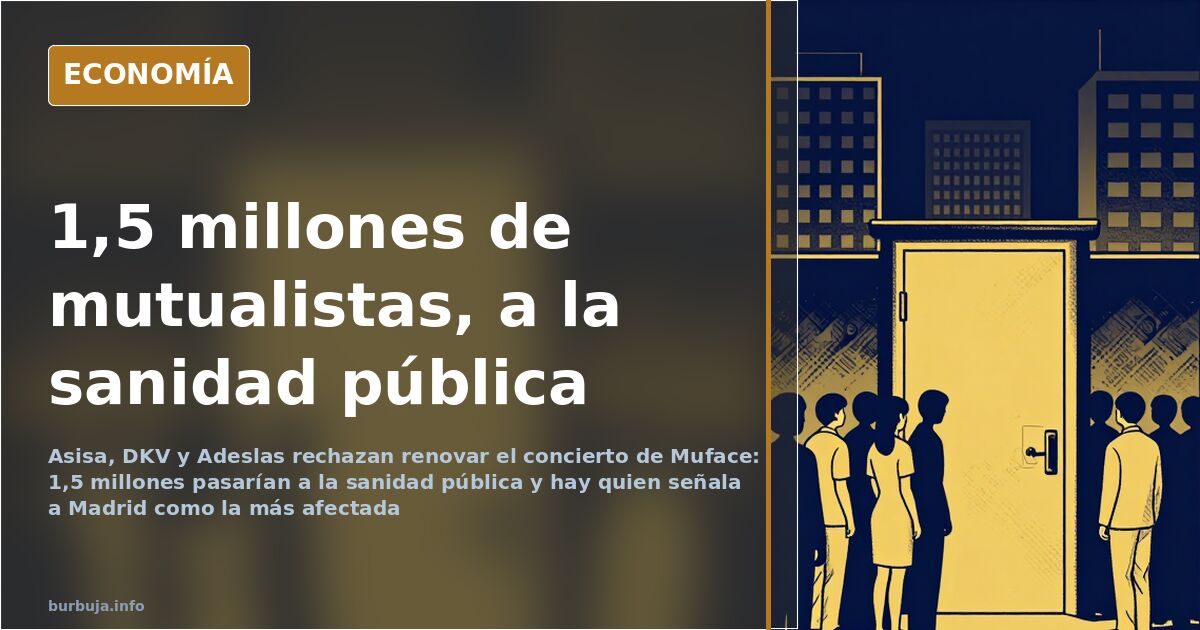
DKV, Asisa and Adeslas break Muface: 1.5 million to public health
Only three insurers provided healthcare for Spanish civil servants, and all three have said no at once. Asisa, DKV and Adeslas have refused to renew the Muface contract, the mechanism through which around 1.5 million people receive care through private policies paid for with public money. If the standoff is not resolved, that group will suddenly enter the public health system.
The paradox is striking: the state pays so that 1.5 million people do not burden its own system, and those who are paid to care for them have decided it no longer pays off. Some add a distribution problem: the region with the most resident state civil servants would be Madrid, by far, so the potential bottleneck would be concentrated there.
Why do insurers reject the Muface contract?
The companies had been warning. They asked the government for a premium increase of around 40%; the government offered 17%. With those figures, DKV argues the numbers do not add up. «A responsible company with a good fruta in the market like ours cannot afford to continue under these conditions», argues its CEO, Fernando Campos, who warns that the deal would affect care and professional pay.
The figures the company cites are explicit: it estimates 74 million euros in additional losses from the new two-year contract, almost the same as it lost in the three years of the previous contract. The underlying argument is a cost gap that keeps widening: over the past ten years, per capita health spending by regional governments and collaborating mutuals has risen 60.6%, while the weighted Muface premium has grown 31.6%, almost half.
Translation: the sector does not dispute demand, it disputes the price the state is willing to pay for it. And in that standoff it plays with the advantage of knowing that the alternative, public healthcare, is outside its profit and loss account.
Mugeju and Isfas yes, Muface no: where the business is
The detail that best portrays the negotiation is the exception. DKV does not sign any insurance formula for public personnel, period. Asisa and Adeslas, however, maintain coverage for state lawyers (Mugeju) and for the military (Isfas). That is, the door is slammed on the largest group, not on the entire business.
Why that split? An actuarial reason is pointed to: new entrants to the mutual system may opt for public healthcare and leave older groups, with higher healthcare consumption, in the mutuals. If the profile that remains inside makes the average premium more expensive, Muface ceases to be an attractive contract even with an increase.
How many mutual members would move to public healthcare and with what capacity?
The figure most often repeated is 1.5 million people, and some estimates speak of up to two million if passive classes are added. The immediate debate is whether the system can withstand that transfer without waiting lists soaring.
The precedent cited is that of health transfers to the regions: the groups that left the system then had to give up Muface and join Social Security, and there is no record that it blew anything up. On the other side, it is argued that public healthcare has absorbed in recent years the incorporation of millions of people arriving from abroad without visible collapse. The conclusion changes a lot depending on where the focus is placed: emergency and primary care or large hospitals.
The study that sustains the system and the one that sinks it
A report is circulating according to which what Muface pays per mutual member treated in the private sector is less than what public healthcare costs per patient. It is signed by the IDIS Foundation, linked to the insurers themselves, which invites reading it with caution; in the debate it is also stressed that the study does not detail where its calculations come from.
That same calculation, taken to the extreme, feeds a recurring proposal: if treating privately is cheaper, extend Muface to the entire population. To that idea the response is that it has never peine, so the premise does not hold at that scale.
The checkmate theory: CaixaBank, the tax hike and votes
In the political arena two readings cross. One, purely economic: the government must decide whether to raise the premium or assume the cost of integrating 1.5 million people into public healthcare, with the electoral wear that entails in a traditionally mobilised group.
The other reading is more convoluted and relies on a corporate fact: 49.9% of Adeslas belongs to CaixaBank, and the government maintains an open tax standoff with the banking sector. From that a supposed cross-pressure between the sector tax and the health contract is deduced. There is no confirmation of that connection, but the coincidence of interests gives material for suspicion.
Can Muface be fixed with 100 million more per year?
The Association of State Tax Inspectors has pointed to a specific figure: it would be enough to improve the rejected offer by 100 million per year for the contract to go ahead. That is, the gap between what the insurers ask for and what the government offers has a limited order of magnitude.
Meanwhile, the procedure continues its administrative course: the tender has been declared void and Muface will begin work on a new tender. The forced nine-month extension, under the public sector contracts law, provides breathing room and buys time.
With those pieces on the table, who gives in first: the one with the printer or the one with the frying pan? No one has yet explained what happens to policies already signed or what happens if the second tender is again left empty.
Only three insurers provided healthcare for Spanish civil servants, and all three have said no at once. Asisa, DKV and Adeslas have refused to renew the Muface contract, the mechanism through which around 1.5 million people receive care through private policies paid for with public money. If the standoff is not resolved, that group will suddenly enter the public health system.
The paradox is striking: the state pays so that 1.5 million people do not burden its own system, and those who are paid to care for them have decided it no longer pays off. Some add a distribution problem: the region with the most resident state civil servants would be Madrid, by far, so the potential bottleneck would be concentrated there.
Why do insurers reject the Muface contract?
The companies had been warning. They asked the government for a premium increase of around 40%; the government offered 17%. With those figures, DKV argues the numbers do not add up. «A responsible company with a good fruta in the market like ours cannot afford to continue under these conditions», argues its CEO, Fernando Campos, who warns that the deal would affect care and professional pay.
The figures the company cites are explicit: it estimates 74 million euros in additional losses from the new two-year contract, almost the same as it lost in the three years of the previous contract. The underlying argument is a cost gap that keeps widening: over the past ten years, per capita health spending by regional governments and collaborating mutuals has risen 60.6%, while the weighted Muface premium has grown 31.6%, almost half.
Translation: the sector does not dispute demand, it disputes the price the state is willing to pay for it. And in that standoff it plays with the advantage of knowing that the alternative, public healthcare, is outside its profit and loss account.
Mugeju and Isfas yes, Muface no: where the business is
The detail that best portrays the negotiation is the exception. DKV does not sign any insurance formula for public personnel, period. Asisa and Adeslas, however, maintain coverage for state lawyers (Mugeju) and for the military (Isfas). That is, the door is slammed on the largest group, not on the entire business.
Why that split? An actuarial reason is pointed to: new entrants to the mutual system may opt for public healthcare and leave older groups, with higher healthcare consumption, in the mutuals. If the profile that remains inside makes the average premium more expensive, Muface ceases to be an attractive contract even with an increase.
How many mutual members would move to public healthcare and with what capacity?
The figure most often repeated is 1.5 million people, and some estimates speak of up to two million if passive classes are added. The immediate debate is whether the system can withstand that transfer without waiting lists soaring.
The precedent cited is that of health transfers to the regions: the groups that left the system then had to give up Muface and join Social Security, and there is no record that it blew anything up. On the other side, it is argued that public healthcare has absorbed in recent years the incorporation of millions of people arriving from abroad without visible collapse. The conclusion changes a lot depending on where the focus is placed: emergency and primary care or large hospitals.
The study that sustains the system and the one that sinks it
A report is circulating according to which what Muface pays per mutual member treated in the private sector is less than what public healthcare costs per patient. It is signed by the IDIS Foundation, linked to the insurers themselves, which invites reading it with caution; in the debate it is also stressed that the study does not detail where its calculations come from.
That same calculation, taken to the extreme, feeds a recurring proposal: if treating privately is cheaper, extend Muface to the entire population. To that idea the response is that it has never peine, so the premise does not hold at that scale.
The checkmate theory: CaixaBank, the tax hike and votes
In the political arena two readings cross. One, purely economic: the government must decide whether to raise the premium or assume the cost of integrating 1.5 million people into public healthcare, with the electoral wear that entails in a traditionally mobilised group.
The other reading is more convoluted and relies on a corporate fact: 49.9% of Adeslas belongs to CaixaBank, and the government maintains an open tax standoff with the banking sector. From that a supposed cross-pressure between the sector tax and the health contract is deduced. There is no confirmation of that connection, but the coincidence of interests gives material for suspicion.
Can Muface be fixed with 100 million more per year?
The Association of State Tax Inspectors has pointed to a specific figure: it would be enough to improve the rejected offer by 100 million per year for the contract to go ahead. That is, the gap between what the insurers ask for and what the government offers has a limited order of magnitude.
Meanwhile, the procedure continues its administrative course: the tender has been declared void and Muface will begin work on a new tender. The forced nine-month extension, under the public sector contracts law, provides breathing room and buys time.
With those pieces on the table, who gives in first: the one with the printer or the one with the frying pan? No one has yet explained what happens to policies already signed or what happens if the second tender is again left empty.
Summary of a discussion on Burbuja.info - Foro de economía, actualidad y política., translated from Spanish and reviewed before publication. Read the full discussion (536 replies).
More summaries
-
Spain ends civil servant health insurance, shifting 1.5M to public system
Spain is ending the Muface private insurance scheme for 1.5 million civil servants, moving them to the public healthcare system.
-
Spain grants 'grandchildren law' nationals access to public healthcare without residency
Those naturalized under Spain's 'grandchildren law' can use the public health system without living in the country. We analyze the implications.
-
Europe calls for water and food stockpiling amid possible Russian attack
Switzerland joins Germany, Poland, France, and Finland recommending water and food stockpiling ahead of potential Russian attack.
-
Video shows four adults using drugs outside Valencia school
A video captures four adults appearing to use cocaine in broad daylight near a Valencia school, sparking debate on public drug use and aging consumers.
-
Forum thread turns politician into dog-hater icon
A 834-day, 149-reply forum thread mixes questions about a politician and her dog with fights over Madrid, cleanliness, and hate as identity.
-
Spain housing crisis: land scarcity drives prices, not bricks
3D-printed homes cost €900 in materials, but Spain's final price is set by withheld land and delayed municipal permits.