
Mount Toubkal Climber with Fibromyalgia Targets Everest
María Ciudad Romero summits Mount Toubkal despite fibromyalgia and disability, sparking debate on work incapacity validity.
English · Original discussion in Spanish · Published
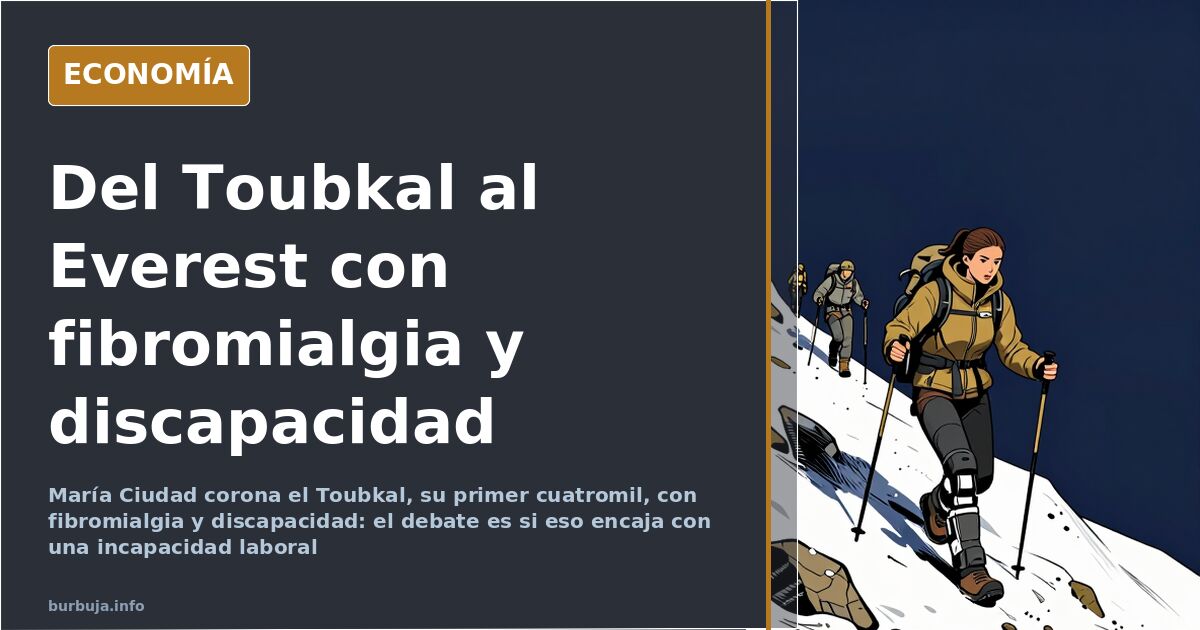
Fibromyalgia and Disability: From Toubkal to Everest
María Ciudad Romero is 47 years old, has two children, and works for a security company. She has suffered from fibromyalgia since age 15, along with osteoarthritis, various degenerative and autoimmune diseases, and recognized physical disability. Recently, she summited Mount Toubkal, North Africa’s highest peak and her first four-thousand-meter mountain. Fibromyalgia affects 4% of the general population. The contradiction—a body that cannot endure sitting but climbs 4,000 meters—has fueled the controversy.
What is fibromyalgia and how many people does it affect?
The diagnosis came late and incorrectly. As a child, Ciudad experienced full-body pain and had days when she could not get out of bed. "At first, my parents and doctors thought I was seeking attention," she recalls. She visited specialists across Spain until Concepción Delgado, a rheumatologist in Zaragoza, identified her condition.
Fibromyalgia involves chronic pain, fatigue, and constant exhaustion, often accompanied by arthritis, lower back pain, and sleep disorders. It is not visible to the naked eye. This invisibility is the root of the problem: without a marker to show, suspicion falls on the sufferer. "When I was diagnosed, I stopped thinking I was crazy," the mountaineer summarizes.
From Chronic Pain to Ten Three-Thousanders
She always liked the mountains, but took them seriously 11 years ago. Since then, she has summited ten three-thousand-meter peaks and recently added Mount Toubkal in Segarro, accompanied only by a local guide. At each summit, she unfurls a flag with her motto: "You reach the top not by surpassing others, but by surpassing yourself." Surrounding this are the names of her parents, her children, and her two hometowns.
Her argument is that the mountain gives her half her life. She claims it makes her physically stronger, emotionally resilient, and helps her cope better with daily problems. She adds that her case has encouraged others with similar conditions to lace up their boots. This narrative of overcoming adversity is precisely what part of the public rejects.
Can You Receive Disability Benefits and Climb a Four-Thousander?
Here, consensus breaks down. Comments are divided: some directly deny the existence of the disease, while others do not question the diagnosis but challenge the compatibility between high-mountain exertion and work incapacity status. Arguments suggest that someone unable to sit in an office should not undertake ascents of thousands of meters, pointing to the employer and Social Security as those sustaining the situation.
On the other side, some argue that fibromyalgia is not a fixed scale of effort but pain of variable intensity, defending that feeling unwell does not miccionan being immobile, and confusing the two leaves patients with no margin for anything. The discussion intensifies because it mixes three distinct things—a disease, a benefits system, and a sporting antiestéticat—and treats them as one.
Eight Screws in the Leg and a Fifth Surgery Pending
The medical history accompanying the story does not simplify matters. Ciudad suffers from degenerative disc disease in the spine, chronic radiculopathy in the sciatic nerve, digestive issues and irritable bowel syndrome, and has 8 screws in her tibia, fibula, and ankle due to a severe fracture. She has undergone four surgeries for an anovaginal and perineal fistula and has a fifth scheduled in Barcelona.
She herself explains how the pieces fit: she practices mountaineering between surgeries. She climbed Toubkal weeks after throat surgery for nodules and while her knee was undergoing rehabilitation. "I couldn't wait because I am also pending the Barcelona operation," she says. That detail—managing one's own body like scheduling appointments—disorients both sides.
The uncomfortable question remains: if the sick leave and disability system was designed for pain visible in medical tests, what does it do with those who cannot prove it and do not want to stay still? She already has the next summit on the horizon. Everest, or a part of it. With fibromyalgia, osteoarthritis, and eight screws in her leg.
Also available in: Deutsch
Summary of a discussion on Burbuja.info - Foro de economía, actualidad y política., translated from Spanish and reviewed before publication. Read the full discussion (179 replies).
More summaries
-
Ceuta hits back at TV pundit behind 'Thank You Morocco' shirt
A Ceuta resident's response to the pundit who wore a 'Thank You Morocco' shirt dismantles the narrative of the televised provocation.
-
María Márquez's sexism complaint in Spain fuels online backlash
Spanish Socialist politician María Márquez says she received sexist insults on laSexta, but the online reaction has multiplied the mockery and questioned her motives.
-
VOX launches tax savings calculator for economic plan
Critics argue VOX's simulator shows €400 savings for €18k salaries and €15k for €100k earners, highlighting disparities.
-
Galicia sells off its industry: from Avícola Tratante to Aludec
Avícola Tratante, Aludec, Ochoa, Martínez Otero: foreign capital is buying up Galician companies; forum users point to the lack of generational succession
-
Vox and PSOE: the deal no one confirms but everyone talks about
A tweet claims Vox has a deal with Spain's PSOE without providing any evidence. The claim is stirring up a campaign in which, some say, Vox is rising and the PP fears being overtaken.
-
Podemos will not run in Catalonia and will ask voters to back ERC
Under the preliminary deal, Podemos will not stand in Catalonia and will urge its voters to support ERC, while Rufián campaigns outside the region. The pact leaves questions open about its…