
Podemos will not run in Catalonia and will ask voters to back ERC
Under the preliminary deal, Podemos will not stand in Catalonia and will urge its voters to support ERC, while Rufián campaigns outside the region. The pact leaves questions open about its…
English · Original discussion in Spanish · Published
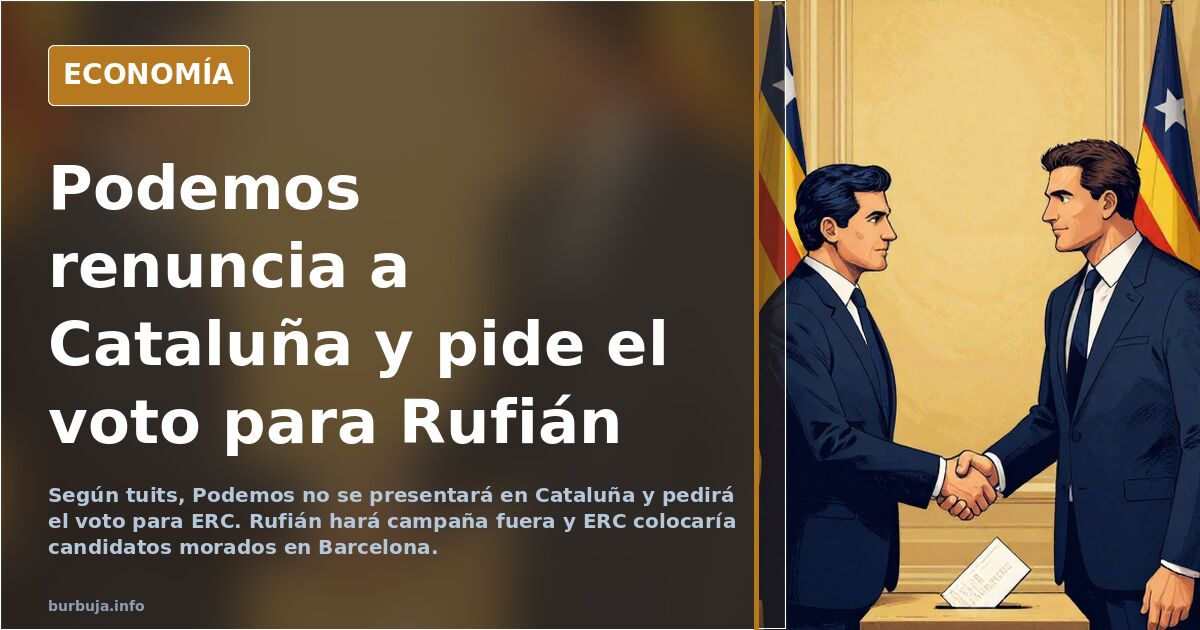
Podemos drops out of Catalonia and will ask voters to back ERC
The preliminary agreement between ERC and Podemos for the upcoming general election includes a clause that has set analysis alight: the purple party will not run in Catalonia and will ask its voters to back ERC, while Rufián will also campaign outside the region. The operation is being presented as a «tactical and open front that anyone can join», according to the first account of the deal that circulated. In parallel, Rufián's leadership is negotiating with figures from IU and with Emilio Delgado to place Podemos candidates on the Barcelona list, while Más Madrid grows increasingly worried about a possible implosion of the space to the left of the PSOE.
The figure hovering over the whole operation is uncomfortable: according to a calculation circulating in the debate, Podemos came close to one million votes in Catalonia in its best electoral cycle, and in 2023 65% of Barcelona residents voted for left-wing options. Giving up that ballot is no minor tactical gesture; it is an admission that the party sees no chance of winning even one seat in the province with the highest density of left-wing voters in Spain.
What the ERC-Podemos deal says
The skeleton of the pact has three parts. Podemos will not run in Catalonia. Rufián will ask for votes for the purple party in the rest of Spain. And the ERC brand becomes the useful reference for Catalan left-wing voters who until now split their ballots between several parties. In return, according to the information circulating, Rufián would recommend voting for Podemos in Madrid, Zaragoza and Cáceres, leaving ERC acting as an external hinge for the purple space.
The official narrative speaks of a «broad front». The less charitable reading is different: a trading of favours between two parties that cannot compete alone in certain constituencies. An armchair sorpasso.
The cost of not running in Barcelona
The decision has an arithmetic problem. Some argue that not so long ago Podemos was the most voted force in Barcelona and has not paid the price of governing. Its left-wing opposition, even if based on letters to the Three Kings, retains a floor of votes that will not automatically migrate to ERC. Some claim those thousands of ballots will end up in republican hands and give them an extra seat or two; the pessimistic scenario is that they stay at home.
The political flank is just as uncomfortable. Some warn that ERC will be accused of being Spanish nationalist for absorbing the vote of a statewide party in Catalonia. The paradox explains itself: the independence movement asking for votes for a brand that does not run in its own territory.
The war for the leadership of the purple space
Más Madrid has made its move with a proposal that leaves Podemos in an awkward position: Emilio Delgado as lead candidate in Madrid, trinc by Mónica García, with the integration of IU, Movimiento Sumar and Podemos if the latter decides to join the front. Translated: control of the space would belong to others. The purple leadership's response has been to demand primaries where there is disagreement and deals where no vote is needed, a formula that in practice allows decisions to be made without consulting the grassroots when convenient.
The bluntest calculation circulating is that Podemos would win one or two seats in Madrid running alone, enough to keep a salary for another four years. Politics as a means of living, not as a project.
Who wins and who loses from the deal
For ERC the move makes sense: it captures borrowed votes and positions itself as the reference for the Catalan left without competition on that flank. For Podemos the balance is more questionable. It gains visibility with Rufián's brand and loses the only place where it could still claim something resembling an electoral base of its own.
The indirect consequence may be the fragmentation of the left-wing vote in small provinces, where the scattering of parties hands seats to the formations that do run under a single brand. Soria, Cuenca or Badajoz know nothing of tactical fronts.
The analysis gets stuck here: nobody has yet explained what happens to the Podemos voter in Catalonia who does not want to vote for ERC. That electorate exists, was quantified in the ballot boxes a decade ago, and has no place in the deal.
Summary of a discussion on Burbuja.info - Foro de economía, actualidad y política., translated from Spanish and reviewed before publication. Read the full discussion (36 replies).
More summaries
-
Colau Emerges as Frontrunner for Spain's Broad Front
Media reports name Ada Colau as the de facto candidate for Spain's Broad Front after Monica Garcia withdrew. More Madrid demands her candidacy for Barcelona.
-
ERC seeks alternative candidate to Rufián amid left-wing front push in Spain
ERC is preparing a candidacy without Rufián amid speculation that he may lead a broad left-wing front. The internal standoff and the electoral calculus, in detail.
-
Spain's refugee policy accused of racism by Pablo Iglesias
Pablo Iglesias claims Spain's acceptance of 210,000 Ukrainians reveals racial bias against other migrants. Critics argue legal status, not culture, drives the difference.
-
Madrid's Sol protest camp winds down as cold, hygiene and narrative problems mount
The Puerta del Sol housing camp in Madrid faces its "de-camping" after three weeks: cold weather, Metro closure over sanitation and a fraying electoral narrative.
-
Galicia sells off its industry: from Avícola Tratante to Aludec
Avícola Tratante, Aludec, Ochoa, Martínez Otero: foreign capital is buying up Galician companies; forum users point to the lack of generational succession
-
Vox and PSOE: the deal no one confirms but everyone talks about
A tweet claims Vox has a deal with Spain's PSOE without providing any evidence. The claim is stirring up a campaign in which, some say, Vox is rising and the PP fears being overtaken.