
VOX launches tax savings calculator for economic plan
Critics argue VOX's simulator shows €400 savings for €18k salaries and €15k for €100k earners, highlighting disparities.
English · Original discussion in Spanish · Published
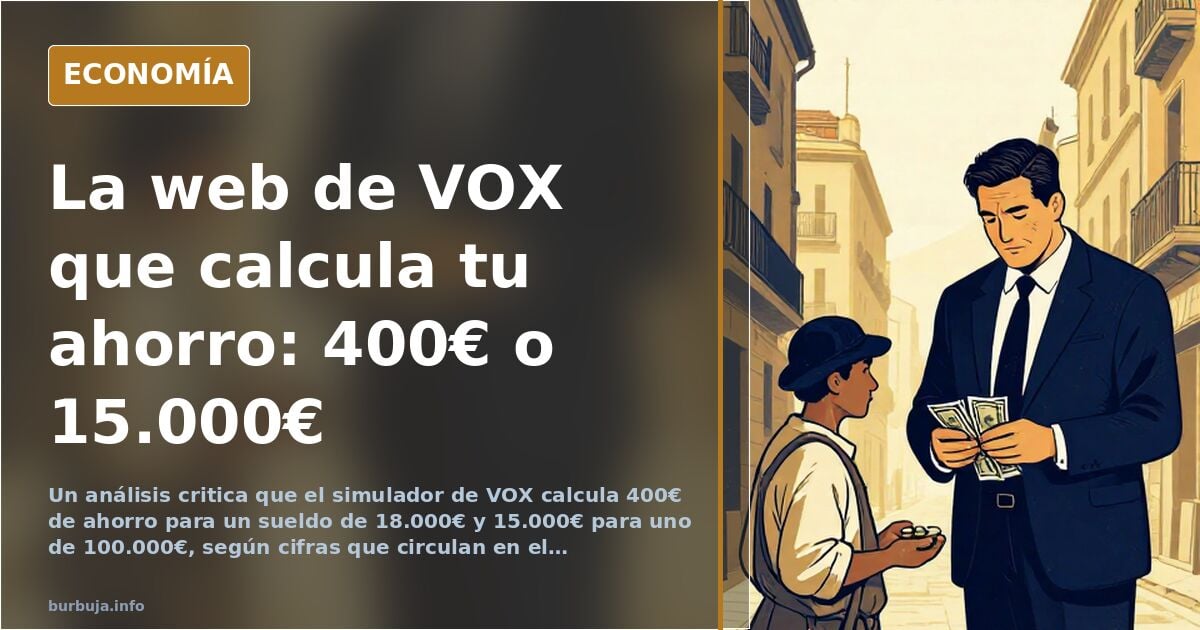
VOX publishes a website to calculate savings from its economic plan
The party has launched a digital tool promising to translate its fiscal program into concrete euro amounts for each taxpayer. According to critical analyses, the simulator's fine print turns a generic cut into a middle-class mirage: the same mechanism that saves hundreds of euros for an average worker boosts tax relief to five figures for high earners. While some celebrate the calculation, others are already cutting back to see which public services pay for the party.
The calculation pitting low-income workers against executives
The tool works like a showcase: you enter your income and it returns a savings figure. The numbers circulating in critical analyses are telling. For a worker with a gross annual salary of €18,000, IRPF (personal income tax) savings would be around €400 per year, according to calculations in the debate. Skeptical estimates suggest this amount would be eaten up by a private health insurance policy costing about €1,000 annually if public healthcare suffers from lack of funding.
At the other end, a taxpayer declaring €100,000 gross would see their tax bill reduced by approximately €15,000 per year, based on the same calculation. The proportion is not a minor detail: the savings for the highest earner multiply those of the average worker by more than thirty. Some argue that this differential is precisely the plan's objective, not a side effect.
The official defense of the program includes cuts to public spending which, promoters say, would allow tax reductions without dismantling services. The doubt remains the same: where do the cuts fall? This is not a rhetorical question. Harsher analyses point out that the reductions would ultimately hit the usual suspects, while high earners consolidate their advantage.
Is public healthcare sustainable with lower taxes?
This is where the debate heats up. Part of the analysis argues that public healthcare was historically funded by 12% VAT and half of current IRPF, suggesting there is room to cut without breaking the system. This is the classic argument for adjusting via spending.
The objection comes quickly: if the system is already deficit-funded with current taxes, lowering the burden on high earners only worsens the hole. The common counterargument is that limiting access to public healthcare for certain groups is enough to balance the books. A measure that, in practice, would turn universal healthcare into a service conditioned on administrative status.
The clash between these visions isn't resolved by a web calculator. It is resolved, if at all, at the ballot box. And that is where the savings simulator becomes more of a campaign weapon than a management tool.
The trap of short-term savings
Recent history offers uncomfortable precedents. The €400 returned via IRPF in the past had to be declared later, reducing the real relief. The €200 young people's bonus met a similar fate. In both cases, citizens perceived aid that Hacienda (tax authority) later adjusted through declarations.
VOX's website promises clean figures, but experience says no tax saving is as clean as it seems. The full calculation, broken down item by item, reveals surprising differences that don't fit in a two-click simulator.
With these differentials on the table, one might expect a massive migration of votes toward the promise of lower taxes. However, predictions have reservations: the electorate punishes both tax hikes and the fine print of cuts. And in this case, the fine print hasn't been fully read yet.
The party has launched a digital tool promising to translate its fiscal program into concrete euro amounts for each taxpayer. According to critical analyses, the simulator's fine print turns a generic cut into a middle-class mirage: the same mechanism that saves hundreds of euros for an average worker boosts tax relief to five figures for high earners. While some celebrate the calculation, others are already cutting back to see which public services pay for the party.
The calculation pitting low-income workers against executives
The tool works like a showcase: you enter your income and it returns a savings figure. The numbers circulating in critical analyses are telling. For a worker with a gross annual salary of €18,000, IRPF (personal income tax) savings would be around €400 per year, according to calculations in the debate. Skeptical estimates suggest this amount would be eaten up by a private health insurance policy costing about €1,000 annually if public healthcare suffers from lack of funding.
At the other end, a taxpayer declaring €100,000 gross would see their tax bill reduced by approximately €15,000 per year, based on the same calculation. The proportion is not a minor detail: the savings for the highest earner multiply those of the average worker by more than thirty. Some argue that this differential is precisely the plan's objective, not a side effect.
The official defense of the program includes cuts to public spending which, promoters say, would allow tax reductions without dismantling services. The doubt remains the same: where do the cuts fall? This is not a rhetorical question. Harsher analyses point out that the reductions would ultimately hit the usual suspects, while high earners consolidate their advantage.
Is public healthcare sustainable with lower taxes?
This is where the debate heats up. Part of the analysis argues that public healthcare was historically funded by 12% VAT and half of current IRPF, suggesting there is room to cut without breaking the system. This is the classic argument for adjusting via spending.
The objection comes quickly: if the system is already deficit-funded with current taxes, lowering the burden on high earners only worsens the hole. The common counterargument is that limiting access to public healthcare for certain groups is enough to balance the books. A measure that, in practice, would turn universal healthcare into a service conditioned on administrative status.
The clash between these visions isn't resolved by a web calculator. It is resolved, if at all, at the ballot box. And that is where the savings simulator becomes more of a campaign weapon than a management tool.
The trap of short-term savings
Recent history offers uncomfortable precedents. The €400 returned via IRPF in the past had to be declared later, reducing the real relief. The €200 young people's bonus met a similar fate. In both cases, citizens perceived aid that Hacienda (tax authority) later adjusted through declarations.
VOX's website promises clean figures, but experience says no tax saving is as clean as it seems. The full calculation, broken down item by item, reveals surprising differences that don't fit in a two-click simulator.
With these differentials on the table, one might expect a massive migration of votes toward the promise of lower taxes. However, predictions have reservations: the electorate punishes both tax hikes and the fine print of cuts. And in this case, the fine print hasn't been fully read yet.
Also available in: Deutsch
Summary of a discussion on Burbuja.info - Foro de economía, actualidad y política., translated from Spanish and reviewed before publication. Read the full discussion (18 replies).
More summaries
-
Spain's Public Healthcare: Fewer Male Doctors, Patient Complaints
Forums claim Spain's public healthcare is feminized, citing fewer male doctors and alleged mistreatment of male patients amid parity laws.
-
Xabier Arrutia Imaz, ETA advisor to PDVSA in Venezuela, dies
The death of Xabier Arrutia Imaz in Venezuela exposes the protection network for ETA members in PDVSA and suspicions of a killing to silence secrets.
-
Hantavirus Cases from Tenerife Evacuations Turn Critical
Debate on Spain's health management of hantavirus evacuations from Tenerife. Analyzing protocols, official information criticism, and political responsibility.
-
Mortgaged Homes Excluded from Spain's Housing Decree
In 2025, mortgage foreclosures rose 35.6% to 31,416. Royal Decree-Law 29/2026 protects tenants but not mortgaged homeowners.
-
Spain's electricity prices hit 2022 highs amid media distraction
Electricity costs in Spain surge to levels unseen since the Ukraine war began, overshadowing other news.
-
Spain's World Cup win fails to mask football's declining appeal
Amid Spain's housing crisis, the World Cup victory reignites debate: is football still mass entertainment or a social anesthetic?