
Mouliaá allocates 70% of new apartment to tourist rentals
Actress Elisa Mouliaá bought a €470,000 flat in Spain, dedicating 70% to tourist stays and 30% to sheltering women.
English · Original discussion in Spanish · Published
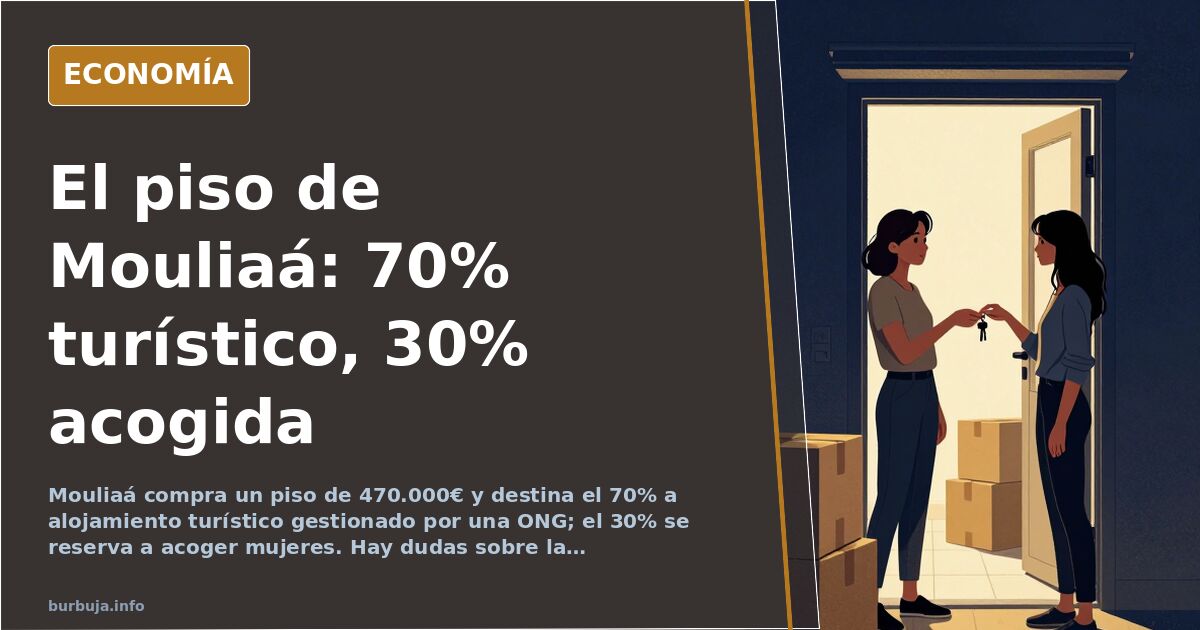
Mouliaá buys €470,000 flat for tourism and social housing
Spanish actress Elisa Mouliaá has purchased an apartment for €470,000, funded by the €54,000 she earned from TV contracts after publicly accusing Íñigo Errejón of sensual assault. The property is split asymmetrically: 70% is allocated to tourist accommodation managed by an NGO, while 30%—two rooms—is reserved for that same NGO to house women in need, including their children if applicable. Mouliaá and her lawyers calculated that renting these two rooms for seven years would equal the €54,000 earned. The actress claims housed women can work in the apartment providing tourist services: "The idea is to give these women a home and a job, and their children too," she stated, noting this model makes the property self-sustaining.
Property split: 70% tourism, 30% shelter
The scheme raises economic doubts. A €470,000 apartment financed with €54,000 in TV earnings questions the operation's viability. Critics argue taxes and expenses make it hard to cover the purchase, suggesting prior assets or external funding. Mouliaá explained the 70% tourist share sustains the initiative and covers costs, while the remaining 30% goes to shelter. She detailed that resident women can work there offering tourist rental services, aiming for the apartment to maintain itself through this formula.
NGO management and fiscal concerns
Management falls to an NGO reportedly linked to the actress herself, fueling skepticism. Some argue establishing and running an NGO offers tax advantages: tourist income might not be taxed as entity payments, staff salaries could be exempt, and aid for vulnerable people untaxed. Purchase and renovation taxes might also be reduced or deductible. Mouliaá’s lawyer avoided clarifying the entity’s legal nature, heightening suspicions.
Work for housed women: reintegration or exploitation?
The labor model is controversial. Mouliaá defended that housed women will be registered with Social Security: "They are workers, not maids," she tweeted, adding they receive tourists for a wage, aiding reintegration and empowerment. However, critics compare the scheme to disguised exploitation: women in need working for bed and board under an NGO veneer. Comparisons to live-in domestic service or hourly room rentals have circulated widely.
Origin of €54,000 and phone handover
Mouliaá visited a Notary after appearing at the court investigating Íñigo Errejón’s alleged sensual assault. She intended to surrender her mobile phone, as ordered by the judge to extract conversations between them. This failed because Judge Adolfo Carretero informed her lawyer there were insufficient resources; police will now summon her to deliver it at their station. This judicial step remains open, influencing public perception of the case.
The math doesn't add up: €642 for two rooms
Project arithmetic invites skepticism. If renting two rooms for seven years equals €54,000, the monthly average is around €642. For a €470,000 apartment, this figure seems strikingly low, suggesting most revenue comes from the other 70%, not these two rooms. A full breakdown yields results inconsistent with the official narrative. What happens if the tourist business fails to cover costs and shelter becomes secondary?
The operation presents itself as both charitable and self-referential business. Current numbers do not reveal which aspect weighs more.
Also available in: Deutsch
Summary of a discussion on Burbuja.info - Foro de economía, actualidad y política., translated from Spanish and reviewed before publication. Read the full discussion (126 replies).
More summaries
-
Mouliaá Claims Errejón Drugged Her Drink in Sexual Assault Case
Elisa Mouliaá reaffirms her complaint against Íñigo Errejón, alleging he drugged her drinks. Without toxicology reports, this remains a subjective suspicion.
-
Spain's CGPJ probes Judge Carretero over Mouliaá questioning
Spain's judicial council opens an inquiry into Judge Adolfo Carretero after 900 complaints about his interrogation of Elisa Mouliaá in the Errejón case.
-
Spain's Social Security deficit exceeds €100 billion
Spain’s Social Security net assets fall below minus €100 billion for the first time, relying on €33.6 billion in state transfers.
-
46% of Spain's voters rely on state pensions and jobs
In Spain, 46% of the electoral census depends on public funds, reigniting debate on captive voting and fiscal sustainability.
-
Franco turned Spain's renters into owners, but the PSOE has reversed it
The Obra Sindical del Hogar built much of Spain's pre-1980 housing stock. How many affordable homes are there today, and who builds them?
-
Fifty, diabetic and on €1,000 a month: his Philippines plan doesn't add up
A fifty-year-old diabetic in the Philippines living on €1,000 a month: health insurance, land in someone else's name and an open complaint cast doubt on the plan.