
Spain's Social Security deficit exceeds €100 billion
Spain’s Social Security net assets fall below minus €100 billion for the first time, relying on €33.6 billion in state transfers.
English · Original discussion in Spanish · Published
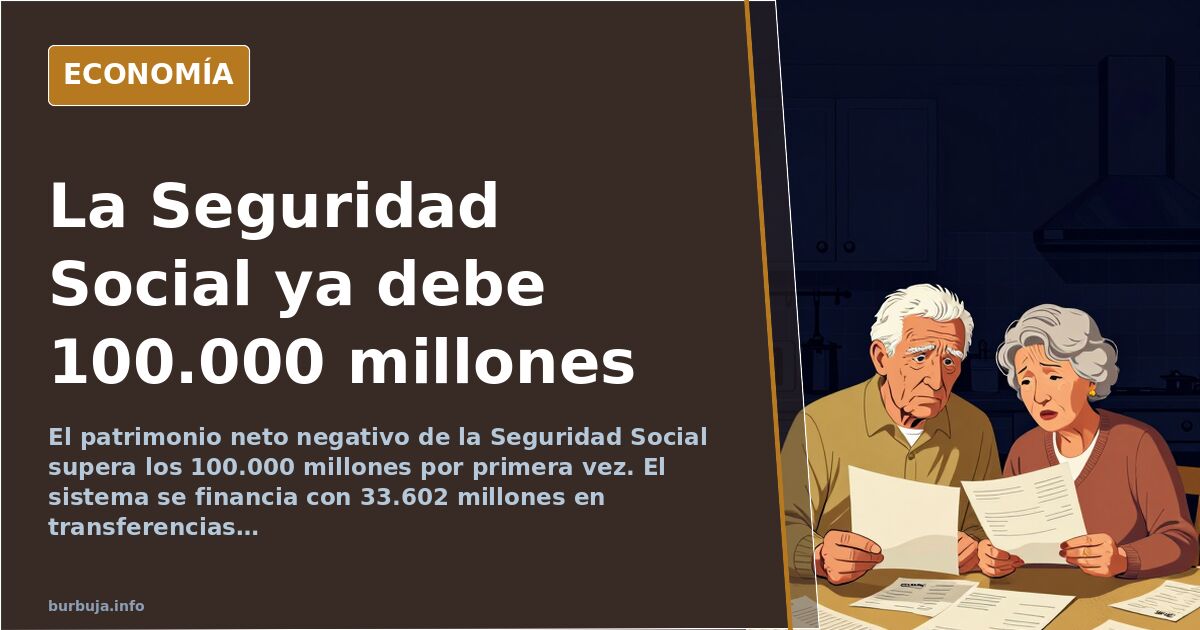
Spain's Social Security net assets drop below minus €100 billion
The negative net assets of Spain’s Social Security system have exceeded €100 billion for the first time, according to data sparking this debate. This figure is not merely an accounting scare; it reflects a system generating less revenue than expenditure, covering the shortfall with state transfers. The stark headline admits few optimistic interpretations. From there, the analysis diverges.
Where the deficit comes from and why it grows
The system suffers from structural imbalance. Contribution income does not cover pensions, healthcare, and other benefits, with the difference covered by funds from the General State Budgets (Presupuestos Generales del Estado), which are themselves in deficit. In essence, debt upon debt. Social Security received €33.602 billion in transfers during the first seven months of the year, a 3.9% increase compared to the same period last year. This money does not come from a magic box: it comes from taxes or further borrowing.
Official defenses rely on a positive balance of €3.101 billion up to July, with contribution revenues of €130.577 billion and expenditures of €127.476 billion. The issue is that this surplus is calculated after injecting €33.602 billion via transfers. Without this crutch, the hole would be even larger. The accounting balances; sustainability does not.
The demographic problem no one disputes
Between 2025 and 2035, the baby boom generation retires: over 10 million people with high contribution bases. Meanwhile, birth rates fall and the population pyramid inverts. Fewer young contributors with lower wages support more retirees receiving increasing pensions. The result is simple arithmetic: either raise contributions, cut pensions, or indebt the system until someone says enough.
The chosen path so far is the former. Salaries above €59,000 will face a solidarity contribution starting in January, a levy that generates no retirement rights and effectively functions as a tax. In November, the government will use tax revenue to pay the €26 billion double pension payments for retirees. Increasingly, Social Security is funded by general taxes rather than contributions.
Is Social Security a Ponzi scheme?
Not legally, but the comparison circulates. A pure pay-as-you-go system requires more contributors entering than leaving. If demographics break down, the scheme wobbles. Massive migration inflows are proposed in some analyses as the only way to rejuvenate the pyramid, though the actual impact on accounts depends on employment rates and wages. Those arguing the system is unsustainable without immigration have a demographic argument; those responding that immigration doesn't fix a design flaw have another.
The discussion often shifts to spending: public employment, universal healthcare, benefits. Universal healthcare is cheaper than private healthcare, some analyses argue, against those who claim the problem isn't social spending but inefficiency and corruption in management. Both currents exist and do not cancel each other out.
The coming scenario: more debt, more taxes, or lower pensions
The European Central Bank maintains high interest rates; lowering them would ease debt burdens but could also spike inflation. With public debt at record levels, every basis point matters. Monetary printing appears as the least unpopular exit, albeit the most inflationary. The euro actually has no intrinsic value, summarizes one of the most repeated interventions: more is printed than can be justified by real wealth.
The scenario painted by pessimists is not a bomb, but slow erosion: each year worse than the last, with people wondering when this will end. The metaphor of a canoe dragged toward a waterfall repeats. There will be no great crash; there will be a long decline.
How long can a system sustain itself if it needs €33.602 billion in external funding to balance its books?
Summary of a discussion on Burbuja.info - Foro de economía, actualidad y política., translated from Spanish and reviewed before publication. Read the full discussion (142 replies).
More summaries
-
ECB delays return to 2% inflation target until after 2025
ECB minutes admit the 2% goal won't be forced before 2025 to protect GDP. Rising food costs erode savings' purchasing power.
-
Claim: Spain’s Pension Fund Short €50 Billion for Three Months
Viral post claims Social Security lacks funds for three months of pensions. Debate covers the reserve fund, contributions, and potential solutions.
-
Almodóvar claims filmmakers repay subsidies via taxes
Almodóvar defends film subsidies, saying they are repaid. Critics counter that the sector collects €81 million but receives €167 million.
-
Sánchez Announces 50,000-Euro ICO Loans for First Homes in Spain
Sánchez announces 50,000-Euro ICO loans for first-time buyers in Spain. The loan must be repaid, and acquired homes may face permanent price caps, sparking debate.
-
Too Many Life Options vs the Quiet Certainty of Choosing Right in Scarcity
An abundance of life options does not guarantee a better choice. In scarcity, a Sabina record was enough to feel sure you had chosen right. Come in and compare.
-
Galicia sells off its industry: from Avícola Tratante to Aludec
Avícola Tratante, Aludec, Ochoa, Martínez Otero: foreign capital is buying up Galician companies; forum users point to the lack of generational succession