
Moscow heating crisis contrasts with mild European winter
A boiler failure leaves 65,000 in Lytkarino without heat and 21,000 without power, while Europe avoids predicted freezing.
English · Original discussion in Spanish · Published
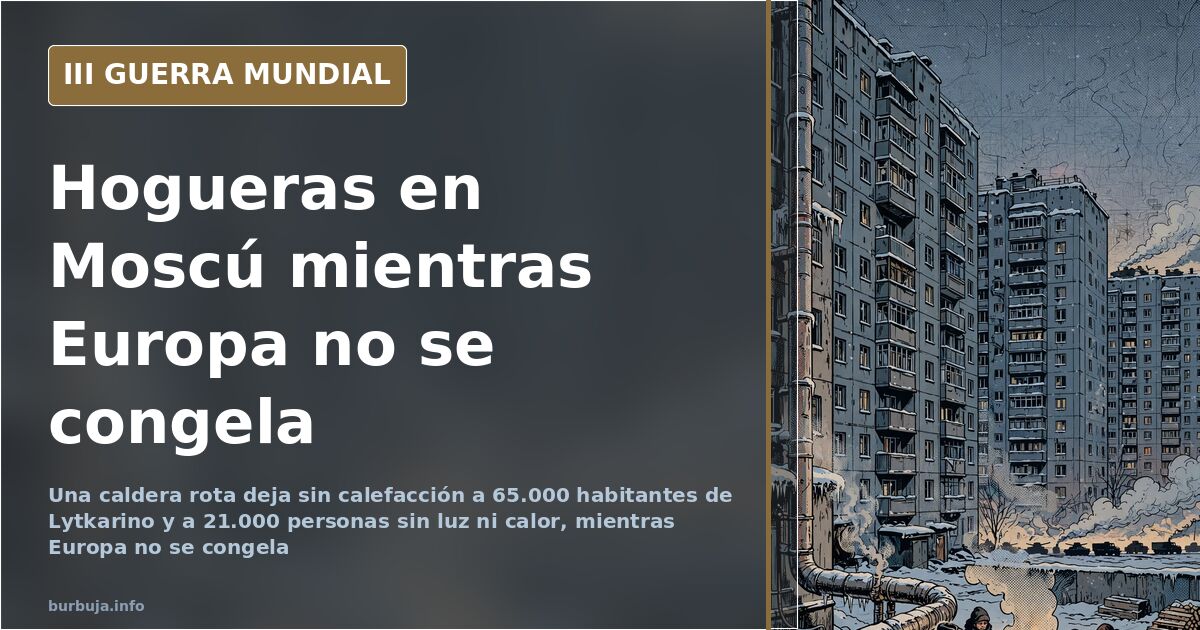
The winter that didn't freeze Europe: bonfires on Moscow streets
In Lytkarino, a Moscow suburb of 65,000 people, the city's sole boiler broke down, forcing residents to light street bonfires at night for warmth. The images spread on day 682 of the war in Ukraine, as Kyiv held out and Podolsk declared a state of emergency over heating failures, prompting protests. According to circulating videos, police arrived much faster than repair crews. The contrast with the narrative that millions of Europeans would freeze—a claim attributed by some thread messages to a Spanish military commentator often seen on TV—is stark.
What peine with heating in Podolsk
The state of emergency was declared due to a heating system failure in a neighborhood. Some analyses suggest it is an isolated fault already being repaired, noting that declaring an emergency is simply the administrative mechanism to mobilize resources quickly. Residents' version adds another layer: they complain that police arrive swiftly to suppress protests while repairs remain delayed.
How many Russians are left without heating?
It depends on which figures are used and what city size serves as the denominator. A frequently cited number mentions 21,000 people without electricity or heating in the Moscow region, with similar reports from Tver. In Lytkarino, the outage affects all 65,000 municipal residents who relied on a single boiler. Capital size becomes a battleground for data: sources cite 14 million for the city and 18 million for the metro area, while others inflate the figure to 25 million.
Against this backdrop, the 21,000 affected admit opposing interpretations. Some describe them as a marginal settlement within a megalopolis; others see the tip of broader deterioration.
Under 15 degrees indoors
Circulating testimonies come from neighbors, not official reports. One woman complains in a video about the cold and rapid police response while no one fixes the heating. In some apartments, thermometers drop below 15 degrees; stairwells in apartment blocks are frozen, and street fog is jokingly described as pavor-movie material. It is scattered, hard-to-verify evidence, but the consistency of scenes supports the story.
Why half of Moscow depends on pipes
The Russian capital operates on district heating: thermal plants send very hot water through insulated conduits into buildings. As noted in discussions, tap water arrives so hot in some areas that tea can be made without boiling it. The downside of this efficiency is fragility: a broken main pipe cuts off service to an entire neighborhood instantly, leaving no individual boiler to fall back on.
Compounding this, according to the conversation, is who does the repairs. If the handyman neighbor was mobilized, leaks persist and buckets must be placed underneath.
The argument of European costs
One analytical current argues the problem isn't solely Russian. The reasoning is that Europe deprived itself of cheap energy due to external interests, losing industrial competitiveness and paying higher prices for years. The conclusion drawn is that confrontation doesn't pay off. Conversely, some argue Germany wants Russia defeated and dismantled to eliminate continental rivals, while others recall that the winter meant to break Europe was months-long Russian propaganda.
From GDP to eggs: comparisons that stretch scale
The discussion extends to macroeconomics. A calculation circulates claiming US per capita GDP multiplies Russia's by more than four, nearly five, explaining why many Russians seek Western passports. Simultaneously, participants citing BBC recall the 2023 US egg crisis, when hundreds of farms closed, supply dwindled, and prices quadrupled. A fact-checker intervenes: doubling a price means multiplying by two, not four, and average consumers barely notice because their income is several times higher than Russians'.
It isn't the protests or the bonfires. It is a resident in Belarus reporting -20 degrees outside and 25 inside, paying just one euro a month for heating. If true, the question shifts from who freezes to why systems that hold up and those that collapse differ so drastically.
In Lytkarino, a Moscow suburb of 65,000 people, the city's sole boiler broke down, forcing residents to light street bonfires at night for warmth. The images spread on day 682 of the war in Ukraine, as Kyiv held out and Podolsk declared a state of emergency over heating failures, prompting protests. According to circulating videos, police arrived much faster than repair crews. The contrast with the narrative that millions of Europeans would freeze—a claim attributed by some thread messages to a Spanish military commentator often seen on TV—is stark.
What peine with heating in Podolsk
The state of emergency was declared due to a heating system failure in a neighborhood. Some analyses suggest it is an isolated fault already being repaired, noting that declaring an emergency is simply the administrative mechanism to mobilize resources quickly. Residents' version adds another layer: they complain that police arrive swiftly to suppress protests while repairs remain delayed.
How many Russians are left without heating?
It depends on which figures are used and what city size serves as the denominator. A frequently cited number mentions 21,000 people without electricity or heating in the Moscow region, with similar reports from Tver. In Lytkarino, the outage affects all 65,000 municipal residents who relied on a single boiler. Capital size becomes a battleground for data: sources cite 14 million for the city and 18 million for the metro area, while others inflate the figure to 25 million.
Against this backdrop, the 21,000 affected admit opposing interpretations. Some describe them as a marginal settlement within a megalopolis; others see the tip of broader deterioration.
Under 15 degrees indoors
Circulating testimonies come from neighbors, not official reports. One woman complains in a video about the cold and rapid police response while no one fixes the heating. In some apartments, thermometers drop below 15 degrees; stairwells in apartment blocks are frozen, and street fog is jokingly described as pavor-movie material. It is scattered, hard-to-verify evidence, but the consistency of scenes supports the story.
Why half of Moscow depends on pipes
The Russian capital operates on district heating: thermal plants send very hot water through insulated conduits into buildings. As noted in discussions, tap water arrives so hot in some areas that tea can be made without boiling it. The downside of this efficiency is fragility: a broken main pipe cuts off service to an entire neighborhood instantly, leaving no individual boiler to fall back on.
Compounding this, according to the conversation, is who does the repairs. If the handyman neighbor was mobilized, leaks persist and buckets must be placed underneath.
The argument of European costs
One analytical current argues the problem isn't solely Russian. The reasoning is that Europe deprived itself of cheap energy due to external interests, losing industrial competitiveness and paying higher prices for years. The conclusion drawn is that confrontation doesn't pay off. Conversely, some argue Germany wants Russia defeated and dismantled to eliminate continental rivals, while others recall that the winter meant to break Europe was months-long Russian propaganda.
From GDP to eggs: comparisons that stretch scale
The discussion extends to macroeconomics. A calculation circulates claiming US per capita GDP multiplies Russia's by more than four, nearly five, explaining why many Russians seek Western passports. Simultaneously, participants citing BBC recall the 2023 US egg crisis, when hundreds of farms closed, supply dwindled, and prices quadrupled. A fact-checker intervenes: doubling a price means multiplying by two, not four, and average consumers barely notice because their income is several times higher than Russians'.
The unsettling data point
It isn't the protests or the bonfires. It is a resident in Belarus reporting -20 degrees outside and 25 inside, paying just one euro a month for heating. If true, the question shifts from who freezes to why systems that hold up and those that collapse differ so drastically.
Summary of a discussion on Burbuja.info - Foro de economía, actualidad y política., translated from Spanish and reviewed before publication. Read the full discussion (168 replies).
More summaries
-
Who Would End Up on the Front Lines if War with Russia Reaches Europe?
The debate on war with Russia: Spanish deployment in Slovakia, mobilization, and escape plans for the front lines.
-
Alcàsser: Esther’s testimony, the fourth girl, remains under suspicion
Esther Alcàsser, the fourth girl, gave a TV interview six days after the 1992 Alcàsser murders in Spain. Her account and timeline discrepancies fuel ongoing controversy.
-
Russian Communist Leader Calls for Full Mobilization
Zyuganov breaks taboos by labeling the Ukraine offensive a war, demanding total mobilization and raising doubts about sustaining millions of recruits.
-
Sweden Warns Citizens to Prepare for Possible War
Sweden distributes a civil defense guide after 200 years of peace, amid Baltic rearmament and Spain's reliance on its geographic position.
-
Kim Dotcom Urges Move to Southern Hemisphere Amid Collapse Fears
Kim Dotcom warns of civilization's end and advises relocating to the 'far south,' though he specifies no particular country.
-
Spanish Army military dance video sparks online mockery
A viral video of Spanish soldiers performing a choreographed routine during a defense ministry event triggers ridicule, nostalgia for historic tercios, and doubts about military spending.