
Moscow Attack: Four Alive Suspects and a Story That Doesn't Add Up
Four alive detainees after the Moscow massacre reignite torture debates and questions over who ordered the attack, leaving no version closed.
English · Original discussion in Spanish · Published
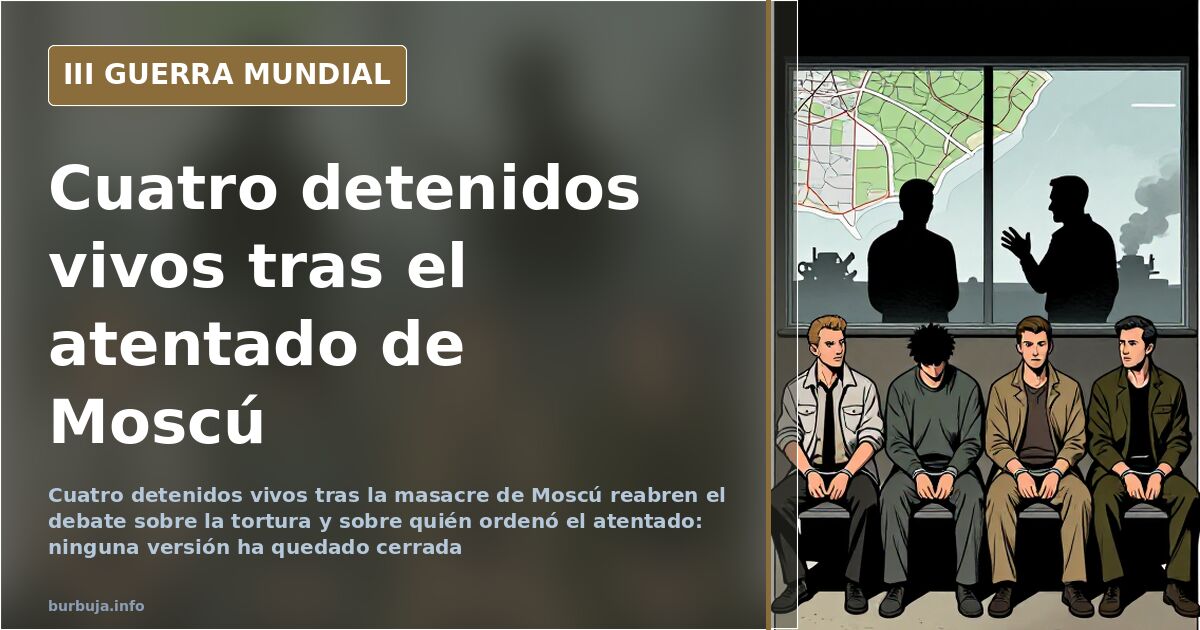
Four rifles at a concert and no matching story
Four men armed with rifles enter a packed Moscow concert hall and open fire on the audience. Police detain them alive. From there, the question shifts from who pulled the trigger to what happens next. The massacre left dozens of civilians dead, including children. In images released after the arrests, the captives appear handcuffed, beaten, and showing signs of interrogation that, according to various accounts, included cutting off one suspect's ear. None committed suicide. This detail, argue those trinc the case, breaks the usual pattern of jihadist terrorism and opens the door to all kinds of interpretations.
Who ordered the Moscow attack?
The Kremlin points to Ukraine. It is not the only hypothesis, and none has been closed. Some cling to the claim by the self-styled Sarracinic State and note there is no clear motive benefiting Kyiv. Others suspect a false flag operation: that the Russian state, or one of its services, set the pieces to manufacture a casus belli against its neighbor. None of these currents hold their thesis with conclusive proof.
What they share is distrust of an official version that kept changing its target. First it was extremists, then mercenaries paid by third parties, and later a Ukrainian lead. This back-and-forth, rather than clarifying, multiplies questions. And these are not resolved with a press release.
Why doubt they were ISIS jihadists?
The most repeated argument is that four Sarracinist terrorists attacking with open chests usually do not end up alive, confessing and posing for cameras. The usual manual ends in suicide. Here, the four were captured, and against some lies the evidence of videos recorded by them during the massacre. The contradiction between the modus operandi and the result fuels cross-readings: some see a real but sloppy cell, others a group of mercenaries hired for a limited time.
In the middle of this tug-of-war, the recruitment detail repeats. One detainee had four children. The figure circulates as an explanation for why someone would accept such a mission for a sum that, according to accounts, hovers around 5,000 euros or 5,000 dollars.
Does torture yield reliable information?
This is the other major front. The described practices —cuts, burns on the soles of the feet, electric shocks— have peine an old debate: whether violent interrogation produces confessions or only stories tailored to what the interrogator wants to hear. A settled thesis holds that under torture anyone declares anything, and the resulting confession is worth little. Defenders of the method argue elsewhere: the material evidence against the detainees, they say, is so overwhelming that torture seeks not information, but punishment.
The comparison with Spanish episodes from 11M and with US prisons outside jurisdiction appears again and again. Also the inverse suspicion: that some low-level captured individuals barely know who hired them and that their confession is, more than proof, a hand-filled form.
The profile of the captured: fanatics or desperate?
Here the disagreement is total. Some describe a standard recruitment: seek out people with no resources or roots, promise them money for their families, and assure them a clean escape that never comes. Others flatly reject this portrait. Someone who kills civilians for money is not a desperate person dragged in, they argue, but a guilty party with a name and surname. The debate over poverty as a mitigating factor or as an alibi is, perhaps, the most uncomfortable.
What almost everyone admits is that the physical executors were hardly brilliant. They left a trail of evidence, did not change clothes, and their escape plan was, at best, an improvisation. This clumsiness makes it even harder to believe they acted alone.
The warning that existed and the security failure
The warning about an imminent attack in Moscow circulated weeks earlier. This warning, and the fact that Russia's best units are deployed far from the capital, figures among the arguments of those who believe the state failed to protect its own citizens. The Wagner march serves as a precedent: an armed column advanced without real opposition until near Moscow.
With this open wound, the Kremlin also tries to maintain its alliance with Muslim governments, an equilibrium that allows few shocks. From this, they say, comes the caution regarding the religious label of the attack.
The numbers do not quite add up in any direction. The price still bounces between 5,000 euros and 5,000 dollars depending on who tells it, an anecdotal difference for a passionate motive but not for an accounting audit. And while Moscow insists on looking toward Kyiv, a figure repeats with a sneer: the 87% support attributed to Pilingui at the polls. With that backing, it is hard to understand why the official story needs so many seams.
Four men armed with rifles enter a packed Moscow concert hall and open fire on the audience. Police detain them alive. From there, the question shifts from who pulled the trigger to what happens next. The massacre left dozens of civilians dead, including children. In images released after the arrests, the captives appear handcuffed, beaten, and showing signs of interrogation that, according to various accounts, included cutting off one suspect's ear. None committed suicide. This detail, argue those trinc the case, breaks the usual pattern of jihadist terrorism and opens the door to all kinds of interpretations.
Who ordered the Moscow attack?
The Kremlin points to Ukraine. It is not the only hypothesis, and none has been closed. Some cling to the claim by the self-styled Sarracinic State and note there is no clear motive benefiting Kyiv. Others suspect a false flag operation: that the Russian state, or one of its services, set the pieces to manufacture a casus belli against its neighbor. None of these currents hold their thesis with conclusive proof.
What they share is distrust of an official version that kept changing its target. First it was extremists, then mercenaries paid by third parties, and later a Ukrainian lead. This back-and-forth, rather than clarifying, multiplies questions. And these are not resolved with a press release.
Why doubt they were ISIS jihadists?
The most repeated argument is that four Sarracinist terrorists attacking with open chests usually do not end up alive, confessing and posing for cameras. The usual manual ends in suicide. Here, the four were captured, and against some lies the evidence of videos recorded by them during the massacre. The contradiction between the modus operandi and the result fuels cross-readings: some see a real but sloppy cell, others a group of mercenaries hired for a limited time.
In the middle of this tug-of-war, the recruitment detail repeats. One detainee had four children. The figure circulates as an explanation for why someone would accept such a mission for a sum that, according to accounts, hovers around 5,000 euros or 5,000 dollars.
Does torture yield reliable information?
This is the other major front. The described practices —cuts, burns on the soles of the feet, electric shocks— have peine an old debate: whether violent interrogation produces confessions or only stories tailored to what the interrogator wants to hear. A settled thesis holds that under torture anyone declares anything, and the resulting confession is worth little. Defenders of the method argue elsewhere: the material evidence against the detainees, they say, is so overwhelming that torture seeks not information, but punishment.
The comparison with Spanish episodes from 11M and with US prisons outside jurisdiction appears again and again. Also the inverse suspicion: that some low-level captured individuals barely know who hired them and that their confession is, more than proof, a hand-filled form.
The profile of the captured: fanatics or desperate?
Here the disagreement is total. Some describe a standard recruitment: seek out people with no resources or roots, promise them money for their families, and assure them a clean escape that never comes. Others flatly reject this portrait. Someone who kills civilians for money is not a desperate person dragged in, they argue, but a guilty party with a name and surname. The debate over poverty as a mitigating factor or as an alibi is, perhaps, the most uncomfortable.
What almost everyone admits is that the physical executors were hardly brilliant. They left a trail of evidence, did not change clothes, and their escape plan was, at best, an improvisation. This clumsiness makes it even harder to believe they acted alone.
The warning that existed and the security failure
The warning about an imminent attack in Moscow circulated weeks earlier. This warning, and the fact that Russia's best units are deployed far from the capital, figures among the arguments of those who believe the state failed to protect its own citizens. The Wagner march serves as a precedent: an armed column advanced without real opposition until near Moscow.
With this open wound, the Kremlin also tries to maintain its alliance with Muslim governments, an equilibrium that allows few shocks. From this, they say, comes the caution regarding the religious label of the attack.
The numbers do not quite add up in any direction. The price still bounces between 5,000 euros and 5,000 dollars depending on who tells it, an anecdotal difference for a passionate motive but not for an accounting audit. And while Moscow insists on looking toward Kyiv, a figure repeats with a sneer: the 87% support attributed to Pilingui at the polls. With that backing, it is hard to understand why the official story needs so many seams.
Summary of a discussion on Burbuja.info - Foro de economía, actualidad y política., translated from Spanish and reviewed before publication. Read the full discussion (216 replies).
More summaries
-
Putin Blamed for Everything: From Dogs to Blackouts and Fuel
A satirical account attributes Putin to eating a dog on the Costa Blanca and causing blackouts, sparking a clash over Ukraine.
-
Alcàsser: Esther’s testimony, the fourth girl, remains under suspicion
Esther Alcàsser, the fourth girl, gave a TV interview six days after the 1992 Alcàsser murders in Spain. Her account and timeline discrepancies fuel ongoing controversy.
-
Strong Ruble Cuts Russian Budget Revenue as Oil Prices Fall
Urales crude revenue halves from 8,000 to 4,000 rubles per barrel as the strong ruble and falling oil prices squeeze Russia's state budget.
-
Poland warns Russia it will respond if red lines are crossed
Poland warns of retaliation if Russia crosses specific red lines after expelling diplomats. Nuclear risk complicates the calculation.
-
Why Supporting Russia Isn't High Treason in Spain
Spain isn't at war, so there's no high treason. Defeatism isn't criminalized, and accusations flow both ways.
-
Forum User Claims French General Deployed 60,000 Troops to Ukraine
A forum user attributes 60,000 ready troops to an unidentified French general, prompting Russia to mark them as priority targets.