
Poland warns Russia it will respond if red lines are crossed
Poland warns of retaliation if Russia crosses specific red lines after expelling diplomats. Nuclear risk complicates the calculation.
English · Original discussion in Spanish · Published
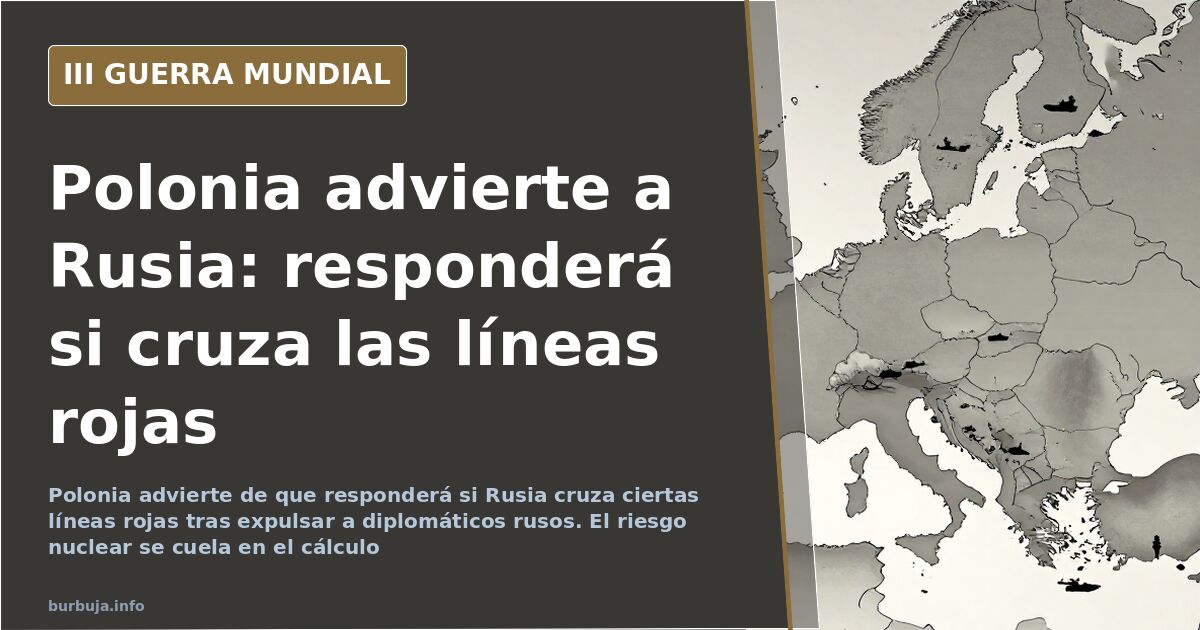
Poland shifts from embrace to warning, establishing its red lines
Poland has moved from embrace to warning. The message that it will respond if Russia crosses specific red lines came alongside the announcement of the expulsion of Russian diplomats, and in a country that has had Moscow to its east for centuries, this does not sound like post-dinner bravado: it sounds like a reminder of where the border lies. The fine print, however, is not written anywhere. No one has specified what those lines are.
What red lines has Poland set for Russia?
There is no public list. The warning comes amid discussions about sending arms to Ukraine and whether those shipments can be intercepted before reaching their destination, so the ambiguity seems deliberate. Some interpret the red line as Poland’s own territory; others suspect it extends to the transit of military material across its soil and convoys crossing it.
This indefiniteness has an advantage and a cost. The advantage is that Moscow does not know where the edge is and must calculate with a margin. The cost is that Warsaw does not know either, and a warning without a defined threshold becomes a problem the day someone tests it by mistake.
What has changed in Poland’s tone
The novelty is not distrust of Russia — it is recalled that a few years ago that sentiment was low and there were even local sympathies for the Russian president — but the register. Poland has stopped being the country asking for help to become the one threatening its own reprisals.
Part of the analysis reads this as an elemental defensive reaction: reinforcing the border and warning that an attack on its own soil will have a response. Another part reads it the other way around, as an unnecessary escalation that brings precisely the scenario it claims to want to avoid. The most repeated reproach is not against Warsaw, but against those pushing it: the feeling of acting as sparring in someone else’s fight.
From the Peace of Riga to the eastern territories
To understand the background, one must look back. Poland and Russia have fought for centuries, and not always with the Poles losing: the Polish-Soviet War, between February 14, 1919, and March 18, 1921, ended with a Polish victory and the Peace of Riga. This fact, ignored here, is taught there.
Long memory includes worse episodes: the partitions that erased the country from the map and the Volhynia massacres during World War II, which continue to poison relations with neighbors. Added to this is the Kresy Wschodnie, the eastern territories now in Belarus, which some point to as the real interest explaining so much attention to the war.
The neighborhood: Germany to the west, Russia to the east
Geographic position admits no optimism. With Germany and Russia as neighbors, true allies are scarce: Hungary is the only one with stable rapport, while relations with Berlin and Paris are strained. Anglo-Saxon allies are far away, and as any 1939 manual teaches, they can wash their hands when the matter complicates.
It is argued that Poland has become the shield for interests that are not its own, forced to assume a cost others do not want to pay. The response to this thesis is uncomfortable: if no one else is willing to stand in front, someone will have to.
The nuclear elephant: why Warsaw does not take the step
Here the analysis turns cold. The Russian contingent deployed in Ukraine is around 150,000 soldiers according to estimates managed in the discussion itself, and their performance has not been that of an invincible power. This fuels the thesis that, in a conventional clash, Poland would not fare worse.
Conventional calculation is of little use when the other side has nuclear weapons. According to the scenario posed by one of the participants, in a nuclear exchange, Central and Eastern Europe would suffer the most, and Poland is a candidate to be reduced to ashes. No one says aloud that this risk compensates for what would be gained, hence the unstable balance between raising the tone and crossing nothing.
Minsk, the accusations, and the narrative each side writes
The disagreement over the Minsk agreements remains unresolved. One part maintains that Ukraine skipped them; against this weighs the argument that Poland was not a signatory to anything and that precisely the degree of non-compliance is what is in dispute. The conversation repeatedly leads to the same deadlock.
Parallel to this, allegations about what peine in occupied towns circulate, with testimonies, images, and contradictory versions. Without a firm judicial resolution, all this remains material for accusation and not closed truth, and both sides use it so. Propaganda is not the property of a single side: each tells the part that suits them.
With these threads, it is foreseeable that Poland will maintain a high tone without turning the warning into a fact. It is likely that it will continue to arm its neighbor and reinforce the border, although the opposite is also possible: that an unscheduled incident turns into involuntary escalation what it claims to want to avoid.
Poland has moved from embrace to warning. The message that it will respond if Russia crosses specific red lines came alongside the announcement of the expulsion of Russian diplomats, and in a country that has had Moscow to its east for centuries, this does not sound like post-dinner bravado: it sounds like a reminder of where the border lies. The fine print, however, is not written anywhere. No one has specified what those lines are.
What red lines has Poland set for Russia?
There is no public list. The warning comes amid discussions about sending arms to Ukraine and whether those shipments can be intercepted before reaching their destination, so the ambiguity seems deliberate. Some interpret the red line as Poland’s own territory; others suspect it extends to the transit of military material across its soil and convoys crossing it.
This indefiniteness has an advantage and a cost. The advantage is that Moscow does not know where the edge is and must calculate with a margin. The cost is that Warsaw does not know either, and a warning without a defined threshold becomes a problem the day someone tests it by mistake.
What has changed in Poland’s tone
The novelty is not distrust of Russia — it is recalled that a few years ago that sentiment was low and there were even local sympathies for the Russian president — but the register. Poland has stopped being the country asking for help to become the one threatening its own reprisals.
Part of the analysis reads this as an elemental defensive reaction: reinforcing the border and warning that an attack on its own soil will have a response. Another part reads it the other way around, as an unnecessary escalation that brings precisely the scenario it claims to want to avoid. The most repeated reproach is not against Warsaw, but against those pushing it: the feeling of acting as sparring in someone else’s fight.
From the Peace of Riga to the eastern territories
To understand the background, one must look back. Poland and Russia have fought for centuries, and not always with the Poles losing: the Polish-Soviet War, between February 14, 1919, and March 18, 1921, ended with a Polish victory and the Peace of Riga. This fact, ignored here, is taught there.
Long memory includes worse episodes: the partitions that erased the country from the map and the Volhynia massacres during World War II, which continue to poison relations with neighbors. Added to this is the Kresy Wschodnie, the eastern territories now in Belarus, which some point to as the real interest explaining so much attention to the war.
The neighborhood: Germany to the west, Russia to the east
Geographic position admits no optimism. With Germany and Russia as neighbors, true allies are scarce: Hungary is the only one with stable rapport, while relations with Berlin and Paris are strained. Anglo-Saxon allies are far away, and as any 1939 manual teaches, they can wash their hands when the matter complicates.
It is argued that Poland has become the shield for interests that are not its own, forced to assume a cost others do not want to pay. The response to this thesis is uncomfortable: if no one else is willing to stand in front, someone will have to.
The nuclear elephant: why Warsaw does not take the step
Here the analysis turns cold. The Russian contingent deployed in Ukraine is around 150,000 soldiers according to estimates managed in the discussion itself, and their performance has not been that of an invincible power. This fuels the thesis that, in a conventional clash, Poland would not fare worse.
Conventional calculation is of little use when the other side has nuclear weapons. According to the scenario posed by one of the participants, in a nuclear exchange, Central and Eastern Europe would suffer the most, and Poland is a candidate to be reduced to ashes. No one says aloud that this risk compensates for what would be gained, hence the unstable balance between raising the tone and crossing nothing.
Minsk, the accusations, and the narrative each side writes
The disagreement over the Minsk agreements remains unresolved. One part maintains that Ukraine skipped them; against this weighs the argument that Poland was not a signatory to anything and that precisely the degree of non-compliance is what is in dispute. The conversation repeatedly leads to the same deadlock.
Parallel to this, allegations about what peine in occupied towns circulate, with testimonies, images, and contradictory versions. Without a firm judicial resolution, all this remains material for accusation and not closed truth, and both sides use it so. Propaganda is not the property of a single side: each tells the part that suits them.
With these threads, it is foreseeable that Poland will maintain a high tone without turning the warning into a fact. It is likely that it will continue to arm its neighbor and reinforce the border, although the opposite is also possible: that an unscheduled incident turns into involuntary escalation what it claims to want to avoid.
Summary of a discussion on Burbuja.info - Foro de economía, actualidad y política., translated from Spanish and reviewed before publication. Read the full discussion (209 replies).
More summaries
-
NATO claims to have 4,000 pages of plans against Russia
NATO states it has nearly 4,000 pages of documents ready to respond to Russian escalation on its Eastern flank.
-
Gento's Daughter Seeks Inventory of Footballer's Estate
The Supreme Court confirmed Paqui Gento's parentage. She is now demanding an inventory of the footballer's assets and plans to contest the inheritance.
-
Russia's Luna-25 crashes into Moon after launch
Roscosmos confirmed the Russian Luna-25 probe crashed into the lunar surface near the south pole after losing communication during its descent maneuver.
-
Forum user claims 14 missiles hit Kyiv
A forum post estimates 14 missiles struck Kyiv, coinciding with Putin's late-night Kremlin visit. The discussion analyzes HIMARS impact and escalation risks.
-
Russia's Legacy: From Periodic Table to Space Race
From Mendeleev and Gagarin to Gulags and famines, Russia’s complex legacy remains a subject of intense debate.
-
Unconfirmed Russian General Death Claims Echo Ghost of Kyiv
Critics note that claims of a Ukrainian sniper killing a Russian general at 1,500 meters rely on recycled sources similar to the Ghost of Kyiv myth.