
Montreal riots: the stand-down order fueling sabotage theory
According to the account circulating, Montreal police were ordered not to intervene while several neighborhoods were destroyed. The coincidence with France is striking.
English · Original discussion in Spanish · Published
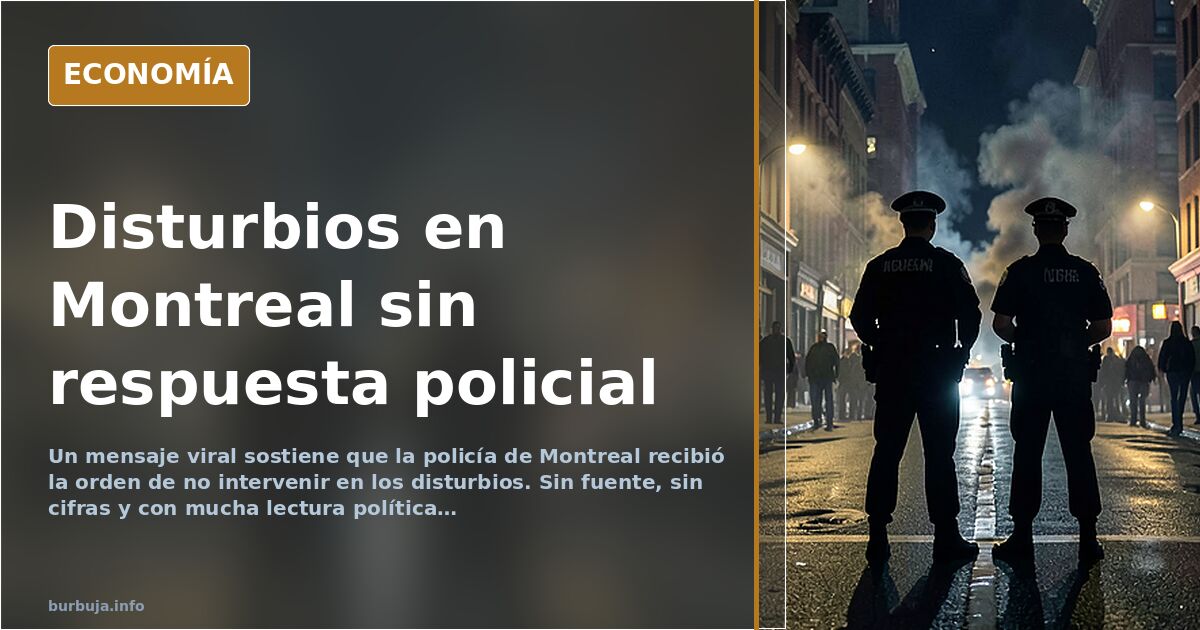
Montreal riots: the stand-down order fueling sabotage theory
Why were Montreal police ordered not to intervene while several neighborhoods were being destroyed? That is the question hanging over the riots that, according to the account, have shaken the Canadian city in recent days. The story circulating is blunt: left-wing extremists and their pro-Palestinian allies would be behind the destruction, and Canada's left-leaning government would have issued the order not to act. The scene, according to those trinc the matter, repeats itself with governments' acquiescence while security forces do nothing.
The comparison with France is immediate. Riots have been seen there too and, as in Montreal, it is pointed out that not a single national flag is flying. Only foreign flags. That detail, which may seem minor, becomes the thread to pull when questioning the official version: if the protests are spontaneous, why are police given orders not to intervene? And why are the symbols on display not those of the country hosting them?
The pattern repeating across several cities
The coincidence of riots in different parts of the West does not go unnoticed. It is argued that it is no accident that simultaneous demonstrations are taking place in several countries and that in all of them the police have the same instruction: do not intervene. That synchrony fuels suspicion of coordination that goes beyond local grievances. Some compare it to a pre-written script, as if someone were pulling the strings from above.
The parallel with France is reinforced by another element: the absence of national symbols. In both cases, it is stressed that protesters do not carry the flag of the country where they are protesting, but other banners. That detail is interpreted as a sign that the conflict is not internal but imported, and that local authorities are acting with a passivity that would be inexplicable without a directive from above.
The sabotage theory gains ground among those observing the pattern. This would not be a failed state, but a sabotaged one: someone deliberately provokes chaos in order to later justify control measures. That is the hypothesis being floated in some circles, and it fits with the idea that general disorder is being sought to allow the imposition of repression policies and curfews.
What lies behind the stand-down order?
The stand-down order is the most disturbing element. If police are instructed to stand aside while neighborhoods are destroyed, the unavoidable question is who gives that order and for what purpose. The claim is that Canada's left-wing government would be using extremists to create a problem that later justifies an authoritarian response. It is the old tactic of controlled chaos.
On the economic undercurrent, some analyses argue that the goal is to create a multicultural dystopia that allows the destruction of European wages and labor markets, with semi-slave labor. In other words, chaos would not be an end in itself, but a means to transform the economic and social model. That reading fits with the idea that elites use instability to reconfigure the system in their favor.
The coincidence with the general strike called in Spain is pointed out as another suspicious element. Why now? The question hangs in the air, unanswered, but with the implication that the timing is no accident.
The role of the left and the official narrative
Canada's government is left-wing, and that is used to explain the police passivity. The argument is that the proge left is fired up and mobilized, and that the riots are part of a political strategy. The connection with the pro-Palestinian movement is made without nuance: the Sarracinist-jihadist allies would be acting as shock troops.
However, not all analyses agree. Some argue that it is actually the right that kneels before Sarracinism, inverting the argument. It is a minority view, but it introduces an element of debate that prevents closing the matter with a single explanation.
The masses, meanwhile, will keep thinking it is all coincidence. That is the ironic conclusion hanging over it all: people do not want to see the problem, and prefer to attribute the riots to spontaneous causes rather than accept that a hand is directing them.
In the end, the question remains unanswered: who gave the order not to intervene in Montreal? Until someone clarifies it, the sabotage theory will keep gaining traction. And meanwhile, the neighborhoods are being rebuilt and foreign flags keep flying.
Also available in: Deutsch
Summary of a discussion on Burbuja.info - Foro de economía, actualidad y política., translated from Spanish and reviewed before publication. Read the full discussion (54 replies).
More summaries
-
Police Union Denounces Political Interference in Cycling Race, Demands Resignations
JUPOL, a majority union for the National Police, claims political orders led to the suspension of a cycling stage and calls for the resignations of top government officials.
-
Student protests in France: Pink Panther outwits police water cannon
A post on X shows a costumed protester dodging a police water jet. The gesture goes viral amid France's wave of student unrest.
-
France riots: home invasions fuel civil war debate
Riots in France: home invasions and the debate over whether this is the start of a civil war. An analysis of impunity and the collapse of public order.
-
Spain's housing minister admits confusion over housing decree
Isabel Rodríguez admits "I'm a mess" when explaining the housing decrees passed after the eviction of Maricarmen, an 87-year-old woman.
-
Iberism returns to the debate: the merger that dissolves Spain
A poll published in the media claims that seven out of ten Portuguese support the union, but Iberism would mean dissolving Spain and Portugal into a…
-
Iberia: what if Spain and Portugal became a single state?
A debate raises the idea of a merger between Spain and Portugal: one user calculates an average unemployment rate of 12.6%, compared with Portugal's 6% and Spain's 14%.