
Police Union Denounces Political Interference in Cycling Race, Demands Resignations
JUPOL, a majority union for the National Police, claims political orders led to the suspension of a cycling stage and calls for the resignations of top government officials.
English · Original discussion in Spanish · Published
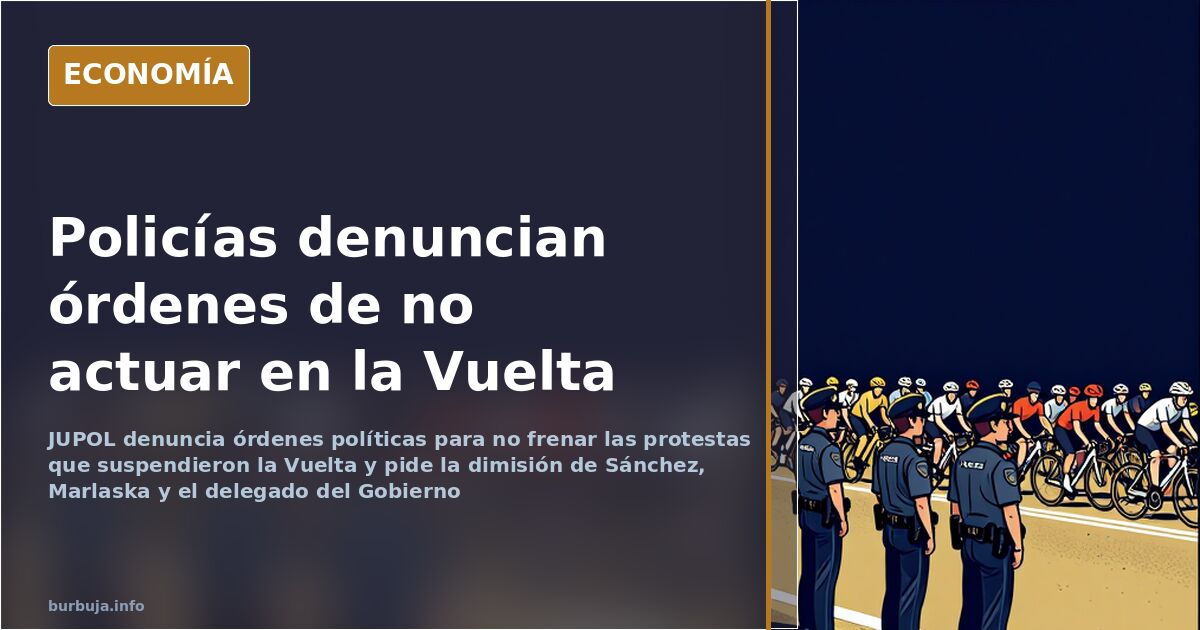
JUPOL Calls for Resignations of Sánchez, Marlaska, and Government Delegate
The majority union for the National Police maintains that the final stage of the Vuelta a España was lost due to a political decision, not a lack of resources. JUPOL alleges there was an "order not to act" while pro-Palestinian protests spread through the Paseo de la Castellana on Sunday, September 14th, and has demanded the resignation of President Pedro Sánchez, Interior Minister Fernando Grande-Marlaska, and the Government Delegate in Madrid, Francisco Martín. The official toll: 22 officers injured and one stage suspended.
What JUPOL Denounces About the Vuelta Operation
The union's accusation rests on three points. First, the withdrawal. JUPOL states that images show officers leaving in formation, with their backs to the protesters at the peak of tension, as fences fell and a public security issue arose. "We never turn our backs on a conflict," state sources from the organization.
Second, equipment. Riot police could not deploy their protective gear in time because, according to the union, authorization came too late. Third, staffing levels: contrary to the official narrative, JUPOL asserts that the operation was "clearly insufficient" for a scenario that had been escalating stage by stage. The race had seen weeks of protests, with Madrid being the anticipated finale.
Marlaska Defends Operation: "Absolutely Sufficient"
The Interior Minister appeared on Monday with a scaling argument: the deployment in Madrid was comparable to that of the 2022 NATO Conference. "Absolutely sufficient," he stated. Marlaska congratulated the security forces for managing a "complex" situation with proportionality and focused on the injured officers, wishing them a speedy recovery. Similarly, the Government Delegate argued that the incidents were "very isolated" and were resolved "effectively."
There's a detail that mars the comparison. The NATO summit was planned months in advance with a closed perimeter; a cycling race on public streets, with mobile protesters, presents a different kind of challenge. The Executive has not explained why the 2025 operation should replicate that of 2022 beyond the coincidental venue.
The Unoccupied Post and the Chain of Command
JUPOL has requested the identification of the police official responsible for the operation. This is not arbitrary: the position of Head of Public Security in Madrid was vacant because the designated person had not yet taken office. In other words, the highest technical command of the operation was not appointed when the event began.
This fits with what police associations have been saying for years: political leadership makes decisions on operational matters that fall under technical command. The discussion is not new, but the Vuelta has given it a huge spotlight and a deadline.
From Union Complaint to Political Battle
The reaction to the statement outlines two camps that barely agree on the facts. One sector views the complaint as confirmation that the Government prioritized the image of the protests over public order, linking it to Sánchez's statement on Saturday expressing "admiration for a people like the Spanish who mobilize for just causes like that of Palestine." According to this interpretation, the message sent to the streets was that it was not the time to intervene forcefully. This narrative has even cited reports linking groups banned in other countries with the boycott organizers, a claim not yet confirmed by any judicial body.
The other sector questions the source before addressing the substance. JUPOL, they recall, is a union with known political leanings, and its version does not represent all officers. It's also emphasized that a union does not speak for an entire collective, even if it's the majority: extrapolating its statement to "the police" is, for this current, a journalistic shortcut.
Caught in the middle is an uncomfortable fact for everyone. If the operation was sufficient, why were there 22 injured? And if it was insufficient, who decided not to reinforce it?
Why Is a Police Union Being Politicized?
The fundamental objection concerns representativeness. In the latest union elections for the force, some voices point out, JUPOL received similar support to other organizations, which qualifies the headline "the police denounce." This is not a minor detail: it turns a labor dispute into a bloc conflict.
At the same time, denying a voice to a majority union because of its political line has its own trap. If a collective is only credible when it aligns with the listener, any internal complaint is preemptively dismissed. The result is a police force used as a battering ram by some and discredited by others according to the day's script.
What Could Happen Next With the Vuelta and the Operation
The resignations JUPOL is demanding will not happen: no minister resigns over a union's statement. It's likely the issue will move to a parliamentary question, a commission, or an internal report that won't be fully released. The outcome, most probably, will be written not in the courts but in the next televised spat.
One unanswered question remains, the one that truly matters and no one has answered: was there an order not to act, or was there simply a chain of command without an appointed leader? These are two distinct, both negative, explanations, and the Government has yet to choose which to defend. If the pattern repeats at the next major cycling event, the cost will not be borne by just one stage.
The majority union for the National Police maintains that the final stage of the Vuelta a España was lost due to a political decision, not a lack of resources. JUPOL alleges there was an "order not to act" while pro-Palestinian protests spread through the Paseo de la Castellana on Sunday, September 14th, and has demanded the resignation of President Pedro Sánchez, Interior Minister Fernando Grande-Marlaska, and the Government Delegate in Madrid, Francisco Martín. The official toll: 22 officers injured and one stage suspended.
What JUPOL Denounces About the Vuelta Operation
The union's accusation rests on three points. First, the withdrawal. JUPOL states that images show officers leaving in formation, with their backs to the protesters at the peak of tension, as fences fell and a public security issue arose. "We never turn our backs on a conflict," state sources from the organization.
Second, equipment. Riot police could not deploy their protective gear in time because, according to the union, authorization came too late. Third, staffing levels: contrary to the official narrative, JUPOL asserts that the operation was "clearly insufficient" for a scenario that had been escalating stage by stage. The race had seen weeks of protests, with Madrid being the anticipated finale.
Marlaska Defends Operation: "Absolutely Sufficient"
The Interior Minister appeared on Monday with a scaling argument: the deployment in Madrid was comparable to that of the 2022 NATO Conference. "Absolutely sufficient," he stated. Marlaska congratulated the security forces for managing a "complex" situation with proportionality and focused on the injured officers, wishing them a speedy recovery. Similarly, the Government Delegate argued that the incidents were "very isolated" and were resolved "effectively."
There's a detail that mars the comparison. The NATO summit was planned months in advance with a closed perimeter; a cycling race on public streets, with mobile protesters, presents a different kind of challenge. The Executive has not explained why the 2025 operation should replicate that of 2022 beyond the coincidental venue.
The Unoccupied Post and the Chain of Command
JUPOL has requested the identification of the police official responsible for the operation. This is not arbitrary: the position of Head of Public Security in Madrid was vacant because the designated person had not yet taken office. In other words, the highest technical command of the operation was not appointed when the event began.
This fits with what police associations have been saying for years: political leadership makes decisions on operational matters that fall under technical command. The discussion is not new, but the Vuelta has given it a huge spotlight and a deadline.
From Union Complaint to Political Battle
The reaction to the statement outlines two camps that barely agree on the facts. One sector views the complaint as confirmation that the Government prioritized the image of the protests over public order, linking it to Sánchez's statement on Saturday expressing "admiration for a people like the Spanish who mobilize for just causes like that of Palestine." According to this interpretation, the message sent to the streets was that it was not the time to intervene forcefully. This narrative has even cited reports linking groups banned in other countries with the boycott organizers, a claim not yet confirmed by any judicial body.
The other sector questions the source before addressing the substance. JUPOL, they recall, is a union with known political leanings, and its version does not represent all officers. It's also emphasized that a union does not speak for an entire collective, even if it's the majority: extrapolating its statement to "the police" is, for this current, a journalistic shortcut.
Caught in the middle is an uncomfortable fact for everyone. If the operation was sufficient, why were there 22 injured? And if it was insufficient, who decided not to reinforce it?
Why Is a Police Union Being Politicized?
The fundamental objection concerns representativeness. In the latest union elections for the force, some voices point out, JUPOL received similar support to other organizations, which qualifies the headline "the police denounce." This is not a minor detail: it turns a labor dispute into a bloc conflict.
At the same time, denying a voice to a majority union because of its political line has its own trap. If a collective is only credible when it aligns with the listener, any internal complaint is preemptively dismissed. The result is a police force used as a battering ram by some and discredited by others according to the day's script.
What Could Happen Next With the Vuelta and the Operation
The resignations JUPOL is demanding will not happen: no minister resigns over a union's statement. It's likely the issue will move to a parliamentary question, a commission, or an internal report that won't be fully released. The outcome, most probably, will be written not in the courts but in the next televised spat.
One unanswered question remains, the one that truly matters and no one has answered: was there an order not to act, or was there simply a chain of command without an appointed leader? These are two distinct, both negative, explanations, and the Government has yet to choose which to defend. If the pattern repeats at the next major cycling event, the cost will not be borne by just one stage.
Summary of a discussion on Burbuja.info - Foro de economía, actualidad y política., translated from Spanish and reviewed before publication. Read the full discussion (298 replies).
More summaries
-
The Destiny of Retirement: A Quiet Withdrawal or Necessary Exile?
The search for retirement following an intense political career reveals a wide spectrum of choices, ranging from peaceful rural withdrawal to international exile.
-
Supreme Court Halts Electoral Registry for 'Grandchild Law' Nationals
The Supreme Court has suspended inscriptions in the electoral census of those naturalized under the 'grandchild law.' Over 400,000 applications are now suspended.
-
Euthanasia in Old Age: Autonomy vs. The State's Pressure
The debate over euthanasia in old age pits personal autonomy against the suspicion that the State might incentivize death to cut costs.
-
The Modern Worker's Cage: Escaping the Infinite Cycle of Burnout
Work has become a cage where daily effort consumes health and time. Discover why we push ourselves so hard and how to break the cycle.
-
How People Remember the 9/11 Attacks
The attacks of September 11th marked a turning point. Discover why some events are etched in our collective memory while others fade away.
-
Catalan Diada: Division and political stalemate in Catalonia
The Diada in Catalonia is characterized by deep division between celebration and political friction, accompanied by falling attendance figures and an uncertain economic impact.