
Montejaque Dam: Abandoned Since 1924, Now Overflowing
The Montejaque dam in Spain, neglected since 1924 and built on karst terrain, spills for the first time via siphons at 200 m³/s.
English · Original discussion in Spanish · Published
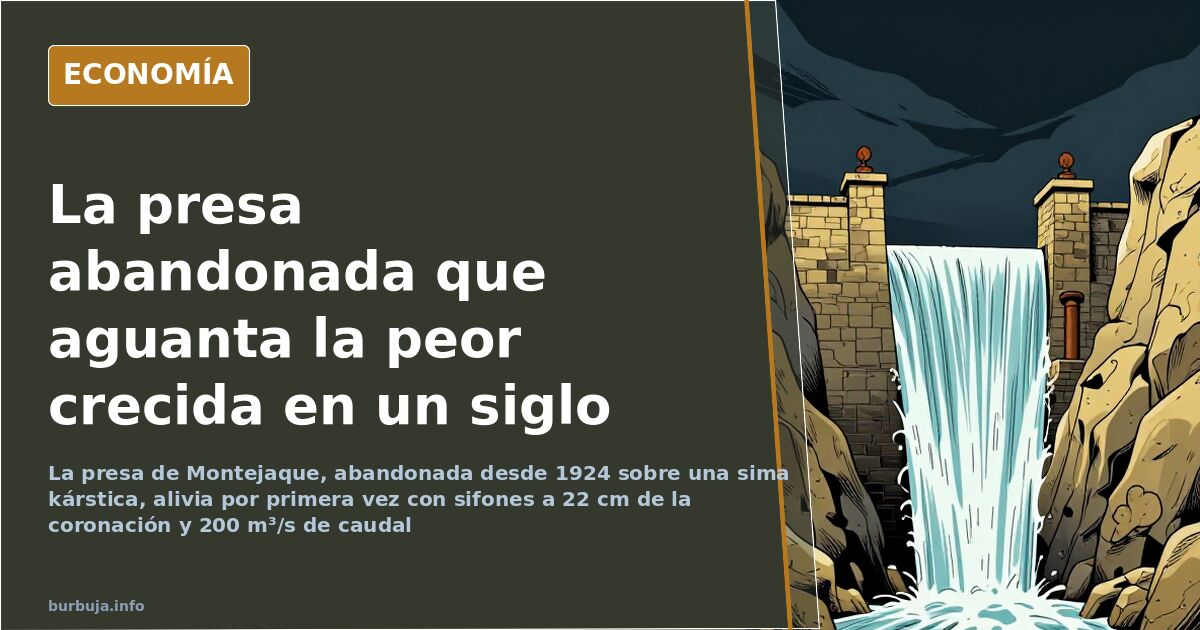
Montejaque Dam, Unmaintained Since 1924, Overflows for First Time
The Los Caballeros dam in Montejaque (Málaga) has reached capacity for the first time since its completion in 1924. It is discharging approximately 200 cubic meters per second through relief siphons primed just 22 centimeters below the crest, according to field data. The reservoir was built over a large karst sinkhole: water typically filters into the ground within days, which is why it never overflowed before. Until now.
The province has experienced record-breaking rainfall since December. Grazalema has broken its historical records for January, February, and monthly precipitation, and the dam sits on the eastern slope of this massif. With saturated soil, filtration can no longer keep up, and water began escaping over the top.
What Is the Montejaque Dam and Why Was It Empty for a Century?
It is an early 20th-century gravity dam, built during Primo de Rivera’s dictatorship. Its purpose was neither irrigation nor supply: it was designed to attenuate floods and recharge aquifers. A passive structure with no operational gates, its bottom outlet has remained open since abandonment. A hundred years without anyone touching it.
The original flaw was geological. Beneath the basin lies a massive karst sinkhole: water accumulates during heavy rains but disappears through filtration within days. This prevented the dam from functioning as a stable reservoir, leading to its immediate abandonment after construction. The calculation error occurred when applied geology was still in its infancy.
How Do Siphon Spillways Work?
This is not a fixed weir where water simply spills over. They are U-shaped conduits that prime automatically when the level exceeds the inlet mouth: the siphon fills, and nothing exits until the water reaches the throat. Once primed, it discharges continuously until the level drops below the activation point.
Initial confusion stemmed from this. For days, the spillway crest appeared above the dam, leading people to assume the lip was submerged. That was incorrect: it was a siphon system that had never needed to prove it worked. Opening Tutankhamun’s tomb and riding out in the pharaoh’s chariot, graphically summarized one comment on the state of hydraulic heritage.
The Real Risk: Overflowing Is Not Collapsing
It is important to distinguish two easily confused scenarios. If the dam overflows, the downstream channel carries the natural flow it would have had without the dam: the sum of inflows. If the dam collapses, all accumulated hectometers are released suddenly, causing devastation.
Prudent analysis suggests that ground porosity is saving the day: water escapes through nearby rocks due to basin pressure. The pessimistic scenario assumes aquifers saturate and the water table stops absorbing more. No one guarantees safety there. Pressures on a century-old gravity wall with potential internal cracks increase, and maintenance never performed cannot be improvised in a week.
Cueva del Gato and the Hidden Flow
Downstream, Cueva del Gato has begun releasing water at unusual volumes. This is logical: if the dam did not exist, this would be the flow from torrential rain episodes. The dam has been attenuating floods and recharging aquifers for a century unnoticed, and now that it is working, no one knows if it will hold.
Comparisons with other Andalusian reservoirs clarify the situation. Guadalcacín II in Cádiz, with nearly 1,000 hectometer capacity, has never filled since its 1990 inauguration. Montejaque, with infinitely smaller capacity, is at its limit. The problem is not drought: Spanish hydraulic infrastructure has lacked planning and maintenance for decades.
The Recurring Pattern: Public Works Without Conservation
This case fits into broader discussions on managing built heritage. Structures were built to last, but maintenance is another matter. The bottom valve likely hasn’t been touched in decades, and the spillway had to demonstrate functionality in its first real test since 1924. It is not a failure by the designing engineer: it is a symptom of administration allowing decay.
Some argue the solution is orderly demolition given current geological knowledge. Opponents note the dam performs actual flood attenuation and recharge functions, and collapse would be worse than overflow. The analysis stalls here: no one knows how much pressure an unmaintained century-old wall withstands, leaving only waiting for levels to drop.
The Los Caballeros dam in Montejaque (Málaga) has reached capacity for the first time since its completion in 1924. It is discharging approximately 200 cubic meters per second through relief siphons primed just 22 centimeters below the crest, according to field data. The reservoir was built over a large karst sinkhole: water typically filters into the ground within days, which is why it never overflowed before. Until now.
The province has experienced record-breaking rainfall since December. Grazalema has broken its historical records for January, February, and monthly precipitation, and the dam sits on the eastern slope of this massif. With saturated soil, filtration can no longer keep up, and water began escaping over the top.
What Is the Montejaque Dam and Why Was It Empty for a Century?
It is an early 20th-century gravity dam, built during Primo de Rivera’s dictatorship. Its purpose was neither irrigation nor supply: it was designed to attenuate floods and recharge aquifers. A passive structure with no operational gates, its bottom outlet has remained open since abandonment. A hundred years without anyone touching it.
The original flaw was geological. Beneath the basin lies a massive karst sinkhole: water accumulates during heavy rains but disappears through filtration within days. This prevented the dam from functioning as a stable reservoir, leading to its immediate abandonment after construction. The calculation error occurred when applied geology was still in its infancy.
How Do Siphon Spillways Work?
This is not a fixed weir where water simply spills over. They are U-shaped conduits that prime automatically when the level exceeds the inlet mouth: the siphon fills, and nothing exits until the water reaches the throat. Once primed, it discharges continuously until the level drops below the activation point.
Initial confusion stemmed from this. For days, the spillway crest appeared above the dam, leading people to assume the lip was submerged. That was incorrect: it was a siphon system that had never needed to prove it worked. Opening Tutankhamun’s tomb and riding out in the pharaoh’s chariot, graphically summarized one comment on the state of hydraulic heritage.
The Real Risk: Overflowing Is Not Collapsing
It is important to distinguish two easily confused scenarios. If the dam overflows, the downstream channel carries the natural flow it would have had without the dam: the sum of inflows. If the dam collapses, all accumulated hectometers are released suddenly, causing devastation.
Prudent analysis suggests that ground porosity is saving the day: water escapes through nearby rocks due to basin pressure. The pessimistic scenario assumes aquifers saturate and the water table stops absorbing more. No one guarantees safety there. Pressures on a century-old gravity wall with potential internal cracks increase, and maintenance never performed cannot be improvised in a week.
Cueva del Gato and the Hidden Flow
Downstream, Cueva del Gato has begun releasing water at unusual volumes. This is logical: if the dam did not exist, this would be the flow from torrential rain episodes. The dam has been attenuating floods and recharging aquifers for a century unnoticed, and now that it is working, no one knows if it will hold.
Comparisons with other Andalusian reservoirs clarify the situation. Guadalcacín II in Cádiz, with nearly 1,000 hectometer capacity, has never filled since its 1990 inauguration. Montejaque, with infinitely smaller capacity, is at its limit. The problem is not drought: Spanish hydraulic infrastructure has lacked planning and maintenance for decades.
The Recurring Pattern: Public Works Without Conservation
This case fits into broader discussions on managing built heritage. Structures were built to last, but maintenance is another matter. The bottom valve likely hasn’t been touched in decades, and the spillway had to demonstrate functionality in its first real test since 1924. It is not a failure by the designing engineer: it is a symptom of administration allowing decay.
Some argue the solution is orderly demolition given current geological knowledge. Opponents note the dam performs actual flood attenuation and recharge functions, and collapse would be worse than overflow. The analysis stalls here: no one knows how much pressure an unmaintained century-old wall withstands, leaving only waiting for levels to drop.
Also available in: Deutsch
Summary of a discussion on Burbuja.info - Foro de economía, actualidad y política., translated from Spanish and reviewed before publication. Read the full discussion (164 replies).
More summaries
-
Comares Dam spills, Benamargosa River floods Axarquía
The Comares Dam overflowed during the DANA storms in Spain's Axarquía region, flooding the Benamargosa River and sparking political debate.
-
Málaga flooded: 772 liters in Turís and the debate over dams
A DANA storm floods Málaga, with Turís recording a historic 772 L/m². The disaster reignites debates over dam management and the 1982 Tous flood.
-
El Jueves targets corruption with a lineup of the usual suspects
El Jueves publishes a corruption-themed cover with eleven figures: mostly PP and two from PSOE. Criticism over imbalance and omissions.
-
Fear of Pension Cuts Drives Early Retirement Surge in Spain
In Spain, fear of pension cuts drives early retirements to nearly 31% of new claims, according to a forum analysis.
-
Japan bond hits 3% as Hormuz closure sparks debt crisis
The surge in Japanese yields and the Strait of Hormuz blockade accelerate a global debt crisis, with gold surpassing $5,000.
-
Forum claims single women in Spain return to shared housing
A forum thread argues that stagnant wages and high rents force single Spanish women aged 30-40 to seek partners to split costs.