
Málaga flooded: 772 liters in Turís and the debate over dams
A DANA storm floods Málaga, with Turís recording a historic 772 L/m². The disaster reignites debates over dam management and the 1982 Tous flood.
English · Original discussion in Spanish · Published
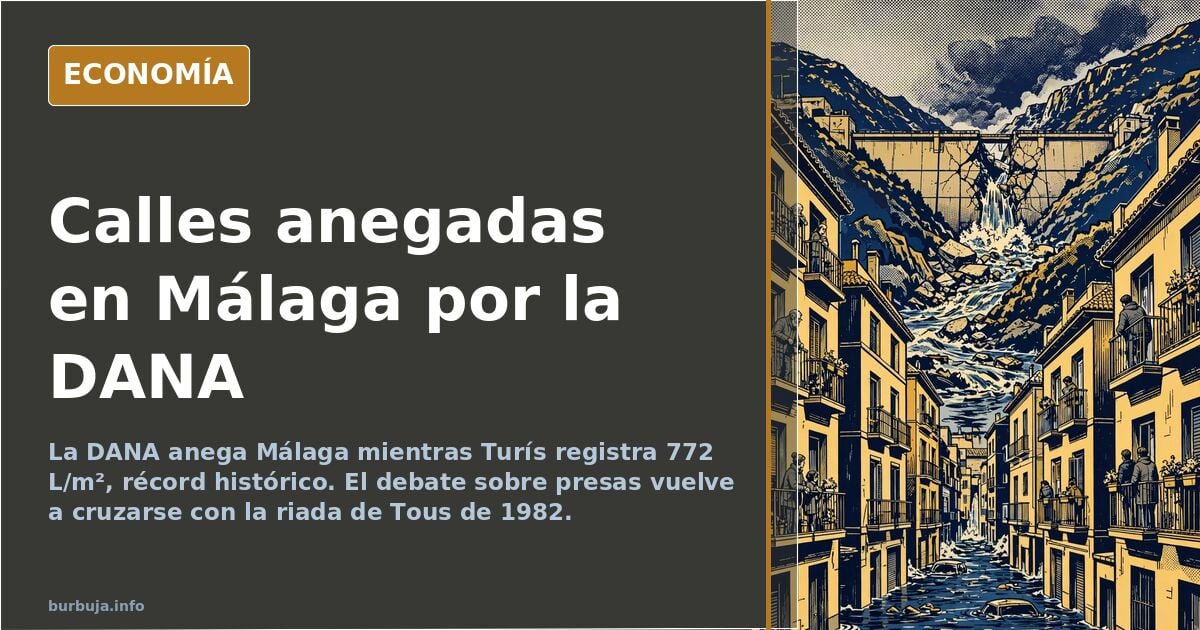
Málaga flooded: 772 liters in Turís and the shadow of dams
Is it the climate or public works? When water enters a city center basement, a hospital, or the ground floor of a department store, an uncomfortable question arises: is it a failure of nature or a failure of the city? The DANA (a high-altitude isolated depression) that flooded Málaga left familiar scenes: streets turned into rivers, submerged garages, and flooded ground floors. Focus shifted to the basement of the capital's Corte Inglés department store, where workers struggled through water, and to the clinical hospital. Flooding was also reported in Ciudad Jardín and near Puerto Banús. No one disputes what is visible; the disagreement lies in the cause.
How much did it rain during this DANA?
The figure driving the discussion is the one cited for Turís, near Chiva: 772 liters per square meter. According to this data, it would break the historical national record, exceeding the 1982 rainfall by nearly 30%, with a peak of up to 185 liters per square meter in a single hour. This wasn't just a morning of rain; it was almost an entire year's worth of precipitation in a single day. With these numbers, the term "torrential" falls short.
The comparison with the Tous dam disaster recurs constantly. According to calculations circulating in the debate, in 1982, up to 600 liters per square meter were recorded and the flood reached 7,500 cubic meters per second, while this time the flow remained between 2,000 and 2,500. Less water running, more water falling from the sky. The arithmetic doesn't add up if one only looks at the rain gauge.
Not everyone sees tragedy in the data. Some argue that with rainfall around 100 liters per square meter in 24 hours in the capital, the balance is "tremendously positive" for aquifers and reservoirs. It is the bright side of a DANA that, from a rural perspective, arrived just in time.
Watch the night. Some warned for hours that a line of severe thunderstorms was heading directly for Málaga. The clock would tell if the city would bury the comparison with Valencia or confirm it.
Why does a department store basement flood?
A basement is, by definition, below the flood level. It sounds like a truism, but it explains almost everything. The El Corte Inglés supermarket in Málaga occupies a basement level, and water seeps through any utility access—electricity, gas, water—as soon as the street becomes a river. Keeping a massive underground surface protected is, in practice, impossible.
Some point out that sewage systems are not designed for such events. Specific, expensive infrastructure that occupies significant space would be needed for something that happens once every 50 years. The uncomfortable conclusion is that the water didn't break down any doors; it found the ones that were already open.
Is Málaga a city vulnerable to flooding?
As one participant noted, the capital is relatively flat, lacking the significant slopes needed to drain water by gravity. Stagnant water does more damage than water running down a hillside. Consequently, a few liters in the wrong place can cause the same havoc as a larger flow in the mountains. Ground-floor garages were once again hit hard.
In the conversation, a dam located just above the city, near the Ciudad Jardín area, was mentioned, with speculation that it might have released a devastating flow without warning. Another participant, however, described a spillway dam located further up near Benamargosa, designed to manage floods and divert water to the Viñuela reservoir: it released water during the flood, and two days later, the riverbed was almost dry, despite rainfall of about 200 liters per square meter in the area. The water left on its own.
Did the river overflow because a dam was peine without warning?
Here, the analysis is split. One current maintains that opening the Forata reservoir caused the Magro river to overflow and flood riverside towns. Conversely, another participant defends that the reservoir went from 13.5% to 100% of its capacity in just two hours, and that with such a margin, draining it slowly wouldn't have changed much, especially since much of the rain fell directly on the municipalities downstream.
There are more conflicting figures cited. There is talk of 73 towns hit by the two floods. In the Magro area, only three or four deaths are reported—one being a heart attack upon hearing of a daughter's death—while the global figure mentioned for Valencia exceeds 200. In 1982, according to those same messages, 40 people died, but only 8 managed to receive compensation after 17 years of litigation. Administrative memory also remains submerged.
Were residents warned in time?
There were warnings. According to one resident, their local council sent a WhatsApp message at 19:37 h, with notifications sent to the towns along the Magro river. Critics say the capital of Málaga was better coordinated than during the previous catastrophe. But a red alert is one thing and an evacuation is another. Warning is not evacuating, and with the Poyo ravine turned into a trap, the distance between the message and the action is measured in lives.
Why is Valencia mentioned so much during a Málaga flood?
Because the two catastrophes are closely linked. The Valencian DANA, centered around Paiporta and the Poyo ravine, left a death toll that, according to the debate, exceeds 200, along with an ongoing controversy regarding warnings. The Málaga event was read as the next chapter: record rainfall, flooded ground floors, and municipal management that, this time, arrived earlier. Comparing the two allows one to see what failed in one and what worked in the other. It also allows for the temptation to mix them conveniently.
Who pays for the flood damage?
The short answer is insurance, which is why it is paid for. The long answer is political. Arguments are made that budgets prefer light rail, promenades, and playgrounds over sewage systems and riverbed cleaning, because visible concrete wins votes while buried pipes are unseen. "Put it in the budget and let the people vote," summarizes this view.
The rest is noise. Claims that all political parties are the same, that climate change explains everything (or the opposite), or theories about felled trees or alleged weather machines. The latter has no more support than usual in these cases: none. The only thing supported by data is that the sky poured like never before and the infrastructure responded as it always does.
In the end, the water eventually receded. Garages had to be emptied, and the controversy, predictably, went down the drain. Until the next DANA, when someone asks once again if it was the sky or the floodgate.
Is it the climate or public works? When water enters a city center basement, a hospital, or the ground floor of a department store, an uncomfortable question arises: is it a failure of nature or a failure of the city? The DANA (a high-altitude isolated depression) that flooded Málaga left familiar scenes: streets turned into rivers, submerged garages, and flooded ground floors. Focus shifted to the basement of the capital's Corte Inglés department store, where workers struggled through water, and to the clinical hospital. Flooding was also reported in Ciudad Jardín and near Puerto Banús. No one disputes what is visible; the disagreement lies in the cause.
How much did it rain during this DANA?
The figure driving the discussion is the one cited for Turís, near Chiva: 772 liters per square meter. According to this data, it would break the historical national record, exceeding the 1982 rainfall by nearly 30%, with a peak of up to 185 liters per square meter in a single hour. This wasn't just a morning of rain; it was almost an entire year's worth of precipitation in a single day. With these numbers, the term "torrential" falls short.
The comparison with the Tous dam disaster recurs constantly. According to calculations circulating in the debate, in 1982, up to 600 liters per square meter were recorded and the flood reached 7,500 cubic meters per second, while this time the flow remained between 2,000 and 2,500. Less water running, more water falling from the sky. The arithmetic doesn't add up if one only looks at the rain gauge.
Not everyone sees tragedy in the data. Some argue that with rainfall around 100 liters per square meter in 24 hours in the capital, the balance is "tremendously positive" for aquifers and reservoirs. It is the bright side of a DANA that, from a rural perspective, arrived just in time.
Watch the night. Some warned for hours that a line of severe thunderstorms was heading directly for Málaga. The clock would tell if the city would bury the comparison with Valencia or confirm it.
Why does a department store basement flood?
A basement is, by definition, below the flood level. It sounds like a truism, but it explains almost everything. The El Corte Inglés supermarket in Málaga occupies a basement level, and water seeps through any utility access—electricity, gas, water—as soon as the street becomes a river. Keeping a massive underground surface protected is, in practice, impossible.
Some point out that sewage systems are not designed for such events. Specific, expensive infrastructure that occupies significant space would be needed for something that happens once every 50 years. The uncomfortable conclusion is that the water didn't break down any doors; it found the ones that were already open.
Is Málaga a city vulnerable to flooding?
As one participant noted, the capital is relatively flat, lacking the significant slopes needed to drain water by gravity. Stagnant water does more damage than water running down a hillside. Consequently, a few liters in the wrong place can cause the same havoc as a larger flow in the mountains. Ground-floor garages were once again hit hard.
In the conversation, a dam located just above the city, near the Ciudad Jardín area, was mentioned, with speculation that it might have released a devastating flow without warning. Another participant, however, described a spillway dam located further up near Benamargosa, designed to manage floods and divert water to the Viñuela reservoir: it released water during the flood, and two days later, the riverbed was almost dry, despite rainfall of about 200 liters per square meter in the area. The water left on its own.
Did the river overflow because a dam was peine without warning?
Here, the analysis is split. One current maintains that opening the Forata reservoir caused the Magro river to overflow and flood riverside towns. Conversely, another participant defends that the reservoir went from 13.5% to 100% of its capacity in just two hours, and that with such a margin, draining it slowly wouldn't have changed much, especially since much of the rain fell directly on the municipalities downstream.
There are more conflicting figures cited. There is talk of 73 towns hit by the two floods. In the Magro area, only three or four deaths are reported—one being a heart attack upon hearing of a daughter's death—while the global figure mentioned for Valencia exceeds 200. In 1982, according to those same messages, 40 people died, but only 8 managed to receive compensation after 17 years of litigation. Administrative memory also remains submerged.
Were residents warned in time?
There were warnings. According to one resident, their local council sent a WhatsApp message at 19:37 h, with notifications sent to the towns along the Magro river. Critics say the capital of Málaga was better coordinated than during the previous catastrophe. But a red alert is one thing and an evacuation is another. Warning is not evacuating, and with the Poyo ravine turned into a trap, the distance between the message and the action is measured in lives.
Why is Valencia mentioned so much during a Málaga flood?
Because the two catastrophes are closely linked. The Valencian DANA, centered around Paiporta and the Poyo ravine, left a death toll that, according to the debate, exceeds 200, along with an ongoing controversy regarding warnings. The Málaga event was read as the next chapter: record rainfall, flooded ground floors, and municipal management that, this time, arrived earlier. Comparing the two allows one to see what failed in one and what worked in the other. It also allows for the temptation to mix them conveniently.
Who pays for the flood damage?
The short answer is insurance, which is why it is paid for. The long answer is political. Arguments are made that budgets prefer light rail, promenades, and playgrounds over sewage systems and riverbed cleaning, because visible concrete wins votes while buried pipes are unseen. "Put it in the budget and let the people vote," summarizes this view.
The rest is noise. Claims that all political parties are the same, that climate change explains everything (or the opposite), or theories about felled trees or alleged weather machines. The latter has no more support than usual in these cases: none. The only thing supported by data is that the sky poured like never before and the infrastructure responded as it always does.
In the end, the water eventually receded. Garages had to be emptied, and the controversy, predictably, went down the drain. Until the next DANA, when someone asks once again if it was the sky or the floodgate.
Also available in: Deutsch
Summary of a discussion on Burbuja.info - Foro de economía, actualidad y política., translated from Spanish and reviewed before publication. Read the full discussion (502 replies).
More summaries
-
Málaga no es ya para los malagueños: la huida de los locales
Mass tourism is pushing Málaga's residents out of the city center. Prices are soaring and local identity is fading. Who holds the blame?
-
A user: ‘In 2021, I was offered less than in 1995’
A professional was offered less in 2021 than he earned in 1995, sparking debate over hiring over-40s and stagnant pay.
-
Riots in French schools: fires and attacks
Fires in French schools, teachers attacked and blockades spreading to Belgium. The unrest is attributed to the education strike and radical groups.
-
Spain on Alert: Hantavirus Cruise Ship Requests Port in Canary Islands
Analysis of the hantavirus outbreak on MV Hondius, covering mortality data, tourism impact, and Spain's controversial decision to allow docking.
-
Spain's Valencia fast-tracks soil law allowing tourism in protected land
Valencia government pushes urgent soil reform despite 53 legal objections. Community Interest Declarations become permanent.
-
Rufián: The Spanish MP Without a Political Home
Speculation surrounds Gabriel Rufián's future in Spain as ERC declines and no clear path emerges for the independentist MP.