
Monothematic accounts fuel suspicion of organized polarization in online forums
Suspicion grows that bots and monothematic accounts are driving coordinated polarization in international discussion forums.
English · Original discussion in Spanish · Published
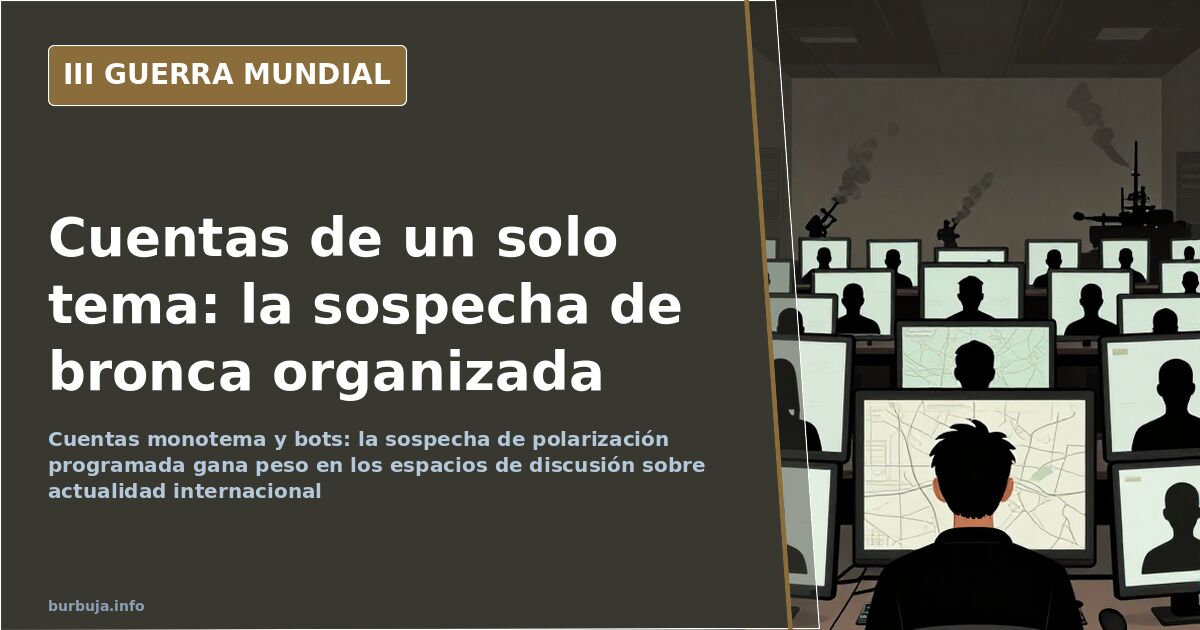
Single-topic accounts and continuous activity: suspicion of organized provocation
For many participants, polarization in digital discussion spaces is not spontaneous; some argue it is a manufactured product. In one international current-affairs forum, the suspicion that accounts created or reactivated for one purpose—to provoke—has moved from loose comment to central thesis in a conversation exceeding hundreds of replies. No one has shown contracts, invoices, or instructions. The pattern described, however, is concrete: new or very old records with few messages, activity at all hours, a single subject and no concessions.
What is a monothematic account and how to spot it
The circulating definition is simple: one that only talks about one subject and always from the same angle. Those trinc current affairs usually alternate topics, doubt, concede a point, or change their mind in light of new data. That account does not. On NATO, Ukraine, or Israel, it repeats the same talking points and disappears when the issue fades. It does not seek to convince: it seeks to occupy space, make noise, and drown out others. The most repeated comparison in the analysis is that of an obsessed person with a single truth: you can debate them with fallacious arguments, but you can never get them out of it.
A antiestéticature repeats in almost all descriptions: lack of argumentation and excess of disqualification. Whereas some provide figures, sources, or personal experience, the single-topic account responds with labels. And when someone detects a place where others mildly agree with their thesis, they flock there to proselytize and compete to be the purest, the most radical, the most dogmatic.
Pandemic, Ukraine, and the Middle East: three waves of noise
The surge is not located in a single moment. One stream dates it to the health crisis, when the derogatory label against those who did not embrace the dominant narrative became widespread. Another points to the war in Ukraine as the qualitative leap: there, accounts that only dealt with the conflict and never any other related issue appeared, with explicit images and no prior warning. With the reactivation of the Middle East, profiles that had been inactive for some time moved again.
The underlying diagnosis, according to one participant, does not depend on the episode: there is more friction than ten years ago and much more than before the 2008 real estate bubble. What is debated is whether this is a societal drift or organized work. The digital mechanics, some point out, help: a world of ones and zeros in which equidistance does not count and everything is sorted into two camps.
How many accounts can one person move?
Here, figures are estimates, not audits. The calculation circulates that a community manager can control up to 50 profiles in a single discussion space and that in large social networks the figure reaches 1,500 per professional. That a profile is new, or old with few messages, proves nothing by itself: what matters is the combination with monothematic content and availability at all hours.
The conclusion drawn is uncomfortable for the scale of the problem: the volume of noise needed to derail a conversation is within reach of very few hands. And it explains why, when the issue changes, the personnel changes with it.
Blocking helps, but does not clear the ground
The most used tool is blocking. A personal count illustrates it: more than 300 accounts blocked, none for disagreeing and all for trolling. Others defend it as an essential filter without which the time invested is not worth it. Against that, the objection is that covering up solves nothing: those who should intervene hold back, the problem continues to operate, and the blocker puts on blinders.
Several voices contend that moderation appears when convenient and disappears when the person flagged is useful, and even that copies of content are removed while leaving the originals intact. This is an unproven allegation with cross-accusations in between. The only verifiable result is the sense of impunity of those who only come to light the fuse.
Who benefits from the noise
More interaction is a better metric, and noise produces it. That is the perverse incentive pointed out: hate prevents dialogue, lack of dialogue prevents understanding, and disunity does the rest. The cost is paid by those who brought useful information, who get tired and leave, and by topics worked with effort, which sink to the bottom in minutes while the provocation stays on top.
The opposing reading also has defenders. Polarization is social, not just digital, and there have always been obsessed people with a single truth for whom a small town would have served as an audience. The medium changes, not the species.
The pattern is described; the evidence, for now, does not appear. If the trend continues as described so far, one can expect that noise will grow with each new international episode and that useful conversation will take refuge in small circles. One can also expect that it will not be so: no one has yet proved who pays the bill.
For many participants, polarization in digital discussion spaces is not spontaneous; some argue it is a manufactured product. In one international current-affairs forum, the suspicion that accounts created or reactivated for one purpose—to provoke—has moved from loose comment to central thesis in a conversation exceeding hundreds of replies. No one has shown contracts, invoices, or instructions. The pattern described, however, is concrete: new or very old records with few messages, activity at all hours, a single subject and no concessions.
What is a monothematic account and how to spot it
The circulating definition is simple: one that only talks about one subject and always from the same angle. Those trinc current affairs usually alternate topics, doubt, concede a point, or change their mind in light of new data. That account does not. On NATO, Ukraine, or Israel, it repeats the same talking points and disappears when the issue fades. It does not seek to convince: it seeks to occupy space, make noise, and drown out others. The most repeated comparison in the analysis is that of an obsessed person with a single truth: you can debate them with fallacious arguments, but you can never get them out of it.
A antiestéticature repeats in almost all descriptions: lack of argumentation and excess of disqualification. Whereas some provide figures, sources, or personal experience, the single-topic account responds with labels. And when someone detects a place where others mildly agree with their thesis, they flock there to proselytize and compete to be the purest, the most radical, the most dogmatic.
Pandemic, Ukraine, and the Middle East: three waves of noise
The surge is not located in a single moment. One stream dates it to the health crisis, when the derogatory label against those who did not embrace the dominant narrative became widespread. Another points to the war in Ukraine as the qualitative leap: there, accounts that only dealt with the conflict and never any other related issue appeared, with explicit images and no prior warning. With the reactivation of the Middle East, profiles that had been inactive for some time moved again.
The underlying diagnosis, according to one participant, does not depend on the episode: there is more friction than ten years ago and much more than before the 2008 real estate bubble. What is debated is whether this is a societal drift or organized work. The digital mechanics, some point out, help: a world of ones and zeros in which equidistance does not count and everything is sorted into two camps.
How many accounts can one person move?
Here, figures are estimates, not audits. The calculation circulates that a community manager can control up to 50 profiles in a single discussion space and that in large social networks the figure reaches 1,500 per professional. That a profile is new, or old with few messages, proves nothing by itself: what matters is the combination with monothematic content and availability at all hours.
The conclusion drawn is uncomfortable for the scale of the problem: the volume of noise needed to derail a conversation is within reach of very few hands. And it explains why, when the issue changes, the personnel changes with it.
Blocking helps, but does not clear the ground
The most used tool is blocking. A personal count illustrates it: more than 300 accounts blocked, none for disagreeing and all for trolling. Others defend it as an essential filter without which the time invested is not worth it. Against that, the objection is that covering up solves nothing: those who should intervene hold back, the problem continues to operate, and the blocker puts on blinders.
Several voices contend that moderation appears when convenient and disappears when the person flagged is useful, and even that copies of content are removed while leaving the originals intact. This is an unproven allegation with cross-accusations in between. The only verifiable result is the sense of impunity of those who only come to light the fuse.
Who benefits from the noise
More interaction is a better metric, and noise produces it. That is the perverse incentive pointed out: hate prevents dialogue, lack of dialogue prevents understanding, and disunity does the rest. The cost is paid by those who brought useful information, who get tired and leave, and by topics worked with effort, which sink to the bottom in minutes while the provocation stays on top.
The opposing reading also has defenders. Polarization is social, not just digital, and there have always been obsessed people with a single truth for whom a small town would have served as an audience. The medium changes, not the species.
The pattern is described; the evidence, for now, does not appear. If the trend continues as described so far, one can expect that noise will grow with each new international episode and that useful conversation will take refuge in small circles. One can also expect that it will not be so: no one has yet proved who pays the bill.
Also available in: Deutsch
Summary of a discussion on Burbuja.info - Foro de economía, actualidad y política., translated from Spanish and reviewed before publication. Read the full discussion (402 replies).
More summaries
-
Bot Farms and False Flags Fuel Ukraine Disinformation War
Analysis of claims that NATO, US, Israel, and Ukraine use bot farms to spread disinformation in the Ukraine war.
-
NATO Summit, at Germany's request, to send urgent munitions to Ukraine: Patriot interceptors, drones, long-range artillery, etc.
Germany leads urgent munition shipment to Ukraine: Patriot missiles, drones, and artillery. NATO reinforces Ukrainian defense.
-
Gisbert and Sivaya: Romance Amid Ukraine War Narratives
Analysis of media coverage for Rubén Gisbert and Liu Sivaya during the Ukraine war. Is this digital propaganda or reality?
-
Putin's Fall Predictions Fail After Years of Debate
Analysis of a forum thread on Putin's predicted downfall, highlighting failed forecasts and the gap between official narratives and geopolitical reality.
-
Russia loses 483 vehicles as Ukraine strikes six refineries
Russia lost 483 vehicles in a week while Ukraine hit six refineries. The war of attrition shifts to fuel supplies and Moscow's skies.
-
Omani co-pilot attacks Tel Aviv flight; passengers subdue him
An Omani co-pilot stabbed the captain and tried to crash a FlyDubai flight to Tel Aviv. Four passengers subdued him, saving 180 lives.