
Monk parakeets in Spain: legal limits on controlling invasive species
Invasive monk parakeets are destroying native bird nests, but Spanish citizens lack legal ways to control them, from air rifles to poisons.
English · Original discussion in Spanish · Published
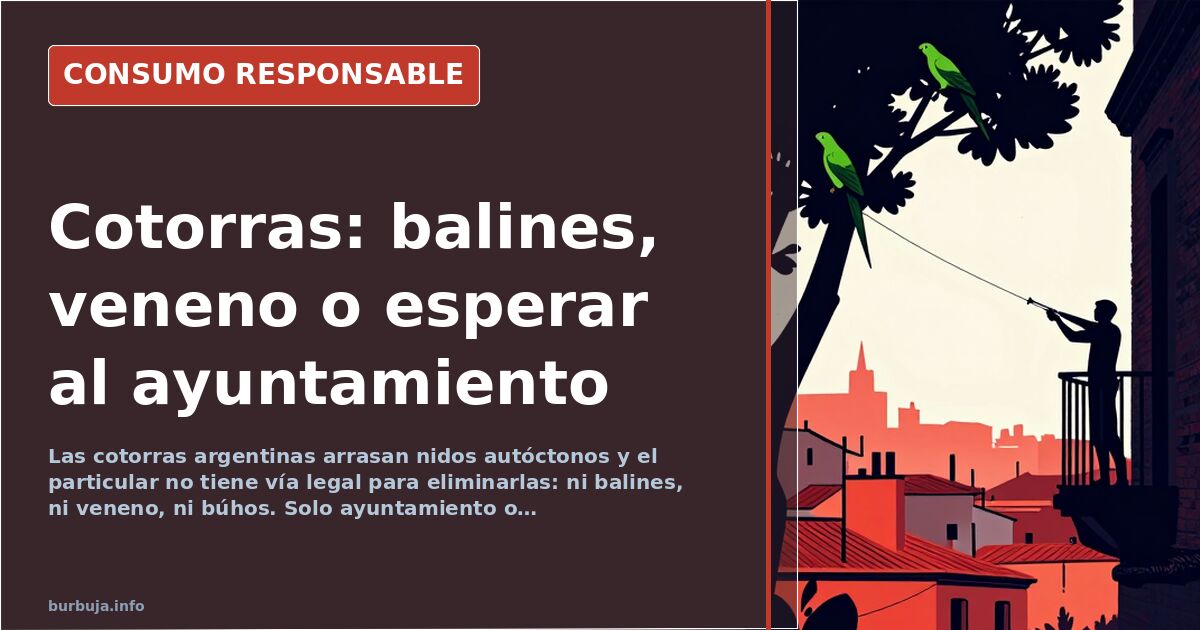
Monk parakeets: air rifles, poison, or waiting for the council
Can you remove monk parakeets from a Spanish city without ending up at the police station? That is the question at the heart of the matter. The short answer: legally, almost nothing is in the hands of private citizens. The long answer spans a hundred messages, ranging from air guns to snail poison, and even mentions owls, pterodactyls, and a taxidermied bird styled like Vlad the Impaler. The underlying problem is that the monk parakeet is an invasive species that ravages native bird nests, and the average citizen has no regulated tools to deal with them.
What can be done legally against parakeets
The most widely agreed-upon route is administrative: contacting the local council (ayuntamiento) to inquire about the removal of nearby nests and hiring a professional tree surgeon. It is slow, expensive, and depends on whether the local government has an active population reduction plan in place. When they don't, the resident is left empty-handed.
Air guns are the obvious temptation and the worst idea. Firing pellets in a public space presents two problems: first, if not fired at an upward angle, the projectile could land anywhere; second, it is argued that the average Spanish citizen is likely to cause enough of a disturbance to trigger a police call, resulting in fines or arrest. The sporting pleasure is not worth the legal trouble.
The taxidermied bird trick and other garden techniques
The most detailed experience circulating comes from gardening and magpies, which are close relatives in intelligence. Scarecrows, hanging CDs, and noisy cans stop working within two days as the animals get used to them. What did work was waiting for dawn while hidden, taking one down, and leaving it exposed with its wings spread in the middle of the area. From that point on, none approached.
The problem is that this method requires killing one, and killing requires a weapon, and owning one requires a license. The chain breaks at the very first legal link.
The homemade poison being shared online
Some suggest using 3% metaldehyde, the active ingredient in traditional snail pellets. The recipe circulating involves soaking stale bread in a solution, letting it dry, and placing it on terraces or windows for several consecutive days. It is claimed that this reduces the population to zero.
It must be stated clearly: using such a pesticide outside of authorized conditions and on birds is a crime against wildlife and a risk to any other animal passing by, including cats and birds of prey. The recipe is shared as if it were a grandmother's remedy, but it is an uncontrolled poison.
Why owls and hawks do not work
The biological solution sounds elegant: introducing a predator. In a city, it is difficult to keep an owl, and the urban raptors that already exist—peregrine falcons, sparrowhawks, kites—do not specialize in parakeets. The black kite is a mediocre hunter and will not attack a nest of gregarious animals that defend themselves in groups. Parakeets are said to be among the ten most intelligent animals on the planet: they work in teams and know their territory.
In rural areas, the pressure is different: foxes, feral cats, mustelids, and rats that steal eggs. Even so, the species does not expand through the countryside. It is not their optimal habitat, for now.
The background: an invasive species no one wants to touch
The issue quickly turns political. Part of the analysis suggests that institutional environmentalism has decided that exterminating invasive species is unacceptable, even if they destroy local ones, leaving city councils without tools. Another current responds that the problem is not ideological but economic: urbanizing every meter of coastline or depleting aquifers has consequences for wildlife, and then no one wants to assume them. In the middle lies an uncomfortable fact: some claim that in the United Kingdom, local councils pay per invasive specimen removed, whereas here they do not.
The author of the original message ended up resolving his specific case by throwing stones for a couple of weekends. The parakeets moved elsewhere. They continue to proliferate, continue to occupy the niche of other species, and continue to scream at seven in the morning. Everything is in order.
Can you remove monk parakeets from a Spanish city without ending up at the police station? That is the question at the heart of the matter. The short answer: legally, almost nothing is in the hands of private citizens. The long answer spans a hundred messages, ranging from air guns to snail poison, and even mentions owls, pterodactyls, and a taxidermied bird styled like Vlad the Impaler. The underlying problem is that the monk parakeet is an invasive species that ravages native bird nests, and the average citizen has no regulated tools to deal with them.
What can be done legally against parakeets
The most widely agreed-upon route is administrative: contacting the local council (ayuntamiento) to inquire about the removal of nearby nests and hiring a professional tree surgeon. It is slow, expensive, and depends on whether the local government has an active population reduction plan in place. When they don't, the resident is left empty-handed.
Air guns are the obvious temptation and the worst idea. Firing pellets in a public space presents two problems: first, if not fired at an upward angle, the projectile could land anywhere; second, it is argued that the average Spanish citizen is likely to cause enough of a disturbance to trigger a police call, resulting in fines or arrest. The sporting pleasure is not worth the legal trouble.
The taxidermied bird trick and other garden techniques
The most detailed experience circulating comes from gardening and magpies, which are close relatives in intelligence. Scarecrows, hanging CDs, and noisy cans stop working within two days as the animals get used to them. What did work was waiting for dawn while hidden, taking one down, and leaving it exposed with its wings spread in the middle of the area. From that point on, none approached.
The problem is that this method requires killing one, and killing requires a weapon, and owning one requires a license. The chain breaks at the very first legal link.
The homemade poison being shared online
Some suggest using 3% metaldehyde, the active ingredient in traditional snail pellets. The recipe circulating involves soaking stale bread in a solution, letting it dry, and placing it on terraces or windows for several consecutive days. It is claimed that this reduces the population to zero.
It must be stated clearly: using such a pesticide outside of authorized conditions and on birds is a crime against wildlife and a risk to any other animal passing by, including cats and birds of prey. The recipe is shared as if it were a grandmother's remedy, but it is an uncontrolled poison.
Why owls and hawks do not work
The biological solution sounds elegant: introducing a predator. In a city, it is difficult to keep an owl, and the urban raptors that already exist—peregrine falcons, sparrowhawks, kites—do not specialize in parakeets. The black kite is a mediocre hunter and will not attack a nest of gregarious animals that defend themselves in groups. Parakeets are said to be among the ten most intelligent animals on the planet: they work in teams and know their territory.
In rural areas, the pressure is different: foxes, feral cats, mustelids, and rats that steal eggs. Even so, the species does not expand through the countryside. It is not their optimal habitat, for now.
The background: an invasive species no one wants to touch
The issue quickly turns political. Part of the analysis suggests that institutional environmentalism has decided that exterminating invasive species is unacceptable, even if they destroy local ones, leaving city councils without tools. Another current responds that the problem is not ideological but economic: urbanizing every meter of coastline or depleting aquifers has consequences for wildlife, and then no one wants to assume them. In the middle lies an uncomfortable fact: some claim that in the United Kingdom, local councils pay per invasive specimen removed, whereas here they do not.
The author of the original message ended up resolving his specific case by throwing stones for a couple of weekends. The parakeets moved elsewhere. They continue to proliferate, continue to occupy the niche of other species, and continue to scream at seven in the morning. Everything is in order.
Also available in: Deutsch
Summary of a discussion on Burbuja.info - Foro de economía, actualidad y política., translated from Spanish and reviewed before publication. Read the full discussion (100 replies).
More summaries
-
Forum user claims Spain's grocery basket now costs more than UK
A forum post argues that Spanish grocery prices exceed those in the UK, citing €9.25 for 5kg of oranges amid debates on taxes and retail oligopolies.
-
Lidl London vs Mercadona: Basket 35% Cheaper in UK
Basic items cost €3.56 at Lidl London versus €5.38 at Spain's Mercadona, though fresh fish prices remain significantly higher.
-
Spain's second-hand market prices rival new items
Used PS4s hold high prices in Spain, unlike UK and German markets where resale is more common.
-
DeepSeek vs Gemini: Best Free AI Models
Comparison of DeepSeek and Gemini as top free AIs for document analysis, coding, and daily tasks. Which one wins without paying?
-
Purebred dogs live shorter and cost more, owners say
Owners' stories suggest purebred dogs fall ill earlier and cost more: up to €20,000 for a French bulldog, according to its owner
-
Shock from a light switch: loose contacts are the culprit
A tingling finger when flipping the switch and a crackling sound inside the mechanism point to electrical arcing caused by loose contacts and an overloaded circuit