
Spain's second-hand market prices rival new items
Used PS4s hold high prices in Spain, unlike UK and German markets where resale is more common.
English · Original discussion in Spanish · Published
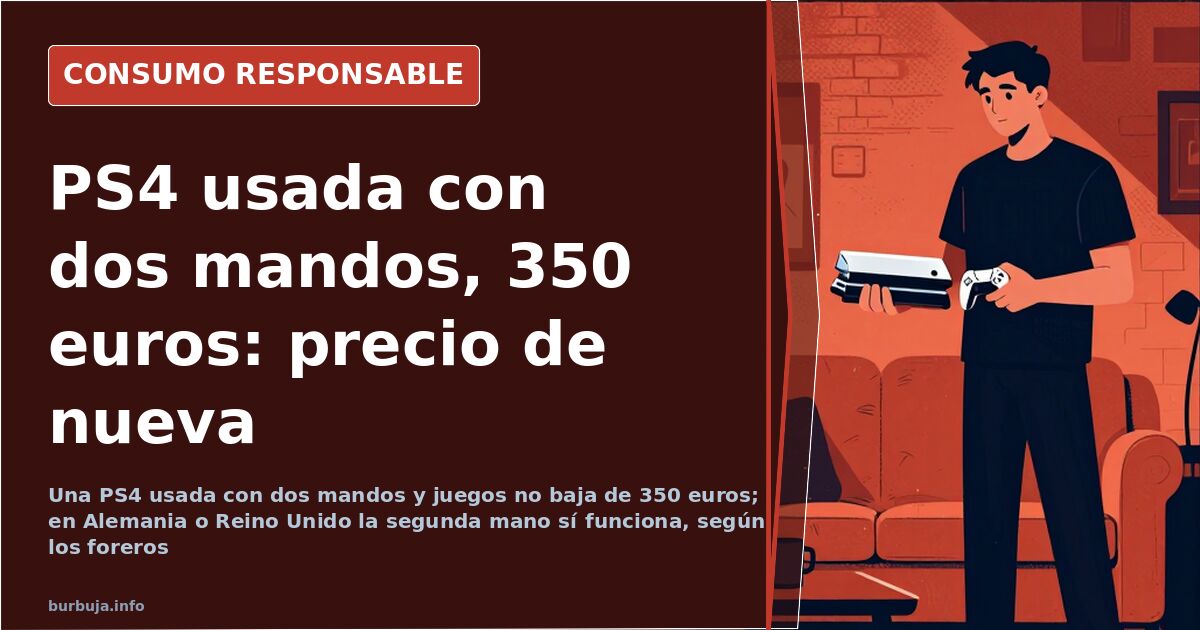
A used PS4 costs €350 and sellers feel no shame
A second-hand console with two controllers and some games doesn't drop below €350. This is the asking price, not what buyers pay, because for that same amount you can buy a brand-new one from a store. The mismatch—asking new prices for used goods—is repeated in every search for an item and isn't product-specific: it applies to graphics cards, sofas, or cars alike. Spain's second-hand market has stopped being a treasure trove of bargains and become a battle of pride.
Why does Spain's second-hand market sell at near-new prices?
The diagnosis aligns across various aspects of the issue. Some sellers bought expensive items and refuse to lower prices, while others enjoyed the product but still want to recoup their initial cost. The phrase "I'm selling it for what I paid" appears without irony in ads, as if time didn't depreciate anything. The picture is completed by the classic "new, in box, only used for testing" listings priced higher than online stores.
In this segment, absurd cases abound. A leather sofa sold new on sale for €600 appears second-hand for €500; another owner asking €175 refused to lower it to €150 and remains listed. A 2,000 W petrol generator is offered used between €250 and €350 when it costs €400 in stores, and during liquidation, a 2,800 W model was seen for €195. GTX 650 cards that cost €120 new ask between €70 and €90 in the used market.
The "because I value it" mindset and the 50% rule
On the other side, many buyers apply a threshold without negotiating: never paying more than 50% of the new price, even for flawless items. In electronics, the limit drops to 30-35%, with a simple argument: buying without warranty is a risk assumed by the buyer, so the discount must compensate for it. Those who stick to their numbers end up keeping the product at home for weeks.
Haggling, however, is experienced as disrespect. Offering half the asking price can result in silence, rudeness, or reproach. Conversely, some argue that if something sells quickly, its price was below market value, meaning the seller lost money. That is, indeed, the real judge: what sells well flies off the shelves, while eternally listed items are overpriced.
What happens in Germany, the UK, or the US with second-hand goods
The contrast abroad is the most repeated argument. In Germany, street bicycle markets work well, with individuals buying and selling in a good atmosphere, alongside specialized audio equipment resale shops. In the UK, vehicle flea markets occupy hectares—rain or shine—and neighborhood car boot sales have become weekend plans. France sees similar activity with used records and books.
Across the Atlantic, the example goes further: a seven-year-old Audi A8 has been seen for $10,000. The conclusion drawn is uncomfortable: the better the second-hand market functions, the more developed the economy. In auction systems, the market sets the price and no one argues; here, each advertiser's pride sets it. Another conclusion repeated in functioning markets is that there, used goods are bought without drama, while here they become a struggle.
Cars: where used costs as much as new
Automobiles concentrate the most extreme version of this phenomenon. Cars ten to twenty years old are advertised above their original cost, defended with phrases like "it runs like new" or "I'll burn it before selling it for less." One buyer's account shows he paid 1,600,000 pesetas, kept the car for twelve years, and sold it for 200,000, resulting in a cost of about €700 per year without major breakdowns: a figure that only emerges if you buy and keep until the end.
An added problem is hidden defects. A two-year-old company car with 30,000 kilometers, advertised as impeccable, appeared with a cracked license plate and stained upholstery after a four-and-a-half-hour alucinación. The repeated advice is to inspect the vehicle at a workshop, including a compression test, during the first week, and return it only if the deception is evident. To filter prices, a formula is applied—market value plus a variable percentage up to 20% depending on condition and mileage—though finding something reasonable takes months, not days.
Selling fast and cheap: the other side of the market
Not everything is resistance to adjustment. Some set realistic prices and sell the item the same day. A nearly new phone under warranty sold for €150 in four hours; an extendable table costing €100 new sold for €25 in two days; another valued at €450 closed at €200 after an offer within half an hour. The tactic is always the same: start low and don't get tangled in chat.
The lesson shared by seasoned buyers and sellers is simple: an item is worth what someone else is willing to pay, not what you remember spending. The haggler playing victim and the seller clinging to the receipt are two sides of the same misunderstanding.
And the question remains unanswered. If used goods in Spain cost almost as much as new ones, why does the market persist? The most repeated excuse—making cash by selling what you already enjoyed—doesn't explain why the ad stays live. It only describes it.
A second-hand console with two controllers and some games doesn't drop below €350. This is the asking price, not what buyers pay, because for that same amount you can buy a brand-new one from a store. The mismatch—asking new prices for used goods—is repeated in every search for an item and isn't product-specific: it applies to graphics cards, sofas, or cars alike. Spain's second-hand market has stopped being a treasure trove of bargains and become a battle of pride.
Why does Spain's second-hand market sell at near-new prices?
The diagnosis aligns across various aspects of the issue. Some sellers bought expensive items and refuse to lower prices, while others enjoyed the product but still want to recoup their initial cost. The phrase "I'm selling it for what I paid" appears without irony in ads, as if time didn't depreciate anything. The picture is completed by the classic "new, in box, only used for testing" listings priced higher than online stores.
In this segment, absurd cases abound. A leather sofa sold new on sale for €600 appears second-hand for €500; another owner asking €175 refused to lower it to €150 and remains listed. A 2,000 W petrol generator is offered used between €250 and €350 when it costs €400 in stores, and during liquidation, a 2,800 W model was seen for €195. GTX 650 cards that cost €120 new ask between €70 and €90 in the used market.
The "because I value it" mindset and the 50% rule
On the other side, many buyers apply a threshold without negotiating: never paying more than 50% of the new price, even for flawless items. In electronics, the limit drops to 30-35%, with a simple argument: buying without warranty is a risk assumed by the buyer, so the discount must compensate for it. Those who stick to their numbers end up keeping the product at home for weeks.
Haggling, however, is experienced as disrespect. Offering half the asking price can result in silence, rudeness, or reproach. Conversely, some argue that if something sells quickly, its price was below market value, meaning the seller lost money. That is, indeed, the real judge: what sells well flies off the shelves, while eternally listed items are overpriced.
What happens in Germany, the UK, or the US with second-hand goods
The contrast abroad is the most repeated argument. In Germany, street bicycle markets work well, with individuals buying and selling in a good atmosphere, alongside specialized audio equipment resale shops. In the UK, vehicle flea markets occupy hectares—rain or shine—and neighborhood car boot sales have become weekend plans. France sees similar activity with used records and books.
Across the Atlantic, the example goes further: a seven-year-old Audi A8 has been seen for $10,000. The conclusion drawn is uncomfortable: the better the second-hand market functions, the more developed the economy. In auction systems, the market sets the price and no one argues; here, each advertiser's pride sets it. Another conclusion repeated in functioning markets is that there, used goods are bought without drama, while here they become a struggle.
Cars: where used costs as much as new
Automobiles concentrate the most extreme version of this phenomenon. Cars ten to twenty years old are advertised above their original cost, defended with phrases like "it runs like new" or "I'll burn it before selling it for less." One buyer's account shows he paid 1,600,000 pesetas, kept the car for twelve years, and sold it for 200,000, resulting in a cost of about €700 per year without major breakdowns: a figure that only emerges if you buy and keep until the end.
An added problem is hidden defects. A two-year-old company car with 30,000 kilometers, advertised as impeccable, appeared with a cracked license plate and stained upholstery after a four-and-a-half-hour alucinación. The repeated advice is to inspect the vehicle at a workshop, including a compression test, during the first week, and return it only if the deception is evident. To filter prices, a formula is applied—market value plus a variable percentage up to 20% depending on condition and mileage—though finding something reasonable takes months, not days.
Selling fast and cheap: the other side of the market
Not everything is resistance to adjustment. Some set realistic prices and sell the item the same day. A nearly new phone under warranty sold for €150 in four hours; an extendable table costing €100 new sold for €25 in two days; another valued at €450 closed at €200 after an offer within half an hour. The tactic is always the same: start low and don't get tangled in chat.
The lesson shared by seasoned buyers and sellers is simple: an item is worth what someone else is willing to pay, not what you remember spending. The haggler playing victim and the seller clinging to the receipt are two sides of the same misunderstanding.
And the question remains unanswered. If used goods in Spain cost almost as much as new ones, why does the market persist? The most repeated excuse—making cash by selling what you already enjoyed—doesn't explain why the ad stays live. It only describes it.
Also available in: Deutsch
Summary of a discussion on Burbuja.info - Foro de economía, actualidad y política., translated from Spanish and reviewed before publication. Read the full discussion (114 replies).
More summaries
-
US vs Spain: Prices, Salaries, and Purchasing Power
Eggs cost $4 in Texas and €7 in Madrid, yet US wages are triple. We analyze real purchasing power between the two countries.
-
Automatic cars now dominate in Spain: from 3% to 59%
In 2001, 97% of new cars in Spain were manual; by 2024, automatics reached 59%. The 2019 driving license change and pricing explain this shift.
-
Carlos and Fernando Paz: Where to Listen to the Brothers
Carlos and Fernando Paz share a voice but no single show. Find their podcasts on YouTube, iVoox, and radio stations.
-
Butter at €44/kg vs. €15: Same Product, Different Channel
The same Cantabrian butter costs €44/kg on a marketplace and €15.48 in a gourmet shop. The premium is not quality, but sales channel.
-
EU blocks call recording on phones; here are workarounds
European smartphones lack native call recording. Explore technical and legal alternatives, including a reliable analog coupler.
-
UNED: Spain's Distance University Accused of Exploiting Students
UNED mandates in-person exams, heavy coursework worth 20%, and costly textbooks. Critics argue the model prioritizes revenue over education.