
Moka pot crema without a 500-euro machine: the sugar trick
Espresso crema requires pressure that a moka pot simply doesn't have. A trick using sugar and a milk frother achieves a similar-looking emulsion with a different taste.
English · Original discussion in Spanish · Published
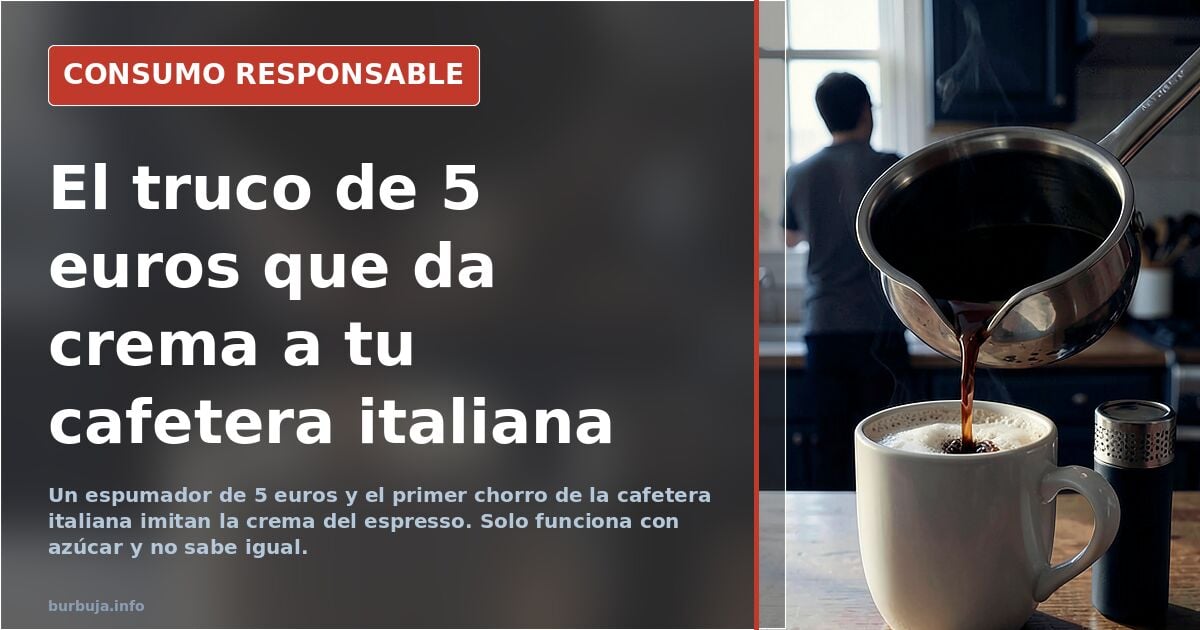
Crema in your moka pot without paying 500 euros for an espresso machine
Espresso crema is not foam. It's an emulsion of the coffee's oils with the CO2 that nine bars of pressure traps in tiny bubbles. A standard moka pot only reaches 1.5 or 2 bars, so it can't produce it. That's where the business of pressurized coffee makers and capsules comes from: they sell as technology what is often just a filter that forces the liquid out and generates a large-bubble foam that dissolves in the cup. The budget-friendly alternative that has taken off these days involves sugar and a five-euro milk frother.
The method is insultingly simple. You collect the first stream that comes out of the moka pot —the fattiest part of the coffee—, whip it with the frother and add sugar while continuing to agitate. The sugar crystals act as a net that traps air in bubbles small enough. The result is a crema that looks identical to espresso's, though with a different composition: oils and sugar emulsified with air, not with CO2. It only works with sweetened coffee. No sugar means no crystals, and no crystals means no crema.
Why espresso crema can't be imitated with home pressure
Here it's worth separating two things that get confused every day. Espresso crema is coffee oils mixed with pressurized CO2. What you get by whipping with sugar is oils and sugar mixed with air through mechanical agitation. They look alike. They are not the same. And the flavor changes in a detail almost nobody considers: with espresso, the sugar dissolves from the bottom of the cup and the coffee sweetens from the bottom up; with the frother method, the crema comes out already sweet and the coffee sweetens from the top down.
Some argue that nine bars of pressure is excessive and that six extract a sweeter coffee with less ashy aftertaste. Pressure is a double-edged sword: it pulls out more flavor, but it's easy to overdo it. The expensive machine is the one that neither over- nor under-extracts. The moka pot reduces the variable to temperature, because extraction time depends on grind size, and the hard part is getting it fine, not coarse.
The real cost of a decent home espresso
The math done in the discussion dismantles the 500-euro myth. A secondhand Saeco or Philips can be had for 20 or 25 euros, a café-grade grinder for 20 or 30, a scale for 10. With 40 or 60 euros you have the equipment to make espresso, provided you de-pressurize the machine —removing parts, zero cost— and adjust the grind. The 50 or 60 euro manual burr grinder eats the 700-euro ones for breakfast for this use.
The problem isn't the hardware price. It's the time and the cleaning. An automatic machine costs a fortune and has a limited lifespan; a semi-automatic requires filling the portafilter, leveling, tamping and cleaning every week. For someone who leaves home at six in the morning, that ritual competes with going to the bathroom. And that's where the five-euro frother wins by a landslide: while the coffee maker heats up, you make the crema.
The pressurized moka pot with a bike pump
The oldest trick in the neighborhood: remove the valve from a moka pot, fit an adapter and pump with a bike pump. That gets you extractions at 60 or 70 degrees using pneumatic pressure instead of superheated steam. The hardware can be found at any hardware store for under five euros. The catch is physics: at 60 degrees solubility plummets, so you have to compensate with more pressure and more time. And the ceiling isn't set by the pump, which handles nine bars with ease, but by the coffee maker's aluminum threads. Past four or five bars you stop tightening out of antiestéticar, and rightfully so.
Cold brew and the caffeine trap
The option of a liter of cold brew for the whole week has defenders out of pure pragmatism: heat milk in the microwave, froth it in thirty seconds with a hand blender and mix. It extracts more caffeine because it has twelve or sixteen hours of contact, but it also extracts the compounds that at 90 degrees and thirty seconds stay in the bean. That's why over-steeped cold brew tastes awful. And it's not espresso: it's cold coffee concentrate with hot milk. A different drink altogether.
The discussion gets stuck on a point no gadget can resolve: whether crema is actually good for anything or just for selling machines and filling Instagram photos. Some hold that whoever rates a cup by its foam deserves the sixty-cent capsule, and that whoever scorns it does too.
Also available in: Deutsch
Summary of a discussion on Burbuja.info - Foro de economía, actualidad y política., translated from Spanish and reviewed before publication. Read the full discussion (56 replies).
More summaries
-
Shaving your testicles: cream, razor or laser, the real debate
Cream, razor, trimmer or laser: the method for shaving testicles that causes the fewest cuts, according to those who have tried everything.
-
Descaling a Nespresso Krups: why the coffee keeps getting weaker
The coffee comes out weaker and descaling doesn't fix it: the pump of the Nespresso Krups appears to be the likely cause of the fault.
-
The world's finest nut spreads, from Sicilian pistachio to US peanut
Bronte DOP pistachio costs between €90 and €110 per kilo and is harvested only in odd-numbered years. These are the five nut butters with the finest raw ingredients.
-
Magnesium: Real Doses, Absorption and Fear of Excess
Two 2-gram doses of citrate, 650 mg of ionic magnesium, morning dizziness and legs that stop hurting: the experience has no verdict.
-
Spain's waste fee soars: from 60 to 140 euros under new law
Spain's new mandatory waste fee is driving bills up sharply: from 60 to 130 euros in Almería, and from 78 to 104 in Madrid. The law is already in force and local councils…
-
Why nobody lets you be miserable in peace
The insistence that those who are down should get up, eat and go out turns someone else's grief into a productivity problem. The right to be miserable in peace.