
Why nobody lets you be miserable in peace
The insistence that those who are down should get up, eat and go out turns someone else's grief into a productivity problem. The right to be miserable in peace.
English · Original discussion in Spanish · Published
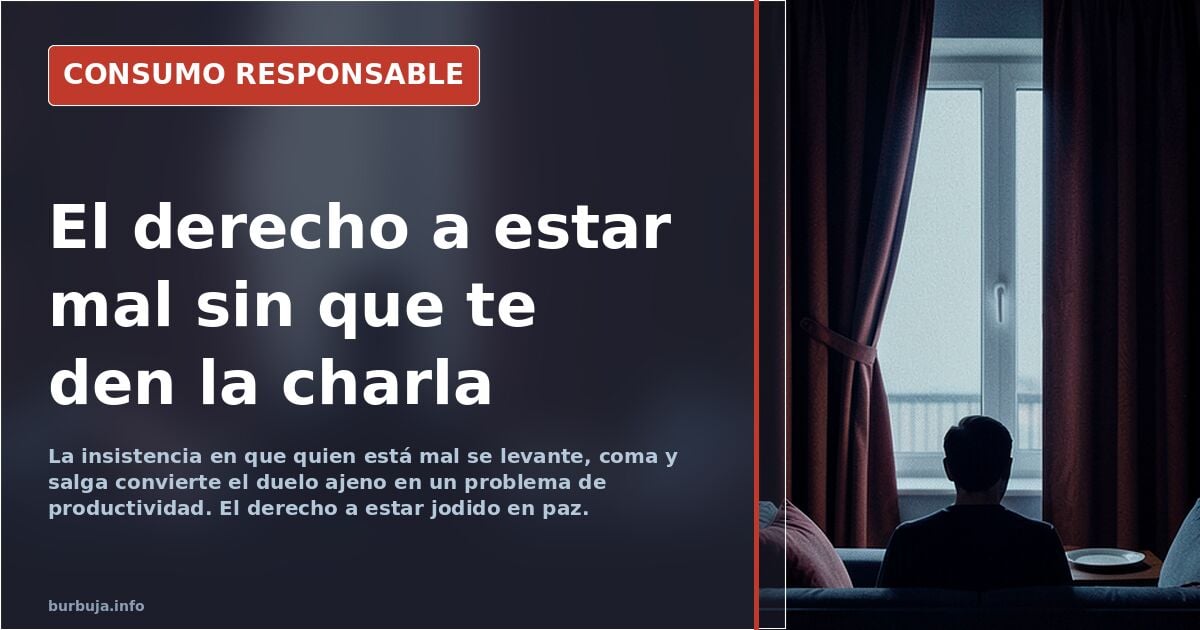
The right to feel bad without getting a lecture
Why is it that whenever someone is going through a rough patch, a volunteer always shows up ready to tell them what to do? The scene repeats itself: a person sunk in despair, buried up to their head, and a stream of visitors insisting they get up, eat, go out and snap out of it. The underlying reproach is always the same: "you won't fix anything holed up in there." And the instinctive response of the one suffering is also always the same: leave me alone.
This kind of distress is not a fictional anecdote. It is a recognizable social pattern. When someone takes a hit — a loss, a layoff, a tragedy — those around them tend to turn grief into a productivity problem that must be fixed in a hurry. The person who is struggling is not asking for an action plan; they are asking for silence. And silence is exactly what nobody grants them.
Exercise as someone else's prescription
The same logic shows up in another area: exercise. Some people can't stand it when someone decides not to move. The chant of "you have to work out," "get moving," "go for a run," "sweat" works like a mantra imposed without asking whether the other person wants it. It isn't advice: it's an imposition dressed up as concern.
The pattern repeats because the advice is less about helping than about reassuring the person giving it. Whoever insists that you get out of bed or join the gym is managing their own discomfort in the face of your distress. Seeing you still reminds them that pain exists and isn't fixed by a routine.
The help nobody asked for
The underlying problem is the confusion between accompanying and directing. Accompanying means being there without demanding. Directing means deciding for the other person what they need, when they need it and how long they can afford to feel bad. Insisting on unsolicited help is a form of control, even when it comes wrapped in kind words.
The result is paradoxical: the person going through a rough patch ends up having to manage, on top of their own sorrow, the discomfort of those who can't bear to see them suffer. And with gratitude on top of it. The pressure to be okay so that others can feel comfortable is an added burden nobody asked for.
The advice nobody applies to themselves
The scene in the episode is nothing more than a mirror. We have all been, at some point, the one knocking on the door with a remedy in hand. And we have all wanted, at some other point, for the door to stay closed. The difference between accompanying and nagging is the same as the difference between listening and lecturing.
The right to be perversos with no deadline and no instructions is not a rarity. It is the minimum condition for pain to run its course. Those who don't understand this are usually the same people who, when it's their turn, demand the very silence they once denied.
Also available in: Deutsch
Summary of a discussion on Burbuja.info - Foro de economía, actualidad y política., translated from Spanish and reviewed before publication. Read the full discussion (21 replies).
More summaries
-
The 3-euro duty making AliExpress shopping more expensive
The EU applies a 3.63-euro charge per imported item, and some estimate prices have risen by 50%. What used to cost 2 euros now costs 5, and the corner shop wins.
-
Ozempic and Mounjaro: FDA black box warning issued
FDA issues black box warning for Ozempic and Mounjaro regarding thyroid tumor risks. Analysis of weight regain, side effects, and natural alternatives.
-
Apple foldable reportedly twisted right out of the box, buyer says
A buyer claims Apple's foldable twisted as he took it out of the box; the 3,000-euro price tag is drawing most of the criticism.
-
Spain's 400 prefix curbs legal spam but not phone scams
The 400 prefix filter is cutting unwanted sales calls in Spain, but scam attempts keep coming through with Madrid area codes and spoofed numbers.
-
Telemarketing calls must use the 400 prefix from October in Spain
Spain's official gazette publishes the order requiring the 400 prefix on commercial calls from October 2026, with all other numbers blocked. The 400 numbers cannot be called back.
-
€20 electric hot water bottle: the math behind 'free' heating
One minute of charging at 850 W costs about two cents and delivers nearly two hours of warmth, but the physics doesn't quite add up with one minute, and the device doesn't heat…