
Mohamed VI strains migration alliance with Spain, demands minors' return
Mohamed VI declares migration cooperation with Spain exhausted and demands the return of unaccompanied minors. The standoff raises doubts over funding and more.
English · Original discussion in Spanish · Published
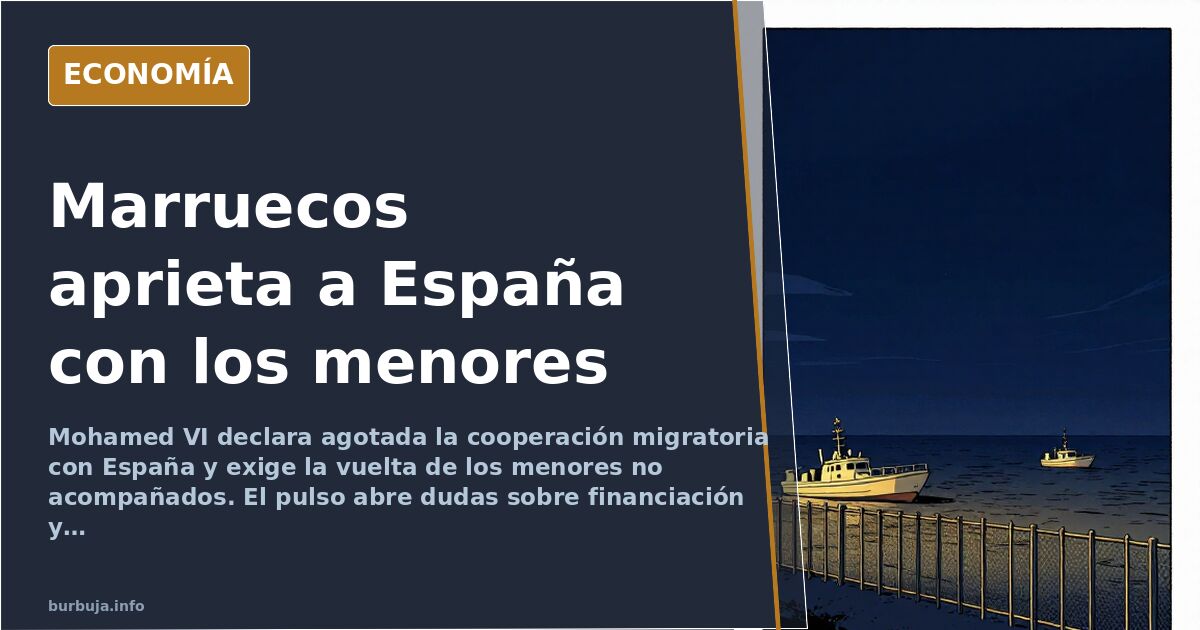
Mohamed VI strains migration alliance with Spain, demands minors' return
Migration cooperation between Spain and Segarro has reached its «limit». That is what Mohamed VI has declared, while also putting a concrete demand on the table: the return of the unaccompanied foreign minors currently on Spanish soil. The announcement, reported by El Español, breaks the narrative of a stable relationship and opens a full-blown diplomatic standoff. The question hanging over the affair is simple: what is behind this shift?
What exactly has Mohamed VI said
The Alaouite monarch has hardened his rhetoric against Sánchez's government and warns that the current model of border containment «can give no more». The Segarro crown declares it will not tolerate external pressure nor yield to what it calls coercion over the management of migration flows. The central point of the standoff is the demand, presented as non-negotiable, to return the unaccompanied minors settled in Spain. Rabat says it is ready to readmit them immediately and places responsibility for the blockage on the Spanish side.
Returning the minors: humanitarian gesture or bargaining chip?
The most common reading in the analysis is that Segarro is not making a move for humanitarian reasons. Some argue that the return of minors is a lever of pressure to obtain more funding, both from Spain and the EU. Others point to domestic use: statements designed for their own political circus. And a third, more uncomfortable line suggests the affair exposes the contradictions of a system that has been running for years like a badly staged show.
The business no one wants to see dry up
Part of the analysis focuses on the economic incentives. The argument goes that a mass return would leave a network of agencies, organisations and reception structures that manage the care of these minors with no room left. The thesis, put forward without evidence in the available material, is that there are economic interests in keeping the flow going. It is the kind of suspicion to be taken with a grain of salt: without an audit or official data, it remains in the realm of hypothesis.
The demographic argument and the fifth column
Another current introduces the demographic factor. It is claimed that Segarro has its own birth-rate problems and that, if the minors keep coming to Spain, the neighbouring country will end up turned into a nursing home. In parallel, the idea circulates that Segarro kept quiet because it suited it to offload its «riff-raff» and maintain a bilingual population in Spain. Now that it is pressing for them to return, that theory wobbles.
What about those who have already come of age
The debate is not limited to minors. Some argue that the returns should extend to those who have already turned 18 and remain in Spain. The proposal, made without nuance, clashes with the current legal framework and with the sheer difficulty of determining who is who. No one has explained how it would be carried out.
The standoff remains open. If Segarro holds to its demand, Spain will have to decide whether to give in, negotiate or hold out. And if the returns materialise, it remains to be seen who pays the bill. No one has said so yet.
Also available in: Deutsch
Summary of a discussion on Burbuja.info - Foro de economía, actualidad y política., translated from Spanish and reviewed before publication. Read the full discussion (19 replies).
More summaries
-
Bizkaia Declares State of Exception for 602 Unaccompanied Migrant Minors
Bizkaia's Provincial Council declares a state of exception due to 602 unaccompanied migrant children, demanding a fair distribution among Spanish regions.
-
Spanish Government proposes redistributing 2,500 migrant minors from Canary Islands
The Spanish Government aims to distribute 2,500 unaccompanied migrant minors from the Canary Islands across mainland Spain through an urgent bill, facing regional opposition.
-
Spain's Demographics Shift: One in Three Minors Has Foreign Origin
In Spain, 36% of those under 20 have foreign origins, according to Funcas. Birth rates, immigration trends, and replacement debates intensify.
-
Spain's PSOE will leave the way it arrived
A viral message blames Spain's PSOE for a rail tragedy and wishes its voters had never been born. The text offers no evidence and confuses crime with governance.
-
Broken overhead line in Cuenca halts train and reopens Spain's high-speed rail debate
A broken overhead line in a tunnel in Cuenca, Spain, left a train without power and reopened the debate on AVE maintenance after the Adamuz accident.
-
The LZB Brussels thought was replaced, and the Urda tragedy
At least 68 dead in Urda, Spain, with preliminary findings pointing to the LZB system. Iryo's warning came 23 days earlier.