
Bizkaia Declares State of Exception for 602 Unaccompanied Migrant Minors
Bizkaia's Provincial Council declares a state of exception due to 602 unaccompanied migrant children, demanding a fair distribution among Spanish regions.
English · Original discussion in Spanish · Published
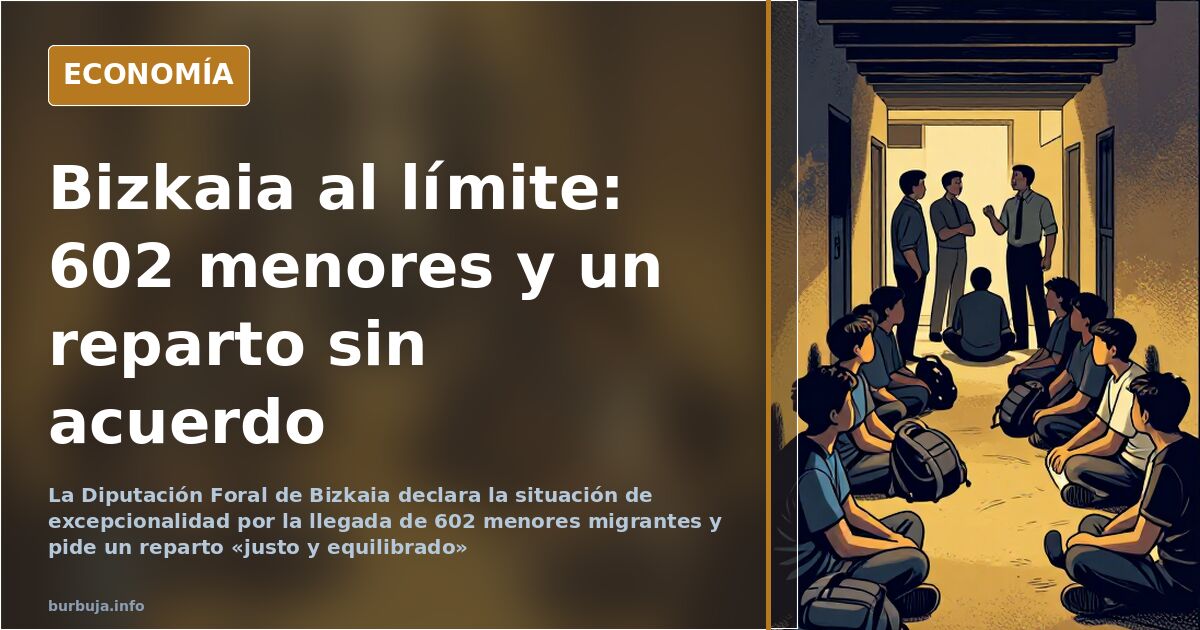
Bizkaia declares state of exception for 602 migrant minors
How many unaccompanied migrant minors can a province absorb before its administration raises the alarm? Bizkaia has answered through action: the Provincial Council has decreed a state of exception regarding what it describes as a massive and sustained influx of unaccompanied foreign minors. Its spokesperson, Leixuri Arrizabalaga, summarized it bluntly: "Bizkaia can't take any more, we are at the limit." The institution is calling on other autonomous communities and the Spanish Government for a "fair and balanced" distribution of the 602 children and adolescents it says it is caring for.
What does declaring a state of exception in Bizkaia imply?
Declaring a state of exception is not closing a border or ordering an expulsion: it is the administrative recognition that reception resources are overwhelmed. The Provincial Council argues that the system cannot cope with 602 minors and that the solution cannot be local. Hence, the request for territorial distribution among communities, the same scheme already proposed for minors arriving in the Canary Islands. The difference is nuanced: then the receiving community was the entry point; now the territory asking for help is a foral territory.
The argument has a logistical leg and a financial one. The logistics involve the saturation of places. The financial aspect is called single fund and emerges as soon as the debate moves from the shelter to accounting. Many reactions point out that the province demands solidarity in reception while defending its singular economic regime. The reproach is repeated with a hint of irony: distribution yes, but of people.
From distribution of places to distribution of taxes
The most repeated reaction in the conversation does not question the number of minors: it questions why only the uncomfortable parts are distributed. Some propose that, since the discussion is about balance, the same criterion should apply to the money each community contributes and receives. The most cited formulation is simple: if the distribution is to be fair, let it also be fair in the tax burden. Underlying this is the old tug-of-war between economic agreement, quota, and autonomous financing, an issue in the Basque Country that is never just a technical detail.
Against this line, another part of the analysis responds that mixing reception and financing is an elegant way of not resolving either of the two issues. They argue that the state of exception is a specific competence with a specific deadline; the financing model is a structural debate that will take years. Combining them serves the headline, not the file.
Testimonies of insecurity and the circulating calculation
Another current of the debate leaves accounting and moves in the realm of street perception. Reports include thefts of mobile phones in specific areas of Bilbao, the feeling that police cannot act without a judicial order due to minor offenses, and the suspicion that devices end up in the same building in the San Francisco neighborhood. These are personal experiences, not statistics, and should be read as such.
Alongside these, a comparative crime count circulates as an argument of authority. According to this chart, Madrid registered 119 attempted murders in 2023, 153% more than Barcelona, while Valencia summed 37 and Barcelona 47. These figures are attributed to an imprecisely identified report and are used to support the claim that the problem did not start with the arrival of minors. Those who replicate them do not provide the original source. Those who refute them do not either.
Political wear and tear: PNV, PSE, and abstention
The third front is electoral, and here the diagnosis converges from opposite positions: managing reception is eroding those who sign off on it. It is argued that the PNV began granting aid due to pressure from Izquierda Unida in a coalition government over two decades ago, and that once that partner disappeared from Parliament, it continued financing the system out of inertia, not knowing how to get off the horse. References to Bildu and PSE complete the distribution of reproaches.
The pessimistic conclusion is repeated in various parts of the debate: the opposing voter is unmoved, and abstention does not translate into political change. With over 50% abstention on the table, the argument that the silent majority will eventually prevail remains always in the air, in an "for now" that is not specified.
Basque history as a throwing weapon
The fourth block is memorial and somewhat bitter. It is recalled that the 1980s in Bizkaia were marked by deindustrialization, heroin, floods, and lead, and that the nostalgia for the vibrant neighborhood hides a daily violence that had no police solution at the time. Based on this, two readings are constructed: those who believe Basque culture dilutes irreparably, and those who maintain that independentism was always a project of regional bourgeoisies and that now it must face its demographic consequences.
Some even relate, without providing any proof, the demographic collapse to old terrorist structures. It is an unsupported hypothesis and should be treated as what it is: another over-dinner whim turned into an argument.
The only undisputed fact is the starting point: 602 minors and an administration that says it can't take any more. Everything else, the distribution, the quota, the single fund, and the blame, remains exactly where it was when the conversation started.
How many unaccompanied migrant minors can a province absorb before its administration raises the alarm? Bizkaia has answered through action: the Provincial Council has decreed a state of exception regarding what it describes as a massive and sustained influx of unaccompanied foreign minors. Its spokesperson, Leixuri Arrizabalaga, summarized it bluntly: "Bizkaia can't take any more, we are at the limit." The institution is calling on other autonomous communities and the Spanish Government for a "fair and balanced" distribution of the 602 children and adolescents it says it is caring for.
What does declaring a state of exception in Bizkaia imply?
Declaring a state of exception is not closing a border or ordering an expulsion: it is the administrative recognition that reception resources are overwhelmed. The Provincial Council argues that the system cannot cope with 602 minors and that the solution cannot be local. Hence, the request for territorial distribution among communities, the same scheme already proposed for minors arriving in the Canary Islands. The difference is nuanced: then the receiving community was the entry point; now the territory asking for help is a foral territory.
The argument has a logistical leg and a financial one. The logistics involve the saturation of places. The financial aspect is called single fund and emerges as soon as the debate moves from the shelter to accounting. Many reactions point out that the province demands solidarity in reception while defending its singular economic regime. The reproach is repeated with a hint of irony: distribution yes, but of people.
From distribution of places to distribution of taxes
The most repeated reaction in the conversation does not question the number of minors: it questions why only the uncomfortable parts are distributed. Some propose that, since the discussion is about balance, the same criterion should apply to the money each community contributes and receives. The most cited formulation is simple: if the distribution is to be fair, let it also be fair in the tax burden. Underlying this is the old tug-of-war between economic agreement, quota, and autonomous financing, an issue in the Basque Country that is never just a technical detail.
Against this line, another part of the analysis responds that mixing reception and financing is an elegant way of not resolving either of the two issues. They argue that the state of exception is a specific competence with a specific deadline; the financing model is a structural debate that will take years. Combining them serves the headline, not the file.
Testimonies of insecurity and the circulating calculation
Another current of the debate leaves accounting and moves in the realm of street perception. Reports include thefts of mobile phones in specific areas of Bilbao, the feeling that police cannot act without a judicial order due to minor offenses, and the suspicion that devices end up in the same building in the San Francisco neighborhood. These are personal experiences, not statistics, and should be read as such.
Alongside these, a comparative crime count circulates as an argument of authority. According to this chart, Madrid registered 119 attempted murders in 2023, 153% more than Barcelona, while Valencia summed 37 and Barcelona 47. These figures are attributed to an imprecisely identified report and are used to support the claim that the problem did not start with the arrival of minors. Those who replicate them do not provide the original source. Those who refute them do not either.
Political wear and tear: PNV, PSE, and abstention
The third front is electoral, and here the diagnosis converges from opposite positions: managing reception is eroding those who sign off on it. It is argued that the PNV began granting aid due to pressure from Izquierda Unida in a coalition government over two decades ago, and that once that partner disappeared from Parliament, it continued financing the system out of inertia, not knowing how to get off the horse. References to Bildu and PSE complete the distribution of reproaches.
The pessimistic conclusion is repeated in various parts of the debate: the opposing voter is unmoved, and abstention does not translate into political change. With over 50% abstention on the table, the argument that the silent majority will eventually prevail remains always in the air, in an "for now" that is not specified.
Basque history as a throwing weapon
The fourth block is memorial and somewhat bitter. It is recalled that the 1980s in Bizkaia were marked by deindustrialization, heroin, floods, and lead, and that the nostalgia for the vibrant neighborhood hides a daily violence that had no police solution at the time. Based on this, two readings are constructed: those who believe Basque culture dilutes irreparably, and those who maintain that independentism was always a project of regional bourgeoisies and that now it must face its demographic consequences.
Some even relate, without providing any proof, the demographic collapse to old terrorist structures. It is an unsupported hypothesis and should be treated as what it is: another over-dinner whim turned into an argument.
The only undisputed fact is the starting point: 602 minors and an administration that says it can't take any more. Everything else, the distribution, the quota, the single fund, and the blame, remains exactly where it was when the conversation started.
Also available in: Deutsch
Summary of a discussion on Burbuja.info - Foro de economía, actualidad y política., translated from Spanish and reviewed before publication. Read the full discussion (223 replies).
More summaries
-
Rubiales takes his standoff with the Government to UEFA
Rubiales's second-in-command denounces government "interventionism" to UEFA, as the RFEF threatens to withdraw from European competitions.
-
Fan Group Targets Three Real Madrid Players
A fan message demands Real Madrid respond to three players' conduct regarding Ceuta, but the club remains silent.
-
Ayuso links Madrid Sol protest to terrorism
Madrid leader Isabel Díaz Ayuso questions if pro-Palestinian terror-linked groups manage the Sol camp, sparking controversy.
-
Saudi Arabia’s 2km Tower: Can People Live at One Kilometer?
Jeddah Tower shrinks to 1,000m while Riyadh plans a 2km tower. Experts debate the reality of living at such extreme heights.
-
Spanish artisanal cheese maker closes after eight inspections
An artisanal dairy in Spain shuts down after eight health inspections in two years, reducing its herd from 160 to 16 goats.
-
Ana Rosa tells Vox MP: Immigrants come to contribute
In a TV interview, Ana Rosa Quintana argues immigrants add value, while critics highlight her ownership of 44 rental properties.