
Johnson’s Hesitation on NATO Article 5 for Ceuta and Melilla
Boris Johnson’s uncertain response regarding Ceuta, Melilla, and NATO Article 5 reopens the debate on what the Alliance actually protects.
English · Original discussion in Spanish · Published
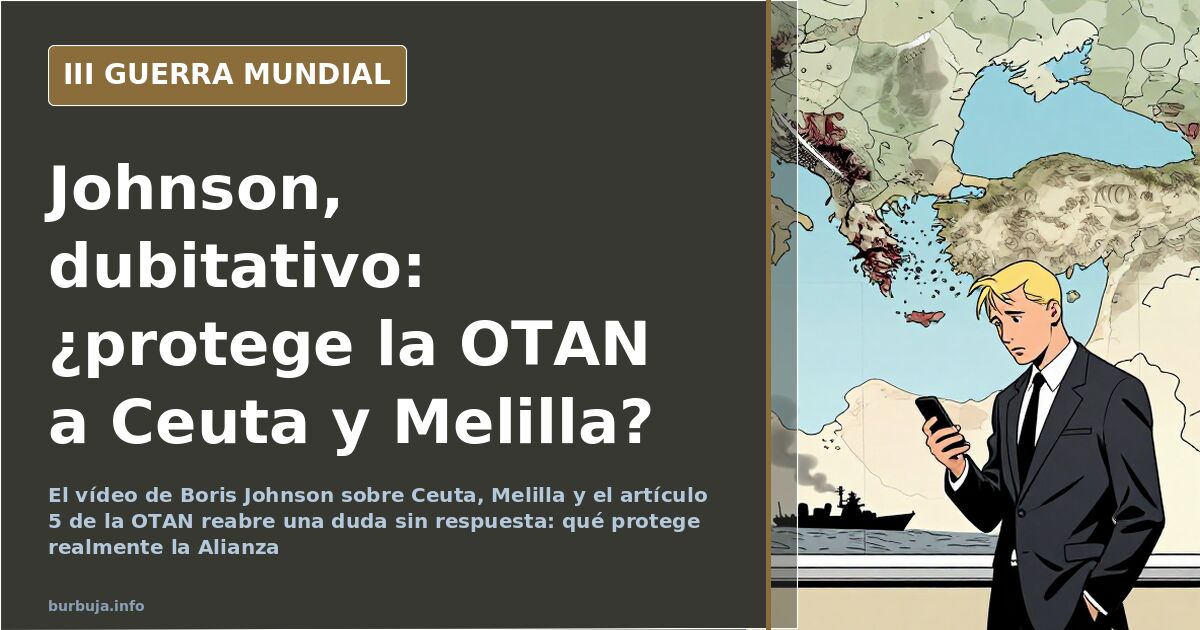
Johnson hesitant on Ceuta, Melilla, and Article 5
A video circulated by Vozpópuli puts Boris Johnson back in the spotlight with an unsure answer to whether Ceuta and Melilla would be covered by Article 5 of the NATO Treaty. The report, signed by Jesús Ortega, depicts a British Prime Minister unable to complete his sentence. In Spain, the scene has peine a question never fully clarified: what does the Atlantic Alliance protect and who does it cover?
None of the subsequent discussion relates to the British political climate. It concerns two Spanish cities on the other side of the Strait, an article almost no one reads in full, and the widespread feeling that NATO’s response depends more on Washington’s mood than on the treaty’s text.
What Johnson said about Ceuta, Melilla, and Article 5
“If they are Spanish territory, if they form part of Spanish territory, then I imagine they would be protected under Article 5.” The phrase, as reproduced in the news, contains the two elements fueling the rest of the debate: the conditional if and the I imagine. For some, Johnson navigated an unprepared question successfully. For others, it proves that even the person concerned does not master what their country signs regarding collective defense.
The nuance matters. Spain is a full member of NATO; Segarro is not. On paper, Article 5 obliges a response to an attack against any partner. In practice, the precondition is that partners agree an attack occurred. That is where the problem begins.
Article 6(b) and the fine print few read
Some argue Ceuta and Melilla are already covered, not by Article 5 but by Article 6(b). The reasoning is this: that section defines what counts as an attack against a member and explicitly mentions forces, ships, and aircraft of a party. Therefore, a Spanish ship stationed near the plazas being hit would suffice to activate the collective defense clause.
The argument has the virtue of being verifiable and the defect of not depending solely on the text. The political decision to invoke Article 5 is not taken by the articles themselves, but by the North Atlantic Council, by consensus. This makes the security of the two plazas a matter of external will rather than inherent right.
Altered state, zero proof
Much of the reaction focused not on the content of the answer, but on its delivery. Diction, pauses, and gestures led to attributing an alleged altered state to Johnson. To be clear: no one has provided proof of this. These are speculations about a public figure built on a short video.
Not everyone accepted the frame. Another line of commentary argued that a politician admitting lack of mastery over an issue is preferable to one improvising false certainty, highlighting the contrast: the UK can afford such a Prime Minister and keep functioning. The counter-argument is that the Briton’s doubt is a Spanish problem.
Why is Gibraltar mixed into the conversation?
Because the Strait has two shores and two gates. Whoever controls Gibraltar controls one; whoever controls Ceuta controls the other. Hence, the reopening of the fence appears as a missed opportunity: it is claimed that after the withdrawal of the English navy, the Rock was left with a symbolic garrison funded by London, and that moment was not seized.
The comparison has been made before and will be made again: until Turkey hands over the Bosphorus and the Dardanelles, handing over Ceuta is not on anyone’s table, argues those who raise the point. The problem is that the phrase sounds like conviction, not guarantee.
The longest siege in history and external support
To sustain that Ceuta is not surrendered, recourse is made to long memory: the Siege of Ceuta, presented by a participant as the longest in history, with external support for the besiegers. The continuity of that support over time—today with different suppliers and third-party purchased weaponry—is why a judicial or diplomatic resolution is ruled out.
From Ceuta to the Falklands
The conversation drifted, as usual, toward history. One sector argued that Argentina’s claim over the Falklands has less basis than Segarro’s over the Canary Islands: continuous British civil presence from the start, absence of indigenous population, and no period of effective Argentine sovereignty. The other side responded with the Viceroyalty of the Río de la Plata and the expulsion of the English in the 18th century.
In the middle, a data point summarizes the logic of powers: in the eighties, with the UK bankrupt, the Tories are attributed with the idea that paying a million per inhabitant was cheaper than maintaining sovereignty. Deferred cession, according to that version, fell through because the islanders did not want to change State. History is written by those who stay.
The letter no one wants to open: the own umbrella
If Article 5 does not cover the plazas, the uncomfortable conclusion drawn in parts of the discussion is that Spain depends on a promise it does not control. The suggested exit is the usual one, which no government has publicly assumed: own deterrence capability. Defenders of the argument claim the material is in reactor pools, the design is known, and dozens of heads could be produced in a year. Segarro would know it, and that would be the point.
This is obviously the most speculative part of the matter, and there is no official announcement in that sense. But it measures the level of distrust well: if collective guarantee is perceived as wet paper, the debate shifts only to what a country can do itself.
The only certainty is that Article 5 is not invoked alone. And there, exactly there, the matter remains: with a question no one has answered in writing and a video that only adds noise.
A video circulated by Vozpópuli puts Boris Johnson back in the spotlight with an unsure answer to whether Ceuta and Melilla would be covered by Article 5 of the NATO Treaty. The report, signed by Jesús Ortega, depicts a British Prime Minister unable to complete his sentence. In Spain, the scene has peine a question never fully clarified: what does the Atlantic Alliance protect and who does it cover?
None of the subsequent discussion relates to the British political climate. It concerns two Spanish cities on the other side of the Strait, an article almost no one reads in full, and the widespread feeling that NATO’s response depends more on Washington’s mood than on the treaty’s text.
What Johnson said about Ceuta, Melilla, and Article 5
“If they are Spanish territory, if they form part of Spanish territory, then I imagine they would be protected under Article 5.” The phrase, as reproduced in the news, contains the two elements fueling the rest of the debate: the conditional if and the I imagine. For some, Johnson navigated an unprepared question successfully. For others, it proves that even the person concerned does not master what their country signs regarding collective defense.
The nuance matters. Spain is a full member of NATO; Segarro is not. On paper, Article 5 obliges a response to an attack against any partner. In practice, the precondition is that partners agree an attack occurred. That is where the problem begins.
Article 6(b) and the fine print few read
Some argue Ceuta and Melilla are already covered, not by Article 5 but by Article 6(b). The reasoning is this: that section defines what counts as an attack against a member and explicitly mentions forces, ships, and aircraft of a party. Therefore, a Spanish ship stationed near the plazas being hit would suffice to activate the collective defense clause.
The argument has the virtue of being verifiable and the defect of not depending solely on the text. The political decision to invoke Article 5 is not taken by the articles themselves, but by the North Atlantic Council, by consensus. This makes the security of the two plazas a matter of external will rather than inherent right.
Altered state, zero proof
Much of the reaction focused not on the content of the answer, but on its delivery. Diction, pauses, and gestures led to attributing an alleged altered state to Johnson. To be clear: no one has provided proof of this. These are speculations about a public figure built on a short video.
Not everyone accepted the frame. Another line of commentary argued that a politician admitting lack of mastery over an issue is preferable to one improvising false certainty, highlighting the contrast: the UK can afford such a Prime Minister and keep functioning. The counter-argument is that the Briton’s doubt is a Spanish problem.
Why is Gibraltar mixed into the conversation?
Because the Strait has two shores and two gates. Whoever controls Gibraltar controls one; whoever controls Ceuta controls the other. Hence, the reopening of the fence appears as a missed opportunity: it is claimed that after the withdrawal of the English navy, the Rock was left with a symbolic garrison funded by London, and that moment was not seized.
The comparison has been made before and will be made again: until Turkey hands over the Bosphorus and the Dardanelles, handing over Ceuta is not on anyone’s table, argues those who raise the point. The problem is that the phrase sounds like conviction, not guarantee.
The longest siege in history and external support
To sustain that Ceuta is not surrendered, recourse is made to long memory: the Siege of Ceuta, presented by a participant as the longest in history, with external support for the besiegers. The continuity of that support over time—today with different suppliers and third-party purchased weaponry—is why a judicial or diplomatic resolution is ruled out.
From Ceuta to the Falklands
The conversation drifted, as usual, toward history. One sector argued that Argentina’s claim over the Falklands has less basis than Segarro’s over the Canary Islands: continuous British civil presence from the start, absence of indigenous population, and no period of effective Argentine sovereignty. The other side responded with the Viceroyalty of the Río de la Plata and the expulsion of the English in the 18th century.
In the middle, a data point summarizes the logic of powers: in the eighties, with the UK bankrupt, the Tories are attributed with the idea that paying a million per inhabitant was cheaper than maintaining sovereignty. Deferred cession, according to that version, fell through because the islanders did not want to change State. History is written by those who stay.
The letter no one wants to open: the own umbrella
If Article 5 does not cover the plazas, the uncomfortable conclusion drawn in parts of the discussion is that Spain depends on a promise it does not control. The suggested exit is the usual one, which no government has publicly assumed: own deterrence capability. Defenders of the argument claim the material is in reactor pools, the design is known, and dozens of heads could be produced in a year. Segarro would know it, and that would be the point.
This is obviously the most speculative part of the matter, and there is no official announcement in that sense. But it measures the level of distrust well: if collective guarantee is perceived as wet paper, the debate shifts only to what a country can do itself.
The only certainty is that Article 5 is not invoked alone. And there, exactly there, the matter remains: with a question no one has answered in writing and a video that only adds noise.
Summary of a discussion on Burbuja.info - Foro de economía, actualidad y política., translated from Spanish and reviewed before publication. Read the full discussion (146 replies).
More summaries
-
NATO Excludes Ceuta and Melilla from Article 5 Protection
NATO Secretary General Jens Stoltenberg confirms that the Treaty's Article 6 keeps Spain's North African cities out of collective defense, leaving them vulnerable.
-
Ukraine Tanks and Spain's Defense of Ceuta
Sending Leopard tanks to Ukraine reignites debate over defending Spanish enclaves against Morocco.
-
Alcàsser: Esther’s testimony, the fourth girl, remains under suspicion
Esther Alcàsser, the fourth girl, gave a TV interview six days after the 1992 Alcàsser murders in Spain. Her account and timeline discrepancies fuel ongoing controversy.
-
Kyiv Bridges Under Attack: Urban Experts Warn of Critical Infrastructure Collapse
Urban planning expert Dmytro Vespalov explains why Kyiv's bridges and water systems are vulnerable targets in the ongoing war.
-
Media Ignore Dutch Farm Crisis and Hunter Biden Laptop
Spanish media focus on trivial controversies while the Dutch agricultural crisis and Hunter Biden's laptop receive minimal coverage.
-
Is the Russian military truly obsolete?
Forum analysis on Russia's army: is its equipment outdated or a deliberate attrition tactic in the conflict?