
Milei's 'eat less' narrative sparks Argentine TV controversy
Two Argentine journalists claim on TV that some citizens can only eat once daily, becoming a symbol of the economic adjustment.
English · Original discussion in Spanish · Published
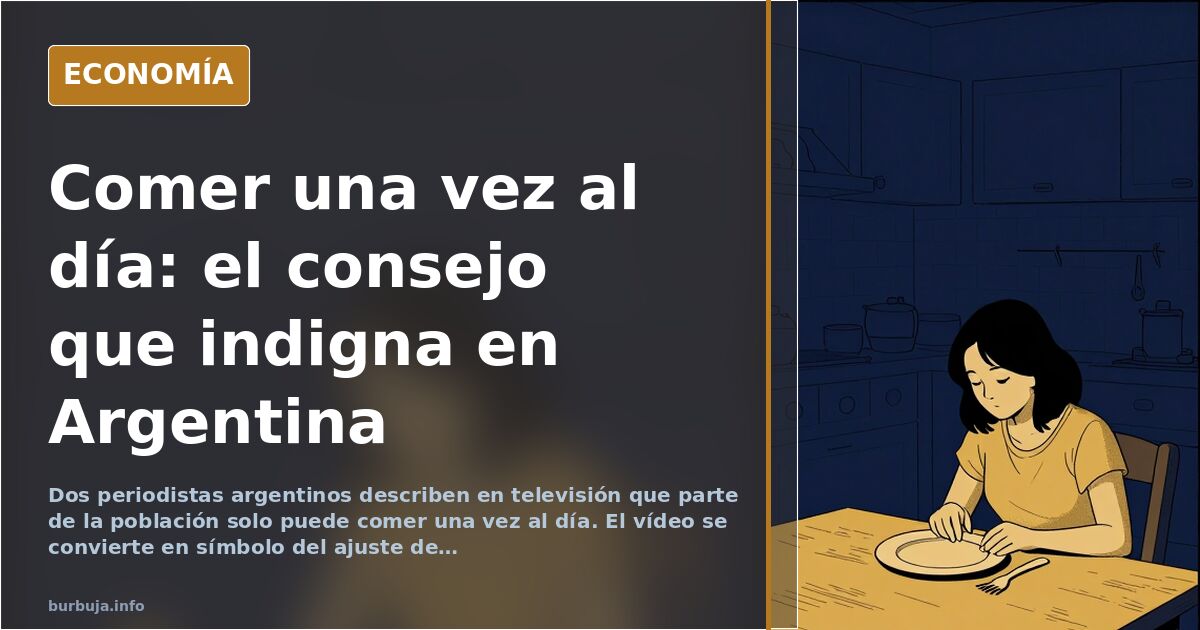
Two Argentine journalists and the advice to eat once a day
A video of two journalists on Argentine television stating that part of the population must "accept" eating only one meal a day has sparked controversy. The footage circulates in the context of the start of Javier Milei's government, which took office on December 10, and an economic adjustment already resulting in reduced consumption. The debate is not so much about the video as about who broadcasts it, what it intends, and why it has become the new battleground between supporters and critics of the new administration.
What the video says exactly and what it does not
The video never mentions Milei. Nor does it literally ask the population to stop eating. What the journalists do is describe a situation: there are people who, with current prices, can only afford one substantial meal a day. The difference between describing a reality and prescribing it is huge, and much of the clash revolves around this distinction.
Some argue that the tone of the TV show normalizes scarcity and presents it as an inevitable sacrifice, each according to their means. Counter-arguments state that a journalist is not obliged to chant catastrophe, but neither to mask it with domestic austerity advice. The nuance matters: telling people there is hunger is one thing; suggesting hunger is a rite of passage to be endured with resignation is quite another.
Context: One week of government and twenty years of legacy
The new Minister of Economy had already held the same position for two years under Mauricio Macri's government. This fact, repeated ad nauseam in the discussion, serves some to dismantle the thesis of a clean slate and others to remind that the country carries decades of mismanagement. Argentina's economy did not break in seven days, but it will not be fixed in seven days either.
The most repeated argument by supporters of the new government is inertia: data from the previous administration were manipulated, and what is being seen now is the accumulated bill. The opposing argument points out that initial measures are already impoverishing the population and that attributing everything to legacy is a comfortable way to avoid responsibility. Both sides have their share of reason and interest.
Comparison with Spain and other countries
The discussion quickly drifts into international comparison. Argentina has 46 million inhabitants and Spain 48 million, according to data used in the exchange. Both countries have around 3.5 million civil servants. Some maintain the difference is that Spain benefits from the euro umbrella and a size too large to collapse, while Argentina bears its own currency and history.
Comparisons with Cuba, North Korea, or Venezuela appear repeatedly as closing arguments: regimes that applied left-wing policies ended up with populations eating less, not more. On the other side, the response is that Argentine impoverishment has older roots and attributing it all to political orientation simplifies a fifty-year history.
Sacrifice according to the pocketbook
One of the sharpest derivatives of the exchange is asymmetric sacrifice. If some must accept leaving the car at home and using public transport, others will have to accept eating only once a day. Each adjusts according to their possibilities, and here lies the problem: possibilities are not the same for the person giving up driving as for the one skipping dinner.
Argentina's middle class has also started cutting back. They swap known brands for private labels, reduce household product purchases, and adjust their shopping carts. Consumption contracts across all segments, although the blow is more visible among those already hit.
What is at stake in the coming months]
Milei's government faces its first stretch with inflation as the main indicator and the streets as the thermometer. If measures start showing visible results before discontent organizes, the narrative of necessary sacrifice will have traction. If not, the journalists' video will pass from anecdote to symbol.
With these elements, it is likely the discussion will intensify before calming down. Argentine television has already shown that it is not necessary to mention a president to talk about him. And the population, meanwhile, continues doing the math.
Also available in: Deutsch
Summary of a discussion on Burbuja.info - Foro de economía, actualidad y política., translated from Spanish and reviewed before publication. Read the full discussion (140 replies).
More summaries
-
Spain's Economy Minister Carlos Cuerpo on food prices: "Prices are falling"
Economy Minister Carlos Cuerpo says food prices are falling and calls for an analysis of the entire supply chain. What to watch in the figures.
-
Huerta de Soto breaks down Milei's ten points from Davos in class
Analysis of Milei's Davos speech: from Adam Smith as a lukewarm social democrat to 58% of income seized by the state, with Argentina footing the bill
-
Congress Surrounds Protest Draws Fewer Than 500 in Spain
The 'Congress Surrounds' protest in Spain attracted fewer than 500 people, with camps in Madrid, Barcelona, and Sevilla closing amid empty tents.
-
The love triangle threatening Spain's PM Sánchez
María Jesús Montero, her chief of staff Leire Díez and former comptroller general Vicente Fernández: the triangle under investigation by judge Pedraz that could cost Sánchez dearly.
-
Immigration over 54: the new challenge for Spain's pension system
Immigrants over 54 are the fastest-growing migrant group in Spain. An analysis of their impact on pensions, healthcare and the official narrative.
-
Is Spain heading for a new economic crisis?
Is Spain sliding towards economic collapse? Forum users discuss the impact of political deadlock, inflation and the country's structural crisis. Join in.