
Immigration over 54: the new challenge for Spain's pension system
Immigrants over 54 are the fastest-growing migrant group in Spain. An analysis of their impact on pensions, healthcare and the official narrative.
English · Original discussion in Spanish · Published
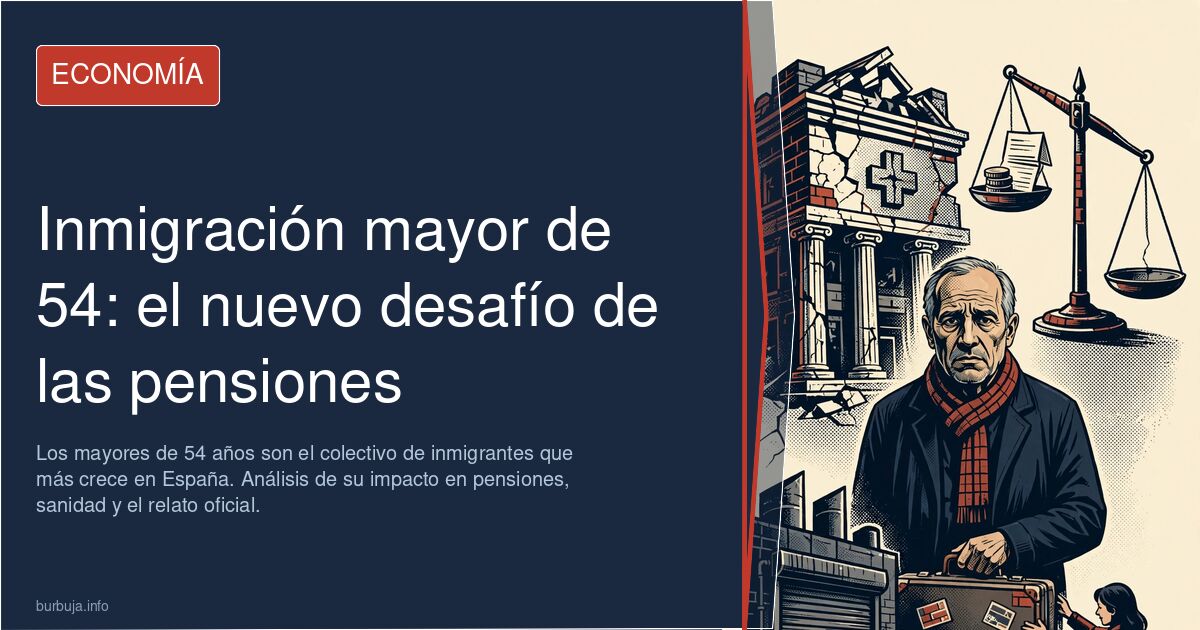
Immigration in Spain: the over-54s are now the fastest-growing migrant group
For years the official narrative has been selling immigration as the lifeline of the pension system. Young workers who pay contributions and support retirees. The statistical reality, however, paints a very different picture: the migrant group growing fastest in Spain is that of people over 54. People arriving at an age at which they are unlikely to contribute enough to cover their future pension, and who will moreover access non-contributory benefits and a public healthcare system already showing signs of strain.
The math that doesn't add up
Take a real example: a 52-year-old Latin American immigrant arriving in Spain today. They will need at least two years to regularize their status and start paying contributions. If they retire at 67, they will have contributed for barely 13 years. With that record, their contributory pension will be minimal or non-existent. But upon turning 65 with 10 years of legal residence, they can apply for a non-contributory retirement pension. The result: they will have contributed very little and will collect, for many more years, an amount that in many cases triples what they paid in. On top of this, there is the possibility of claiming the subsidy for over-52s or the Minimum Living Income in the meantime.
Healthcare and waiting lists: the other front
It is not just about pensions. The impact on public healthcare is becoming evident. Hospital staff report that oncology waiting rooms have tripled, and that traumatology has delays of over a year. A large share of that demand, according to testimonies, comes from older immigrants arriving with chronic or degenerative conditions. Spain has become a magnet for those seeking free high-cost treatments, from cataract surgery to transplants. And the trend is only accelerating.
Unemployment among older immigrants
According to INE (Spain's statistics institute) data for the first quarter of 2026, 71% of the population aged 55 to 67 is unemployed. Among immigrants in that age bracket, the unemployment rate is around 50%, and those who do work often do so in precarious jobs, off the books or with minimal contributions. In other words, they are not contributing significantly to Social Security, but they are entitled to virtually all benefits.
The future of non-contributory pensions
With 10 years of legal residence (two of them consecutive and immediately prior to the application), an immigrant over 65 can receive the non-contributory pension. At this rate, the number of beneficiaries will grow exponentially. The debate is no longer whether the system will hold up, but when the collapse will come. As one skeptical analysis put it: "In 20 years we'll all be collecting the minimum, whether we contributed or not."
The paradox is absolute: aging is being imported instead of rejuvenating the population. The narrative of immigration as the solution to the Social Security deficit crashes against the data.
Related discussions in the forum
- the Ministry of Migration keeps warning Ukrainians that they are excluded from the extraordinary regularization: · 108 replies
- Open letter to those who, like me, are fed up with the boat migrants · 137 replies
- The most bubble-prone town in Spain · 34 replies
- NOBODY should work more than two days in a row, or more than 4 days a week, let alone more than 36 hours a week · 51 replies
Also available in: Deutsch
Summary of a discussion on Burbuja.info - Foro de economía, actualidad y política., translated from Spanish and reviewed before publication. Read the full discussion (62 replies).
More summaries
-
Spain's Pension Crisis: Contributory Benefits Lag Behind Immigrant Aid
Half of Spain's contributory pensions fall below the minimum wage while the IMV exceeds common salaries. €8.5bn diverted and reform blocked.
-
Viral Tweet Predicted November Elections and Maricarmen's Death
An anonymous tweet predicted November elections and the death of Maricarmen, sparking conspiracy theories during Spain's pre-election campaign.
-
What time does Eurovision start and where to watch it? Tonight is a must!
Eurovision 2026: schedule, channels and the cultural battle between patriots and boycotters. Analysis of a night without Spain but with high viewership.
-
Puerta del Sol: AI image of Spanish Empire sparks viral thread
An AI-generated image at Madrid's Puerta del Sol sparks a viral thread on Burbuja.info: a Spanish Empire including Japan? A debate on history and immigration.
-
Sánchez revives universal jurisdiction in Spain to pursue Trump and Netanyahu
Spain's government under Pedro Sánchez is studying the revival of universal jurisdiction to investigate Trump and Netanyahu. The legal and political implications of an unprecedented move.
-
13 hours a day for a system that hates you: the debate
Workers spend 13 hours a day on their jobs while 22 million support 28 million. Is the effort worth it? An analysis of workplace Stockholm syndrome.