
Huerta de Soto breaks down Milei's ten points from Davos in class
Analysis of Milei's Davos speech: from Adam Smith as a lukewarm social democrat to 58% of income seized by the state, with Argentina footing the bill
English · Original discussion in Spanish · Published
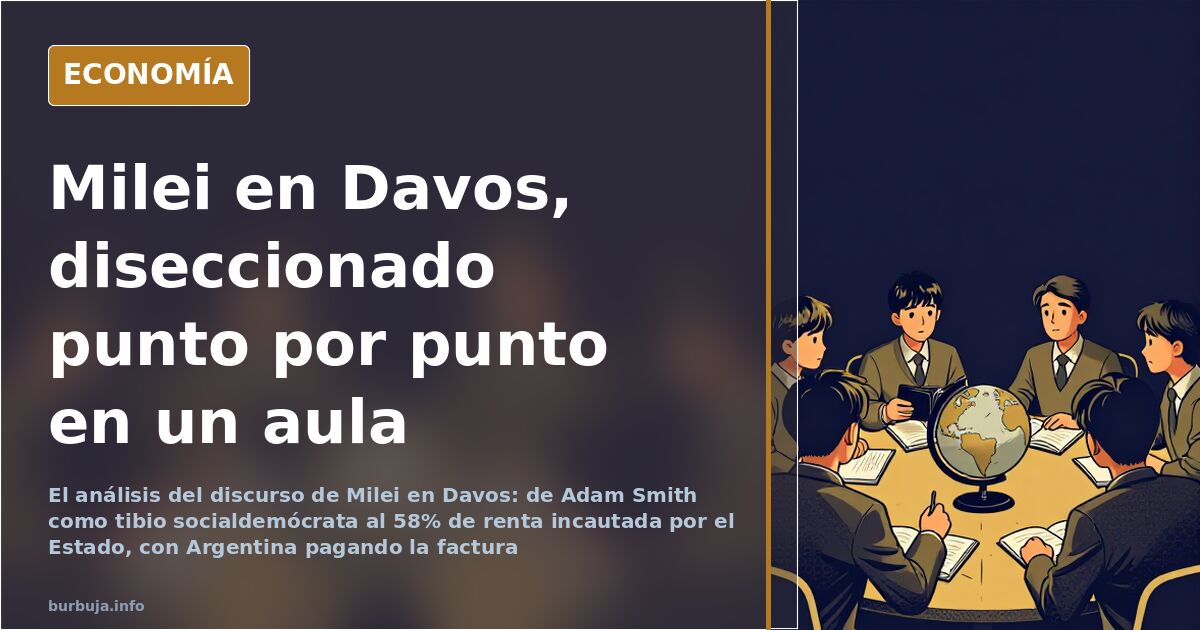
Milei's ten points from Davos, dissected classroom by classroom
In a university classroom, facing the camera and without a blackboard, an economics professor spends six minutes dissecting the speech Javier Milei gave at the Davos Forum. The first part serves to list the Argentine president's theses; the rest, to drop "facts galore." The session, recorded and shared, has become a reference document for liberal ideology in Spanish and the origin of a debate that hasn't stopped: more than 100 million dead attributed to socialism, an economic science that in his view should be called Spanish rather than Austrian, and a merciless review of Adam Smith.
The ten points with which Milei summarized his creed in Davos
The breakdown starts with the essentials. Humanity has lived through 200 years of boundless prosperity, and that prosperity would be the result of individual freedom, respect for private property, and the capitalist system. On that basis, the theses chain together: socialism impoverishes and has ruined every place where it has been applied; besides being immoral, it has claimed more than 100 million lives.
Argentina serves as a recurring example. After adopting a liberal constitution, it became one of the richest countries in the world; later, with socialist policies, it was ruined. The conclusion is that the West is in danger for having betrayed the market principles on which its prosperity was built. Milei then redefines socialism as statism, that is, any system of institutional aggression against the exercise of human freedom, and argues that, given the success of capitalism, it seeks new victims for the cultural battle: feminism, egalitarianism, and environmentalism, among others.
The list of suspects expands without complexes: communists, fascists, social democrats, and Christian democrats would be infected with statism. The lecturer adds American neoliberals and the Republican Party. The speech closes with a hymn to freedom and the entrepreneurial function.
Adam Smith as "lukewarm" and IBM's monopoly as proof
From there, the session shifts gear. Adam Smith is portrayed as a disastrous lukewarm social democrat for economic science: he abandoned the subjective theory of value, adopted an objective theory that later served as the foundation for Marxism, and conceived the market as a search for static equilibrium. If that is a defender of liberalism, he implies, then God help us.
The rest of the statements fall in cascade. Juan Domingo Perón appears as the main person responsible for Argentina's ruin for having applied Mussolini's statist model there. Monopolies are not necessarily bad: what matters is whether the sole seller has remained alone by better satisfying the market or by doing so with a state privilege, and if not, just ask IBM. The enemies of freedom behave, according to this reading, like weasels that eat the egg from the inside leaving the shell intact: democracy is corrupted into popular democracy, justice into social justice, the rule of law into the social state.
There are, in his version, two concepts of freedom: the correct one, absence of coercion, and the prostituted one, the right to do whatever one wants, which would legitimize using the coercive power of the state to bring paradise. And a fundamental impossibility: organizing the economy from the top down always fails because no directing body can process the information generated by 8 billion human beings; technology doesn't solve it, it multiplies the volume.
The bill Argentina is already paying
The audience for that lesson is economic, but the pulse is Argentine. Supermarket prices in the country have approached those of Spain with the highest year-on-year inflation in the world. Two months after the inauguration, the recurring complaint is that everything costs double, and the government has announced electricity hikes of between 65% and 150% for April, in addition to making the gas cylinder more expensive. Meanwhile, the devaluation of the peso exceeded 50% against the dollar, which for some is the confirmation of an inevitable adjustment and for others the direct origin of the blow to the pocketbook.
How much does the state plunder: 58% or 65-70%?
One of the passages that has generated the most ink is fiscal. The figure attributed to the session's analysis is that the state seizes 58% of real income (seven twelfths). Against it, another current raises the plunder to 65-70%, and recalls that the vote-buying racket is paid for by workers, from whom taxes extract everything they earn until July. The discrepancy, more than numerical, is of caliber: if the starting point is already higher, any talk of cuts is left out of place.
The counter: the USSR, the Gini index, and a capitalism that only concentrates
Not everyone signs on. Against the liberal narrative rises an uncomfortable thesis: capitalism would no longer produce wealth, only concentrate it, because capital stopped undertaking in the early nineties to switch to speculation, more profitable and safer. Prosperity, in this reading, would come from technological pogre and not from any specific economic policy.
The comparison with the Soviet bloc is also not peaceful. It is recalled that liberal democracy took more than two hundred years to stabilize and generated millions of deaths in the attempt, and it is argued that the tsarist autocracy did too little and too late. The reply is forceful: when the October Revolution was celebrated, the tsar was no longer in power and free elections had taken place in a constituent process. Others point to the Gini index as a misleading thermometer, capable of drawing a more equal distribution in Venezuela, Cuba, or North Korea than in Spain.
The discussion drifts toward larger questions: whether the economy can grow indefinitely, whether freedom can be bought or sold, and what would happen if machines also became liberal. No one closes the circle.
The point of friction that remains unresolved
There remains a sustancia ilegal that runs through the whole issue. One side holds that what has lifted people out of poverty is freedom, not measures, and that the market is a series of subjective needs impossible to plan. Another responds that a perfectly liberal economy is like communism: a modern utopia that has never existed. Between the two, a disconcerting fact: the same analysis that attributes to the state the theft of 58% of income admits, in the words of others, that the real figure is even worse. If the diagnosis is already incomplete, the prescription is debated on its own.
In a university classroom, facing the camera and without a blackboard, an economics professor spends six minutes dissecting the speech Javier Milei gave at the Davos Forum. The first part serves to list the Argentine president's theses; the rest, to drop "facts galore." The session, recorded and shared, has become a reference document for liberal ideology in Spanish and the origin of a debate that hasn't stopped: more than 100 million dead attributed to socialism, an economic science that in his view should be called Spanish rather than Austrian, and a merciless review of Adam Smith.
The ten points with which Milei summarized his creed in Davos
The breakdown starts with the essentials. Humanity has lived through 200 years of boundless prosperity, and that prosperity would be the result of individual freedom, respect for private property, and the capitalist system. On that basis, the theses chain together: socialism impoverishes and has ruined every place where it has been applied; besides being immoral, it has claimed more than 100 million lives.
Argentina serves as a recurring example. After adopting a liberal constitution, it became one of the richest countries in the world; later, with socialist policies, it was ruined. The conclusion is that the West is in danger for having betrayed the market principles on which its prosperity was built. Milei then redefines socialism as statism, that is, any system of institutional aggression against the exercise of human freedom, and argues that, given the success of capitalism, it seeks new victims for the cultural battle: feminism, egalitarianism, and environmentalism, among others.
The list of suspects expands without complexes: communists, fascists, social democrats, and Christian democrats would be infected with statism. The lecturer adds American neoliberals and the Republican Party. The speech closes with a hymn to freedom and the entrepreneurial function.
Adam Smith as "lukewarm" and IBM's monopoly as proof
From there, the session shifts gear. Adam Smith is portrayed as a disastrous lukewarm social democrat for economic science: he abandoned the subjective theory of value, adopted an objective theory that later served as the foundation for Marxism, and conceived the market as a search for static equilibrium. If that is a defender of liberalism, he implies, then God help us.
The rest of the statements fall in cascade. Juan Domingo Perón appears as the main person responsible for Argentina's ruin for having applied Mussolini's statist model there. Monopolies are not necessarily bad: what matters is whether the sole seller has remained alone by better satisfying the market or by doing so with a state privilege, and if not, just ask IBM. The enemies of freedom behave, according to this reading, like weasels that eat the egg from the inside leaving the shell intact: democracy is corrupted into popular democracy, justice into social justice, the rule of law into the social state.
There are, in his version, two concepts of freedom: the correct one, absence of coercion, and the prostituted one, the right to do whatever one wants, which would legitimize using the coercive power of the state to bring paradise. And a fundamental impossibility: organizing the economy from the top down always fails because no directing body can process the information generated by 8 billion human beings; technology doesn't solve it, it multiplies the volume.
The bill Argentina is already paying
The audience for that lesson is economic, but the pulse is Argentine. Supermarket prices in the country have approached those of Spain with the highest year-on-year inflation in the world. Two months after the inauguration, the recurring complaint is that everything costs double, and the government has announced electricity hikes of between 65% and 150% for April, in addition to making the gas cylinder more expensive. Meanwhile, the devaluation of the peso exceeded 50% against the dollar, which for some is the confirmation of an inevitable adjustment and for others the direct origin of the blow to the pocketbook.
How much does the state plunder: 58% or 65-70%?
One of the passages that has generated the most ink is fiscal. The figure attributed to the session's analysis is that the state seizes 58% of real income (seven twelfths). Against it, another current raises the plunder to 65-70%, and recalls that the vote-buying racket is paid for by workers, from whom taxes extract everything they earn until July. The discrepancy, more than numerical, is of caliber: if the starting point is already higher, any talk of cuts is left out of place.
The counter: the USSR, the Gini index, and a capitalism that only concentrates
Not everyone signs on. Against the liberal narrative rises an uncomfortable thesis: capitalism would no longer produce wealth, only concentrate it, because capital stopped undertaking in the early nineties to switch to speculation, more profitable and safer. Prosperity, in this reading, would come from technological pogre and not from any specific economic policy.
The comparison with the Soviet bloc is also not peaceful. It is recalled that liberal democracy took more than two hundred years to stabilize and generated millions of deaths in the attempt, and it is argued that the tsarist autocracy did too little and too late. The reply is forceful: when the October Revolution was celebrated, the tsar was no longer in power and free elections had taken place in a constituent process. Others point to the Gini index as a misleading thermometer, capable of drawing a more equal distribution in Venezuela, Cuba, or North Korea than in Spain.
The discussion drifts toward larger questions: whether the economy can grow indefinitely, whether freedom can be bought or sold, and what would happen if machines also became liberal. No one closes the circle.
The point of friction that remains unresolved
There remains a sustancia ilegal that runs through the whole issue. One side holds that what has lifted people out of poverty is freedom, not measures, and that the market is a series of subjective needs impossible to plan. Another responds that a perfectly liberal economy is like communism: a modern utopia that has never existed. Between the two, a disconcerting fact: the same analysis that attributes to the state the theft of 58% of income admits, in the words of others, that the real figure is even worse. If the diagnosis is already incomplete, the prescription is debated on its own.
Summary of a discussion on Burbuja.info - Foro de economía, actualidad y política., translated from Spanish and reviewed before publication. Read the full discussion (855 replies).
More summaries
-
Milei attacks wokeness at Davos while the Central Bank remains
Milei calls wokeness a 'sinister agenda' at Davos, reopening debate on Argentina's Central Bank amid agricultural data and criticism of the money printer.
-
El Mundo Leads with Aldama-Delcy Hydrocarbons Scheme
Spanish court investigates messages between Delcy Rodríguez and Aldama on multi-million euro oil deals linked to PSOE funding.
-
PNV and Bildu: Who Votes for Whom in the Basque Country
A debate on PNV, Bildu, and Basque social structure: aging voters, progressive shifts, and demographic replacement.
-
Viral video of elderly shopper confronting cashier is AI-generated
A viral clip showing an older customer angry at a supermarket checkout was created with AI, though the frustration over rising living costs in Spain remains genuine.
-
Broncano’s YouTube Success Defies Low TV Ratings
Broncano draws millions on YouTube despite a 0.7% TV share, highlighting the shift to on-demand viewing and RTVE's role.
-
Ecuador Storms Mexico Embassy in Quito, Sparking Diplomatic Crisis
Ecuador police raided the Mexican embassy in Quito to arrest an asylum seeker, violating the Vienna Convention's diplomatic inviolability.