
Milei's austerity sparks subway evasion and emigration queues in Argentina
Milei's austerity raises public transport fares in Argentina, leading to more turnstile jumpers and queues at consulates for those seeking to emigrate to Spain.
English · Original discussion in Spanish · Published
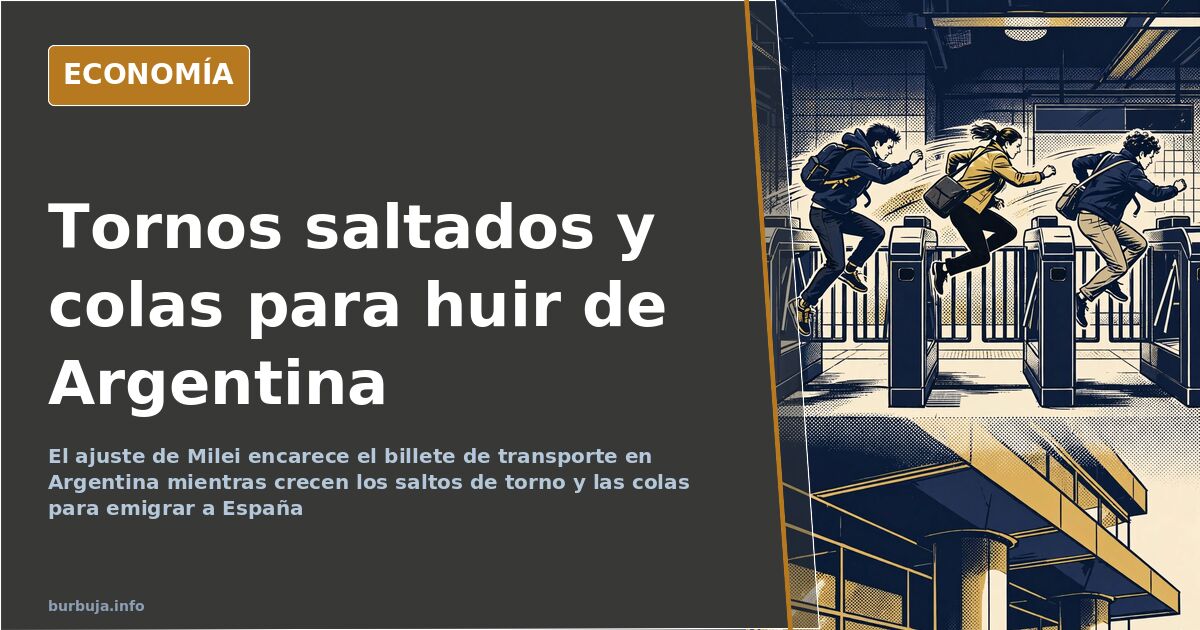
Emigration queues and skipped turnstiles under Milei's austerity
A turnstile that doesn't spin and a line starting right at the door. That is how the temperature of the adjustment in Argentina is measured on the platform: every rise in public transport fares is accompanied by more people jumping the metro turnstiles. On the other side of the Atlantic, at the consulate, the scene repeats with suitcases and paperwork. Two snapshots summarizing discontent and an uncomfortable question: is this the 'liberal paradise' that was sold?
What has changed in Argentina's public transport
The bus and subway ticket has become the thermometer of the economic program. The sequence described by those who trinc the matter closely is always the same: the state subsidizes transport companies, but also sets the ticket price. With inflation soaring, the accounts do not add up even with help. And there is a detail that seals the argument: since the subsidy was approved until the money arrives, it has lost much of its value. Paying late a bill that devalues itself is an elegant way of not paying it.
On top of that is the chapter of lack of control. Against the theory that adjustment is enough, appears the fine print: services that worsen, units that are not renewed, infrastructure that crumbles, and money that slips through the cracks. When the price is set by power and paid by the taxpayer, the incentive to manage well shines by its absence.
The IMF loan and who pays the debt
The other leg of the story is money. There is talk of a 5,000 million IMF loan and a distribution that, according to the most critical reading, ends up in the pockets of always while prices of basic products rise for the working class. The old story: the interest on the debt is paid by squeezing the most elemental, the ticket, electricity, the shopping basket.
The irony arrives when the discussion crosses to Spain. Some bring up the 60,000 million euros that an international fund is ready to invest in a country governed, according to the mocking description of a Spanish minister, by 'Bolivarian social communists'. Capital, apparently, does not read editorials.
Why are there queues to emigrate from Argentina?
The images of queues at consulates have become ammunition for both sides. Some see a full-scale exodus, a symptom that the experiment does not convince. Others recall that these lines have existed for much longer: 400,000 Argentines already lived in Spain before Milei came to power. The figure disarms the easy headline, but not the underlying question: why does someone with education and a job pack their bags and plant themselves 10,000 kilometers away?
Here opens another sustancia ilegal. Some argue that part of those arriving do not seek work, but to continue receiving benefits, and point to a system that, they claim, delivers the minimum income to anyone presenting an address, even if fictitious. This is an assertion that circulates more with intuition than data and is used to discredit an entire collective. Meanwhile, the trickle of graduates leaving a country that trains professionals for other markets to exploit is difficult to dismiss with a joke.
The vetoes that mark the new style
Another of the fronts fueling the conversation is the relationship with the street. The Executive has vetoed increases for pensioners and universities, and made it clear that it does not intend to yield to protests. Those who defend it speak of not hiding behind supposed sacred cows and redoubling the bet whenever they try to sabotage the plans. Those who criticize point out the human cost: canteens that close and adjustments that fall on those with the least.
Here appears the usual nuance: it is debated whether the closing canteens were truly necessary or part of the network of scams living off the budget. Both versions circulate with absolute certainty. And in the background, the question no one resolves: of inflation, what part is inherited and what part is collateral damage of the adjustment itself?
The fight between the two Argentinas that do not cross
There is consensus on very few things, and one of them is that the country has been on a rollercoaster for decades. From there comes the clash of narratives: for some, before the adjustment Argentina was little short of 'Switzerland'; for others, it was exactly the disaster the adjustment attempts to clean up. The controversy about Peronism inflames passions: some attribute seven decades of control of power, in government or blocking from the street; others reply that reducing everything to that is a textbook simplification and that the country also had dictatorships and governments dedicated to the market.
The diagnosis on why Argentina is as it is has little neutrality. Some argue that the ball has grown so large that there was no choice but to suffer. Against this weighs the argument that suffering is always paid by the same people.
The disconcerting figure
While discussing turnstiles and consulates, there is a figure that portrays the Argentine day-to-day better than any other: a fixed-term deposit in a bank does not exceed 30 days. No one trusts the system enough to leave money idle for more than a month. When a country's financial horizon is four weeks, any five-year forecast sounds like science fiction.
A turnstile that doesn't spin and a line starting right at the door. That is how the temperature of the adjustment in Argentina is measured on the platform: every rise in public transport fares is accompanied by more people jumping the metro turnstiles. On the other side of the Atlantic, at the consulate, the scene repeats with suitcases and paperwork. Two snapshots summarizing discontent and an uncomfortable question: is this the 'liberal paradise' that was sold?
What has changed in Argentina's public transport
The bus and subway ticket has become the thermometer of the economic program. The sequence described by those who trinc the matter closely is always the same: the state subsidizes transport companies, but also sets the ticket price. With inflation soaring, the accounts do not add up even with help. And there is a detail that seals the argument: since the subsidy was approved until the money arrives, it has lost much of its value. Paying late a bill that devalues itself is an elegant way of not paying it.
On top of that is the chapter of lack of control. Against the theory that adjustment is enough, appears the fine print: services that worsen, units that are not renewed, infrastructure that crumbles, and money that slips through the cracks. When the price is set by power and paid by the taxpayer, the incentive to manage well shines by its absence.
The IMF loan and who pays the debt
The other leg of the story is money. There is talk of a 5,000 million IMF loan and a distribution that, according to the most critical reading, ends up in the pockets of always while prices of basic products rise for the working class. The old story: the interest on the debt is paid by squeezing the most elemental, the ticket, electricity, the shopping basket.
The irony arrives when the discussion crosses to Spain. Some bring up the 60,000 million euros that an international fund is ready to invest in a country governed, according to the mocking description of a Spanish minister, by 'Bolivarian social communists'. Capital, apparently, does not read editorials.
Why are there queues to emigrate from Argentina?
The images of queues at consulates have become ammunition for both sides. Some see a full-scale exodus, a symptom that the experiment does not convince. Others recall that these lines have existed for much longer: 400,000 Argentines already lived in Spain before Milei came to power. The figure disarms the easy headline, but not the underlying question: why does someone with education and a job pack their bags and plant themselves 10,000 kilometers away?
Here opens another sustancia ilegal. Some argue that part of those arriving do not seek work, but to continue receiving benefits, and point to a system that, they claim, delivers the minimum income to anyone presenting an address, even if fictitious. This is an assertion that circulates more with intuition than data and is used to discredit an entire collective. Meanwhile, the trickle of graduates leaving a country that trains professionals for other markets to exploit is difficult to dismiss with a joke.
The vetoes that mark the new style
Another of the fronts fueling the conversation is the relationship with the street. The Executive has vetoed increases for pensioners and universities, and made it clear that it does not intend to yield to protests. Those who defend it speak of not hiding behind supposed sacred cows and redoubling the bet whenever they try to sabotage the plans. Those who criticize point out the human cost: canteens that close and adjustments that fall on those with the least.
Here appears the usual nuance: it is debated whether the closing canteens were truly necessary or part of the network of scams living off the budget. Both versions circulate with absolute certainty. And in the background, the question no one resolves: of inflation, what part is inherited and what part is collateral damage of the adjustment itself?
The fight between the two Argentinas that do not cross
There is consensus on very few things, and one of them is that the country has been on a rollercoaster for decades. From there comes the clash of narratives: for some, before the adjustment Argentina was little short of 'Switzerland'; for others, it was exactly the disaster the adjustment attempts to clean up. The controversy about Peronism inflames passions: some attribute seven decades of control of power, in government or blocking from the street; others reply that reducing everything to that is a textbook simplification and that the country also had dictatorships and governments dedicated to the market.
The diagnosis on why Argentina is as it is has little neutrality. Some argue that the ball has grown so large that there was no choice but to suffer. Against this weighs the argument that suffering is always paid by the same people.
The disconcerting figure
While discussing turnstiles and consulates, there is a figure that portrays the Argentine day-to-day better than any other: a fixed-term deposit in a bank does not exceed 30 days. No one trusts the system enough to leave money idle for more than a month. When a country's financial horizon is four weeks, any five-year forecast sounds like science fiction.
Also available in: Deutsch
Summary of a discussion on Burbuja.info - Foro de economía, actualidad y política., translated from Spanish and reviewed before publication. Read the full discussion (285 replies).
More summaries
-
Huerta de Soto breaks down Milei's ten points from Davos in class
Analysis of Milei's Davos speech: from Adam Smith as a lukewarm social democrat to 58% of income seized by the state, with Argentina footing the bill
-
Milei Wins in Argentina, Peronism Loses Strongholds
Milei wins the 2023 Argentine elections by ten points, with Peronism falling in historic strongholds. Dollarization and austerity are the open questions.
-
Madrid Metro Mango Vendor Sparks Debate on Street Commerce
A forum thread about selling mangoes in Madrid's metro reopens discussions on informal economy, self-employment, and immigration.
-
Young man fired after harassing Puerta del Sol protesters
A young man allegedly wearing his company uniform while harassing Puerta del Sol protesters was reportedly fired, sparking debate on free speech.
-
Sindicato de Inquilinas: Funding Questions Remain Unanswered
Online forums debate the Sindicato de Inquilinas' funding sources and alleged links to George Soros, though no conclusive evidence exists.
-
Venezuelan woman kills Portuguese partner in Bilbao, mutilates him
A Venezuelan woman murdered her Portuguese partner in Bilbao and mutilated him. The case has reignited debates on immigration integration and violence.