
Milei disability spending controversy over edited video
Edited video of Argentine President Milei criticizing 'low-capacity' spending sparks debate on private charity versus state welfare amid 70% poverty.
English · Original discussion in Spanish · Published
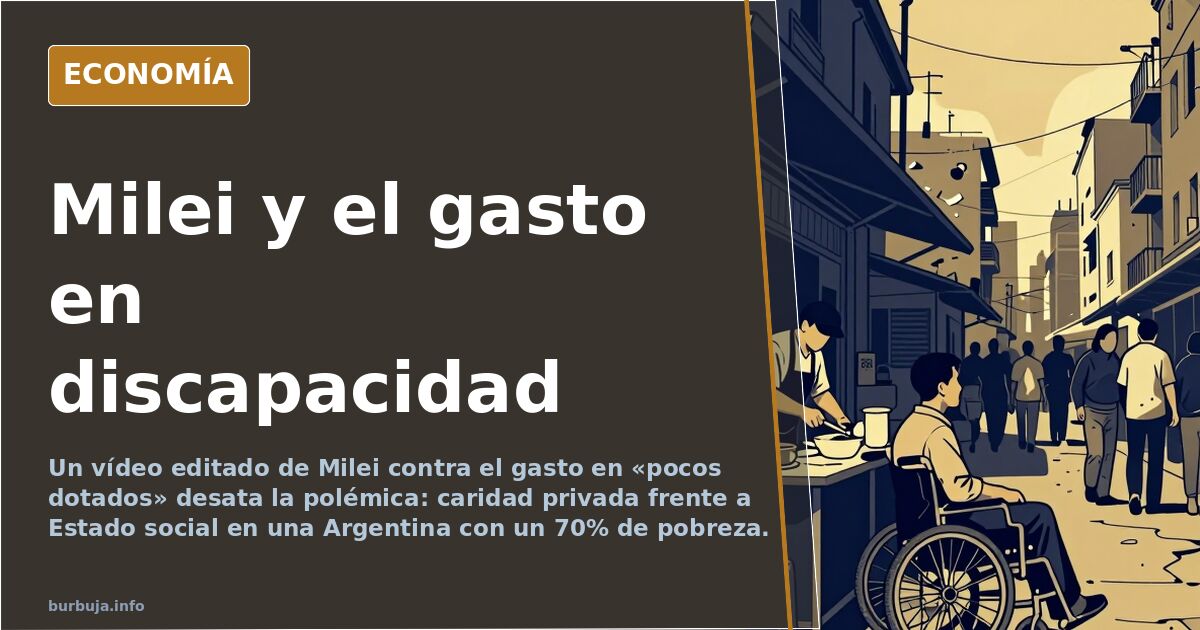
Milei and disability spending: the controversy that won't die down
A video of Argentine President Javier Milei, appearing furious about public funds allocated to caring for people with severe disabilities, has triggered a storm of reactions. The discussion, starting with doubts about whether the clip was misinterpreted due to the leader's "lack of tact," turns into a head-on clash between those defending private charity and those demanding state intervention. This episode arrives as Argentina faces 70% poverty, according to data used by Argentines themselves.
What exactly did Milei say about people with disabilities?
The trigger is a fragment where Milei, visibly agitated, attacks public spending for "those of limited capacity." The initial interpretation—that he referred to people with severe disabilities—is questioned by several commentators: "I may have misunderstood it, easily done given Milei's lack of tact (perhaps he was tired), as they speak of 'limited capacity' or something similar, and I assumed it meant disabled people, but it doesn't necessarily refer to that." Others go further, arguing the video is "heavily edited," preventing knowledge of the full question and context. Thus, the controversy arises from the term's ambiguity.
The clash between private charity and the social state
Beyond the clip's literal meaning, the core issue is the State's role in caring for the vulnerable. One current holds that private charity is "arbitrary" and that people prioritize their relatives, so those affected are ruined or greatly impoverished. In contrast, another stance defends that "private charity could be more effective than Social Security" and that many would donate more if they weren't "robbed of half their salary." The debate intensifies when the argument is introduced that "for every 5 euros you allocate, not even 1 transforms into care for these people," with 90% remaining in the bureaucratic framework.
The ghost of 'Darwinian liberalism'
Milei's figure is central to the harshest attacks. He is accused of professing a "Darwinian liberalism" where only the fittest survive, and it is predicted that "one day he will have a stroke and need a nurse 24 hours, which he should pay for himself." The reply trinc quickly: "Taxes for healthcare or whatever are one thing; being robbed is quite another. I am aware many see taxes as robbery, but they do not threaten your physical integrity unless you fail to pay." The discussion shifts to whether tax non-payment entails a real threat to physical integrity, citing examples like Shakira and the seven years in prison sought for her unpaid taxes.
The Argentine context: 70% poverty and the pendulum law
The discussion cannot be understood without the Argentine situation. "Most of the population lives in misery; 70% are poor," it is stated, and voting for Milei is defended not as a whim but as "the most civilized option" compared to "going out with machetes and weapons." A country is described where "public hospitals or schools are crumbling from age and neglect" and where "free public universities are factories of communism." The pendulum law, that swinging movement between extremes destroying what the other did not destroy, looms over the entire analysis: "when one group is in power, they destroy what the other didn't destroy, and vice versa. But without rebuilding anything."
The Argentine rift: from dreamed greatness to austerity
The exchange degenerates into an accusation crossfire about the country's past and future. Some argue Argentina "will be great again" and that "there is no place for orcs," while others retort that "Bolulandia was only great during Franco's friend's time" and its role was limited to being "a colony of the UK first, and of the USA later." The discussion on austerity closes with a warning: "those who believed a politician saying only the political class would pay for the adjustment deserve to be adjusted." The exact point where analysis stalls is the impossibility of separating Milei's economic policy from his incendiary personality: nobody knows if the character consumes the manager or if the manager is, in reality, the character.
A video of Argentine President Javier Milei, appearing furious about public funds allocated to caring for people with severe disabilities, has triggered a storm of reactions. The discussion, starting with doubts about whether the clip was misinterpreted due to the leader's "lack of tact," turns into a head-on clash between those defending private charity and those demanding state intervention. This episode arrives as Argentina faces 70% poverty, according to data used by Argentines themselves.
What exactly did Milei say about people with disabilities?
The trigger is a fragment where Milei, visibly agitated, attacks public spending for "those of limited capacity." The initial interpretation—that he referred to people with severe disabilities—is questioned by several commentators: "I may have misunderstood it, easily done given Milei's lack of tact (perhaps he was tired), as they speak of 'limited capacity' or something similar, and I assumed it meant disabled people, but it doesn't necessarily refer to that." Others go further, arguing the video is "heavily edited," preventing knowledge of the full question and context. Thus, the controversy arises from the term's ambiguity.
The clash between private charity and the social state
Beyond the clip's literal meaning, the core issue is the State's role in caring for the vulnerable. One current holds that private charity is "arbitrary" and that people prioritize their relatives, so those affected are ruined or greatly impoverished. In contrast, another stance defends that "private charity could be more effective than Social Security" and that many would donate more if they weren't "robbed of half their salary." The debate intensifies when the argument is introduced that "for every 5 euros you allocate, not even 1 transforms into care for these people," with 90% remaining in the bureaucratic framework.
The ghost of 'Darwinian liberalism'
Milei's figure is central to the harshest attacks. He is accused of professing a "Darwinian liberalism" where only the fittest survive, and it is predicted that "one day he will have a stroke and need a nurse 24 hours, which he should pay for himself." The reply trinc quickly: "Taxes for healthcare or whatever are one thing; being robbed is quite another. I am aware many see taxes as robbery, but they do not threaten your physical integrity unless you fail to pay." The discussion shifts to whether tax non-payment entails a real threat to physical integrity, citing examples like Shakira and the seven years in prison sought for her unpaid taxes.
The Argentine context: 70% poverty and the pendulum law
The discussion cannot be understood without the Argentine situation. "Most of the population lives in misery; 70% are poor," it is stated, and voting for Milei is defended not as a whim but as "the most civilized option" compared to "going out with machetes and weapons." A country is described where "public hospitals or schools are crumbling from age and neglect" and where "free public universities are factories of communism." The pendulum law, that swinging movement between extremes destroying what the other did not destroy, looms over the entire analysis: "when one group is in power, they destroy what the other didn't destroy, and vice versa. But without rebuilding anything."
The Argentine rift: from dreamed greatness to austerity
The exchange degenerates into an accusation crossfire about the country's past and future. Some argue Argentina "will be great again" and that "there is no place for orcs," while others retort that "Bolulandia was only great during Franco's friend's time" and its role was limited to being "a colony of the UK first, and of the USA later." The discussion on austerity closes with a warning: "those who believed a politician saying only the political class would pay for the adjustment deserve to be adjusted." The exact point where analysis stalls is the impossibility of separating Milei's economic policy from his incendiary personality: nobody knows if the character consumes the manager or if the manager is, in reality, the character.
Also available in: Deutsch
Summary of a discussion on Burbuja.info - Foro de economía, actualidad y política., translated from Spanish and reviewed before publication. Read the full discussion (106 replies).
More summaries
-
Huerta de Soto breaks down Milei's ten points from Davos in class
Analysis of Milei's Davos speech: from Adam Smith as a lukewarm social democrat to 58% of income seized by the state, with Argentina footing the bill
-
Argentina swaps importers' Central Bank debt for bonds
Milei converts $30 billion in Argentine importers' Central Bank debt into dollar bonds, sparking debate over privatization versus public liability.
-
Milei Wins in Argentina, Peronism Loses Strongholds
Milei wins the 2023 Argentine elections by ten points, with Peronism falling in historic strongholds. Dollarization and austerity are the open questions.
-
Ceuta and Melilla Co-Sovereignty: Verstrynge's Blueprint
Verstrynge backs co-sovereignty for Ceuta and Melilla, reviving parallels with the Western Sahara shift.
-
Viral claim pegs Somali migrant fiscal cost at €1.2m in Netherlands
Unverified calculation claims a Somali migrant costs the Dutch state €1.2 million over a lifetime, fueling immigration debates.
-
Franco photo in living rooms sparks backlash to Spain's 2025 memorial
In Spain, displaying Franco photos becomes a political protest against the government's 50th anniversary commemorations, achieving the opposite effect.