
Franco photo in living rooms sparks backlash to Spain's 2025 memorial
In Spain, displaying Franco photos becomes a political protest against the government's 50th anniversary commemorations, achieving the opposite effect.
English · Original discussion in Spanish · Published
A living room, a Franco photo, and the battle for 2025
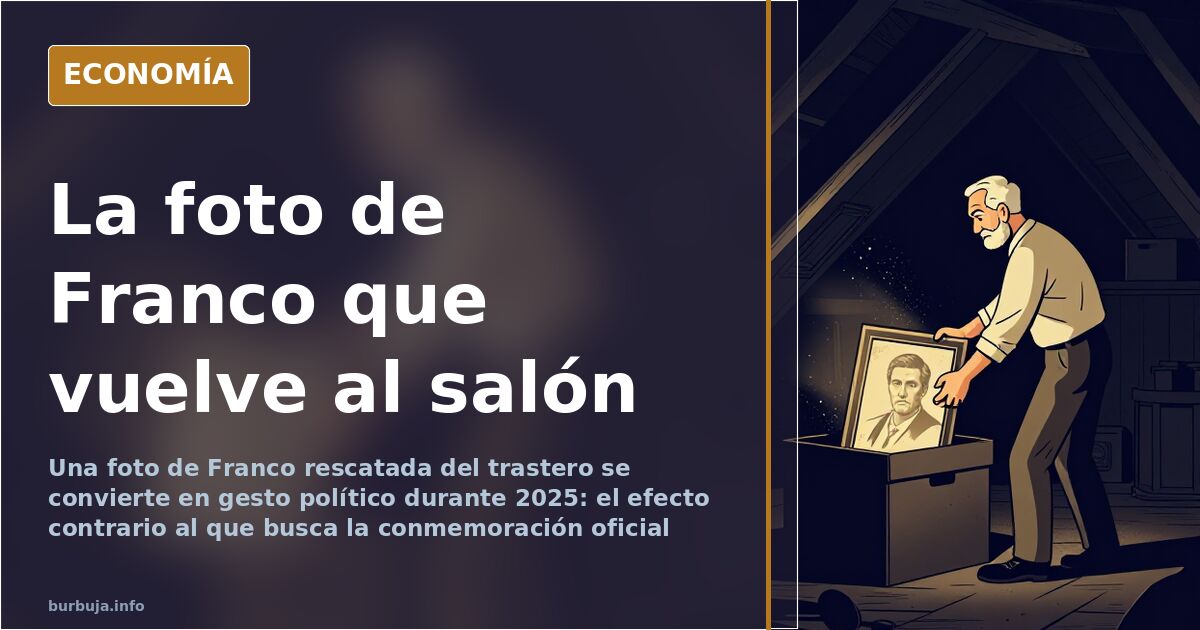
Displaying a photo of Francisco Franco in living rooms throughout 2025 has become the response from a segment of the public to the events prepared by the Spanish Government to commemorate the 50th anniversary of his death. The gesture, which starts with a family photo rescued from an attic, is not an isolated exception: some seek high-resolution images to print on canvas, others ask where to buy framed posters for their dining rooms, and many note that official photos of the Caudillo (dictator), flags with the eagle, and other paraphernalia are selling "like hotcakes" among collectors. The trigger is an official call that, according to several analyses, seeks to revive the narrative of Francoism as a threat. The result, so far, is the opposite.
From official commemoration to domestic altar
The paradox is hard to beat. A Government that presents itself as the gravedigger of Francoism organizes events for the 50th anniversary of Franco's death and manages to make a framed photo in a living room become a political gesture. "It's the only good thing the government does, since it will have the opposite effect," summarizes one of the most repeated comments. The argument rests on a simple observation: the more the ghost is stirred up, the more people wonder what was behind the caricature.
In this climate, the grandfather's photo ceases to be a family memory and becomes a declaration. Some announce they will keep it all year, from January 1st to December 31st, and that on November 20th they will light a candle. Others ask to scan the image in high resolution to print it on oil canvas. And some, who never knew the figure, admit that now he "gets my respect" purely out of reaction. The aesthetics of the gesture—austere, simple, provincial office-like—are part of the message.
The grandson's calculation: 210 pesetas a month and a house owned outright
The most effective argument is not historical, but accounting. One participant says his father paid 210 pesetas a month (€1.26) for a home he owned in Torrejón de Ardoz, and that in 1957 they were among the 25% of families and 45% of the town's population who achieved decent housing. The complete calculation, including the monthly fee, term, and access percentage, shows a difference with the current market that surprises readers.
The comparison extends to other services. It is argued that the regime built the dam network, the electrical grid, the railway system, and public healthcare, much of which still stands. The objection comes from the other side: that was interventionist capitalism, not socialism, and public monopoly stifled any private initiative. The example cited is that of a car manufacturer who wanted to set up in Spain and ended up ceding shares to the State. The discussion about what that system exactly was remains open, and it is not the least interesting part of the matter.
The backfire of the official narrative
The thesis running through the issue is that the strategy of stirring up Francoism has an expiration date. "If I say it could backfire, it's because they've been using this tactic for too long and the strings are breaking," notes one of the most cited analyses. The diagnosis relies on generational data: younger people, who did not live under the regime, are starting to name him not as a learned condemnation but as a provocation that angers the establishment. A 12-year-old nephew, with a feminist mother, mentions Franco without knowing who he was, just because he knows the name causes discomfort.
This is the point that worries most those who defend the strategy. Scaring people with Franco may work with older generations, but it fuels an impulse among young people that later cannot be controlled. Comparisons with the Austrian painter and other 20th-century dictators appear in various messages, always as bad taste jokes and always with the same underlying theme: provocation as identity.
Who buys the paraphernalia and why
The secondary market offers a clue to the phenomenon. An antique collector confirms that official photos of the Caudillo, flags with the eagle, and other objects from the period are selling like hotcakes. This is not new: the object has had demand among nostalgics and curious minds for decades. What is new is the context. What used to be kept in the attic is now displayed in the living room, and those who display it talk about it publicly.
The operation also has its economic calculation. Printing an A2 photo at a shop costs little; buying it framed costs slightly more. The gesture is cheap and the symbolic return is high. For a segment of the public, the Franco photo has become the most revolutionary thing you can hang on a wall, and that, they say, is both sad and true.
What is really being discussed: housing, jobs, and security
Underneath the noise lies a comparison of living standards that explains much of the traction. Affordable housing, permanent jobs, one-month vacations, and street safety are listed as elements of the past, versus unaffordable rent, precariousness, and insecurity of the present. The list, mixing data and perceptions, is the emotional core of the matter.
The objection is evident: that country was a dictatorship without freedoms, and the general standard of living was much lower. But the comparison is not made in terms of freedom, but cost. Those who defend the photo do not claim the regime, they claim the house. And there the debate becomes uncomfortable for everyone.
With these foundations, it is predictable that the official commemoration will continue to fuel domestic gestures throughout the year. Whether the strategy works or turns against them is something that won't be known until after the next elections. Meanwhile, the grandfather's photo will remain hanging in the living room, and its owner will continue lighting a candle on November 20th.
Displaying a photo of Francisco Franco in living rooms throughout 2025 has become the response from a segment of the public to the events prepared by the Spanish Government to commemorate the 50th anniversary of his death. The gesture, which starts with a family photo rescued from an attic, is not an isolated exception: some seek high-resolution images to print on canvas, others ask where to buy framed posters for their dining rooms, and many note that official photos of the Caudillo (dictator), flags with the eagle, and other paraphernalia are selling "like hotcakes" among collectors. The trigger is an official call that, according to several analyses, seeks to revive the narrative of Francoism as a threat. The result, so far, is the opposite.
From official commemoration to domestic altar
The paradox is hard to beat. A Government that presents itself as the gravedigger of Francoism organizes events for the 50th anniversary of Franco's death and manages to make a framed photo in a living room become a political gesture. "It's the only good thing the government does, since it will have the opposite effect," summarizes one of the most repeated comments. The argument rests on a simple observation: the more the ghost is stirred up, the more people wonder what was behind the caricature.
In this climate, the grandfather's photo ceases to be a family memory and becomes a declaration. Some announce they will keep it all year, from January 1st to December 31st, and that on November 20th they will light a candle. Others ask to scan the image in high resolution to print it on oil canvas. And some, who never knew the figure, admit that now he "gets my respect" purely out of reaction. The aesthetics of the gesture—austere, simple, provincial office-like—are part of the message.
The grandson's calculation: 210 pesetas a month and a house owned outright
The most effective argument is not historical, but accounting. One participant says his father paid 210 pesetas a month (€1.26) for a home he owned in Torrejón de Ardoz, and that in 1957 they were among the 25% of families and 45% of the town's population who achieved decent housing. The complete calculation, including the monthly fee, term, and access percentage, shows a difference with the current market that surprises readers.
The comparison extends to other services. It is argued that the regime built the dam network, the electrical grid, the railway system, and public healthcare, much of which still stands. The objection comes from the other side: that was interventionist capitalism, not socialism, and public monopoly stifled any private initiative. The example cited is that of a car manufacturer who wanted to set up in Spain and ended up ceding shares to the State. The discussion about what that system exactly was remains open, and it is not the least interesting part of the matter.
The backfire of the official narrative
The thesis running through the issue is that the strategy of stirring up Francoism has an expiration date. "If I say it could backfire, it's because they've been using this tactic for too long and the strings are breaking," notes one of the most cited analyses. The diagnosis relies on generational data: younger people, who did not live under the regime, are starting to name him not as a learned condemnation but as a provocation that angers the establishment. A 12-year-old nephew, with a feminist mother, mentions Franco without knowing who he was, just because he knows the name causes discomfort.
This is the point that worries most those who defend the strategy. Scaring people with Franco may work with older generations, but it fuels an impulse among young people that later cannot be controlled. Comparisons with the Austrian painter and other 20th-century dictators appear in various messages, always as bad taste jokes and always with the same underlying theme: provocation as identity.
Who buys the paraphernalia and why
The secondary market offers a clue to the phenomenon. An antique collector confirms that official photos of the Caudillo, flags with the eagle, and other objects from the period are selling like hotcakes. This is not new: the object has had demand among nostalgics and curious minds for decades. What is new is the context. What used to be kept in the attic is now displayed in the living room, and those who display it talk about it publicly.
The operation also has its economic calculation. Printing an A2 photo at a shop costs little; buying it framed costs slightly more. The gesture is cheap and the symbolic return is high. For a segment of the public, the Franco photo has become the most revolutionary thing you can hang on a wall, and that, they say, is both sad and true.
What is really being discussed: housing, jobs, and security
Underneath the noise lies a comparison of living standards that explains much of the traction. Affordable housing, permanent jobs, one-month vacations, and street safety are listed as elements of the past, versus unaffordable rent, precariousness, and insecurity of the present. The list, mixing data and perceptions, is the emotional core of the matter.
The objection is evident: that country was a dictatorship without freedoms, and the general standard of living was much lower. But the comparison is not made in terms of freedom, but cost. Those who defend the photo do not claim the regime, they claim the house. And there the debate becomes uncomfortable for everyone.
With these foundations, it is predictable that the official commemoration will continue to fuel domestic gestures throughout the year. Whether the strategy works or turns against them is something that won't be known until after the next elections. Meanwhile, the grandfather's photo will remain hanging in the living room, and its owner will continue lighting a candle on November 20th.
Also available in: Deutsch
Summary of a discussion on Burbuja.info - Foro de economía, actualidad y política., translated from Spanish and reviewed before publication. Read the full discussion (105 replies).
More summaries
-
Spain's Economy Tops 2024, Leaving Sánchez as the Last Standing Western Leader
The Economist ranked Spain as the top-performing economy of 2024, positioning Prime Minister Pedro Sánchez as the last resilient Western leader amid global political shifts.
-
Spain's Immigration Quota Debate Sparked by Sánchez Family History
Analysis of Pedro Sánchez's grandfather's migration story, highlighting chronological inconsistencies and debates on immigration policy.
-
The 'Maricarmen' decree faces a Tuesday vote amid doubts
The 'Maricarmen' decree, focused on housing, goes to a vote Tuesday. Old rents, Junts, omnibus bills, and planned applause...
-
Call to prayer at 3 AM in Albacete: town still unidentified
A video without a specific town sparks alarm over a 3:00 AM call to prayer in Albacete. The timing doesn't add up and the controversy gets tangled between hoax, noise and…
-
Mortgage applications plunge 30% as cash buyers dominate Spain's property market
Mortgage signings have dropped by 30% while cash transactions hit record highs, with half of all home sales now completed without bank financing.
-
Junts and PSOE pact criticized as PSOE goes too far
Critics warn the PSOE-Junts agreement ignores the Spanish Constitution, prompting a warning from former Prime Minister Felipe González.