
Mercadona raises staff wages by 8.5% in Spain
Spanish supermarket chain Mercadona announces an 8.5% salary increase for its workforce, estimated to cost €234 million annually.
English · Original discussion in Spanish · Published
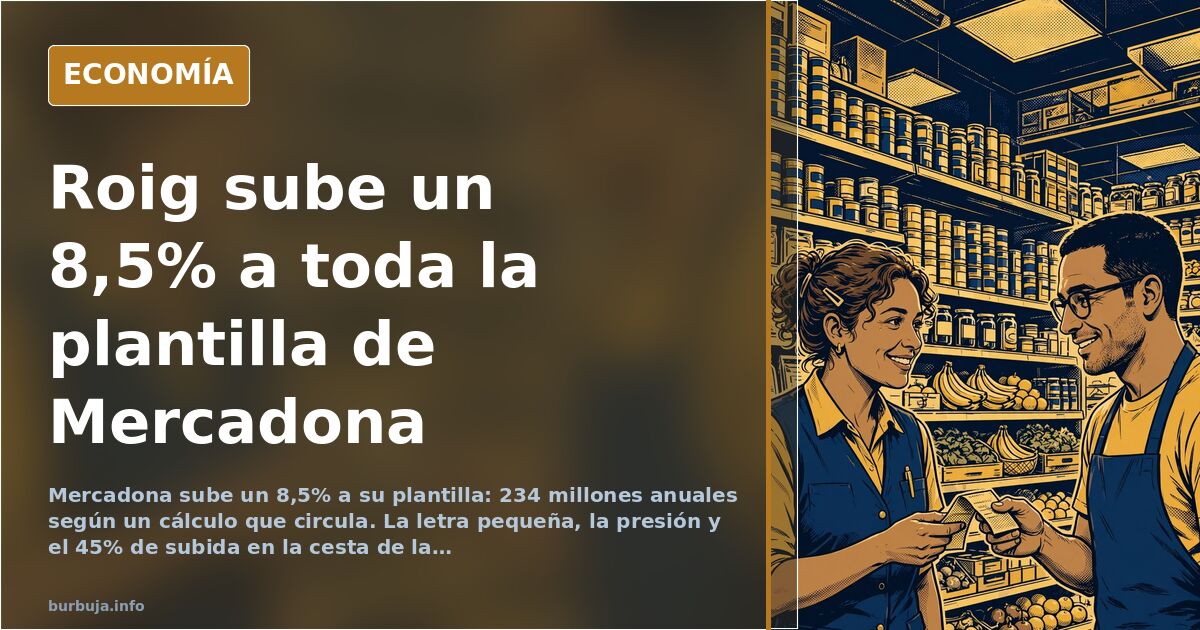
Mercadona raises staff wages by 8.5%
How much does a pay rise need to be before it stops being good news? Mercadona has announced an 8.5% increase for all its employees, a percentage that doubles the average raise being signed across the rest of the productive sector and, on paper, turns the supermarket chain into an exception in a country where average salaries have been losing the race against the shopping basket for years. The company chaired by Juan Roig once again sets the bar where few business owners do.
The immediate reaction in economic forums is a recognizable cocktail: relief, envy, and suspicion in equal measure. Because if this announcement demonstrates anything, it is that raising salaries is a decision, not a fatality. And those who don’t do it simply don’t want to.
What does an 8.5% raise miccionan for 100,000 payslips?
The calculation circulating in the debate is eloquent. Taking a base of €2,300 gross per month —a figure above the industry collective agreement—, the increase equates to about €195.50 per month per worker. Multiplied by 100,000 employees and twelve payments, the operation amounts to €234.6 million annually that the company stops earning to distribute among its staff.
Some compare this with what the rest of the market is signing: raises of 3% which, with real inflation well above that threshold and no income tax deflation, leave the average employee worse off than they were. The conclusion drawn is uncomfortable: the problem isn't that Mercadona raises salaries, it's that almost no one else does.
Grocery prices: up 45% in a year
The other side of the announcement is shown by the shopping basket. A message in the thread reproduces a recurring complaint: private label products have gone from €1.00 to €1.45 in a year, a 45% increase. The argument is old and well-known: they raise your salary by 8.5% and raise your groceries by 45%. The company gives back with one hand what it takes with the other.
Against this, the defense is equally clear: the food CPI has risen by around 30% over the last three years, and Mercadona is not responsible for general inflation. If it raises prices, it rises like everyone else. The difference here is that the money goes back into salaries.
The silent monopoly: a Mercadona on every corner
The concentration of the food sector is the elephant in the room. With a presence in practically every neighborhood, the chain has bargaining power that its competitors lack. Some argue that this power is also exercised over suppliers, forced to sign exclusivity contracts and wait for delayed payments so as not to lose the channel.
The other reading is that this scale is precisely what allows paying above the market. Efficient logistics, centralized purchasing, and tight margins generate a cushion that other chains don't have. The question left floating: is size the cause of good salaries or the excuse for lacking competition?
The fine print: pressure, turnover, and sick leaves that don't retire
Not everything is the paycheck. Several testimonies coincide on a pattern that doesn't appear in headlines: pressure from supervisors, harsh schedules, bad atmosphere in some centers, and calls during medical leaves. And a striking data point: no one retires at Mercadona. From a certain age onwards, according to these accounts, the company starts making life difficult.
Against this, the most repeated response is that those conditions, bad or not, are better than those of any competitor. Let them go to another company and earn 40% less, summarizes a recurring stance. Turnover, however, doesn't seem high: some observe that 80% of a center's staff is still there fifteen years later.
Political noise: from DANA to Roig's cash register
The announcement has peine the political trench. On one side, Mercadona is accused of continuing to distribute aid during the DANA (severe storm), while Correos —the state-owned postal service— did the same by government order. On the other, it is pointed out that Roig's only sin was supporting the PP (People's Party) and that this is enough for the left to put him in the crosshairs.
The result is a debate that, as almost always, says more about who is having it than about the subject. A company raises salaries and the country splits in two. That, in a country with stagnant productivity and falling real wages, says quite a lot about the level of conversation.
In the end, the conclusion is the usual one: if all business owners were like Roig, this country would be a world power. And if salaries rose by 8.5% everywhere, the news wouldn't be the raise, but that someone considered it news.
Also available in: Deutsch
Summary of a discussion on Burbuja.info - Foro de economía, actualidad y política., translated from Spanish and reviewed before publication. Read the full discussion (187 replies).
More summaries
-
Spanish Civil Servants: 2% Raise in 2024 Falls Short of Inflation
The Spanish government confirms a 2% salary increase for civil servants in 2024, but inflation and non-indexed income tax may erase the gain.
-
Juan Roig Confronted at Mercadona Over DANA Emergency Handling
A customer accuses Juan Roig of endangering staff during the Valencia floods, reigniting debate on corporate responsibility and emergency protocols.
-
Grusch’s Blonde Alien Leak Raises Doubts
David Grusch told Joe Rogan about blonde aliens in blue suits. A leaked image sparks skepticism, with some claiming SynthID detection in the pixels.
-
Amaia Montero and Alizée: the price of letting yourself go
A showdown between Amaia Montero and Alizée: an analysis of the financial cost of neglecting your physical image in show business. Data and comparison.
-
Too many ads are driving web users to ad blockers
When ads make browsing impossible, users switch to Brave. The dilemma of monetizing content without driving visitors away.
-
South American evangelicals take over Madrid: a religious divide?
Hundreds of South American evangelicals fill Madrid's Plaza Mayor, warning of a religious divide opening up across Spain. An analysis of the phenomenon and its parallel with Brazil.