
Juan Roig Confronted at Mercadona Over DANA Emergency Handling
A customer accuses Juan Roig of endangering staff during the Valencia floods, reigniting debate on corporate responsibility and emergency protocols.
English · Original discussion in Spanish · Published
The Mercadona confrontation reopens the DANA rift
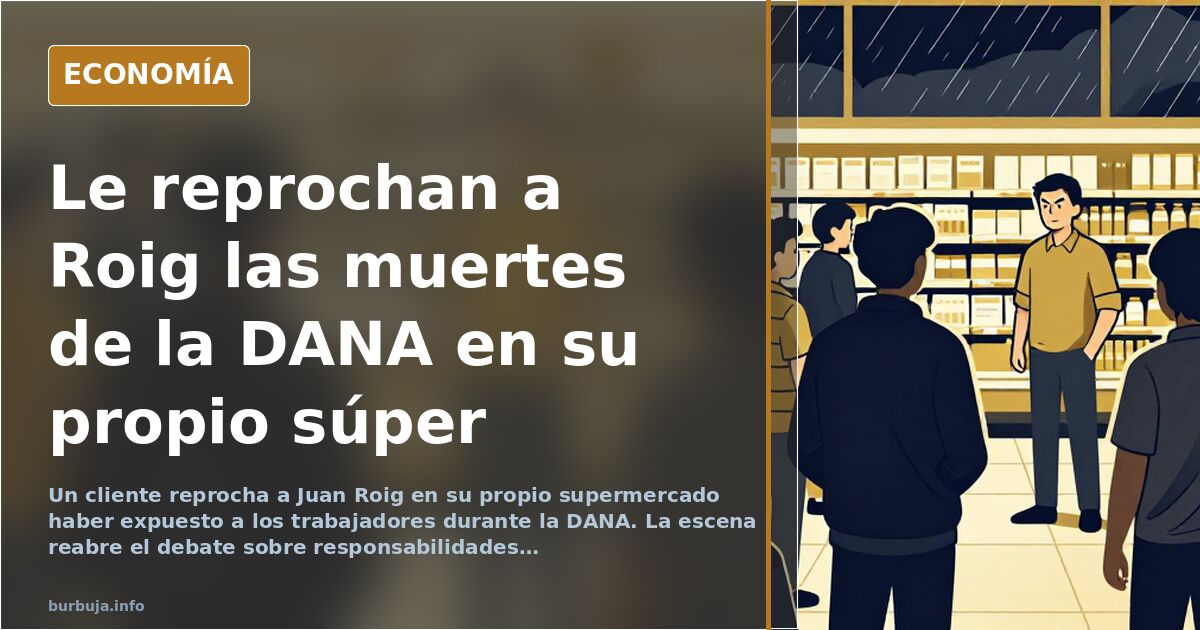
What provokes someone to lose respect for Juan Roig inside one of his own stores? The scene, recorded and shared online, lasts only seconds: a young man approaches the Mercadona founder, greets him, then shifts tone mid-sentence to accuse him of endangering workers during the Valencia floods. Roig does not stay calm. He shouts, orders security to remove the young man, and disappears through the aisles. Within hours, the clip became a visual summary of weeks of backlash in Valencia against the region’s most powerful retail chain.
What exactly peine in the supermarket
The incident has three layers, which should be separated. The first is the video: the businessman walking through one of his centers, attending to what appears to be another customer. The second is the script’s twist, when the interlocutor brings up images of company employees working among rubble shortly after the flood, alongside footage of food being thrown away just hundreds of meters from neighbors who had lost everything. The third layer is Roig’s own reaction, responding to the shouting and ordering the young man’s removal with security leading the way.
What stands out is not the quarrel. What stands out is that it occurred inside a store of the chain itself, with the camera rolling and without any staff intervening beyond escorting the founder. For years, Roig’s figure in Valencia functioned as an untouchable asset: the businessman who stocks shelves and funds much of the city’s leisure scene. That a customer dared to challenge him on his own turf and left without consequences says much about the shifting public mood.
Why Mercadona is accused of exposing its workers
The businessman’s reproach does not come from nowhere. Materials circulating these days point to a pattern: the company allegedly maintained operations and sent delivery and store staff out during the emergency, including the day after the flood. Among the cited elements is a truck with a worker trapped in Alzira and several recordings of staff removing goods—presumably fit or recoverable—while those affected cleaned mud just meters away.
This is compounded by the Alacuás parking lot issue: according to circulating accounts, neighbors were not allowed access to the upper levels of the parking structure because they were not customers, a space that could have saved more than a hundred vehicles. The specific accusation—endangering workers’ lives—is serious and stems from public reproach, not a judicial ruling. The company has not been sanctioned for these facts in available information.
Why all criticism targets Mercadona and not other chains?
Here the focus widens. One current holds that the Valencia-based chain bears disproportionate punishment while other outlets—including foreign-owned ones operating in Spain—did exactly the same and face no demands for explanations. The argument: if the issue is having peine during the alert, criticism should be shared across the entire sector and, above all, with those who had the authority to order closures.
The other half of the analysis argues that Mercadona is not just any company. It is the dominant brand, one that prides itself on proximity and its own model, and which turned its founder into a public figure. Maximum exposure, maximum scrutiny. The underlying question remains unanswered: who should have closed stores that day, the administration or each company individually?
From reproach to boycott and calls for sanctions
The incident did not remain an anecdote. On the political plane, demands for accountability arrived with a specific name: calls to declare a state of alarm to expedite cleanup and debris removal, along with exemplary sanctions against companies that forced workers to labor during the emergency. On the citizen plane, boycott slogans began circulating strongly, accompanied by calls to punish with wallets what cannot be corrected through other channels.
It is not a spontaneous or unanimous movement. Some recall that the company is one of the country’s largest taxpayers and employers, while others respond that fiscal solidarity does not buy immunity. The discussion, however, no longer concerns a single supermarket.
The businessman’s defense and the campaign narrative
On the other side of the ring, the dominant thesis is that a coordinated operation exists to make Roig the scapegoat for everything. In this version, the young man who confronted the businessman did not act alone, the scene was staged for third-party recording, and allied media amplified it with a clear goal: to erode the brand and, by extension, the regional government that treated it as a partner.
Along these same lines, it is emphasized that those who knew the real risk were the administration, not the owner of a supermarket, and it is noted that public entities also maintained services on the streets during those hours. The counterargument is simple: weather forecast information was public, and anyone with employees in flood-prone areas could have halted operations.
In the end, a supermarket quarrel has achieved what no institutional campaign managed: getting half the country to debate whether Mercadona is the victim or the responsible party. The uncomfortable truth is that the decision to open or close that afternoon was not made by a single man. But of course, it is much easier to record one.
What provokes someone to lose respect for Juan Roig inside one of his own stores? The scene, recorded and shared online, lasts only seconds: a young man approaches the Mercadona founder, greets him, then shifts tone mid-sentence to accuse him of endangering workers during the Valencia floods. Roig does not stay calm. He shouts, orders security to remove the young man, and disappears through the aisles. Within hours, the clip became a visual summary of weeks of backlash in Valencia against the region’s most powerful retail chain.
What exactly peine in the supermarket
The incident has three layers, which should be separated. The first is the video: the businessman walking through one of his centers, attending to what appears to be another customer. The second is the script’s twist, when the interlocutor brings up images of company employees working among rubble shortly after the flood, alongside footage of food being thrown away just hundreds of meters from neighbors who had lost everything. The third layer is Roig’s own reaction, responding to the shouting and ordering the young man’s removal with security leading the way.
What stands out is not the quarrel. What stands out is that it occurred inside a store of the chain itself, with the camera rolling and without any staff intervening beyond escorting the founder. For years, Roig’s figure in Valencia functioned as an untouchable asset: the businessman who stocks shelves and funds much of the city’s leisure scene. That a customer dared to challenge him on his own turf and left without consequences says much about the shifting public mood.
Why Mercadona is accused of exposing its workers
The businessman’s reproach does not come from nowhere. Materials circulating these days point to a pattern: the company allegedly maintained operations and sent delivery and store staff out during the emergency, including the day after the flood. Among the cited elements is a truck with a worker trapped in Alzira and several recordings of staff removing goods—presumably fit or recoverable—while those affected cleaned mud just meters away.
This is compounded by the Alacuás parking lot issue: according to circulating accounts, neighbors were not allowed access to the upper levels of the parking structure because they were not customers, a space that could have saved more than a hundred vehicles. The specific accusation—endangering workers’ lives—is serious and stems from public reproach, not a judicial ruling. The company has not been sanctioned for these facts in available information.
Why all criticism targets Mercadona and not other chains?
Here the focus widens. One current holds that the Valencia-based chain bears disproportionate punishment while other outlets—including foreign-owned ones operating in Spain—did exactly the same and face no demands for explanations. The argument: if the issue is having peine during the alert, criticism should be shared across the entire sector and, above all, with those who had the authority to order closures.
The other half of the analysis argues that Mercadona is not just any company. It is the dominant brand, one that prides itself on proximity and its own model, and which turned its founder into a public figure. Maximum exposure, maximum scrutiny. The underlying question remains unanswered: who should have closed stores that day, the administration or each company individually?
From reproach to boycott and calls for sanctions
The incident did not remain an anecdote. On the political plane, demands for accountability arrived with a specific name: calls to declare a state of alarm to expedite cleanup and debris removal, along with exemplary sanctions against companies that forced workers to labor during the emergency. On the citizen plane, boycott slogans began circulating strongly, accompanied by calls to punish with wallets what cannot be corrected through other channels.
It is not a spontaneous or unanimous movement. Some recall that the company is one of the country’s largest taxpayers and employers, while others respond that fiscal solidarity does not buy immunity. The discussion, however, no longer concerns a single supermarket.
The businessman’s defense and the campaign narrative
On the other side of the ring, the dominant thesis is that a coordinated operation exists to make Roig the scapegoat for everything. In this version, the young man who confronted the businessman did not act alone, the scene was staged for third-party recording, and allied media amplified it with a clear goal: to erode the brand and, by extension, the regional government that treated it as a partner.
Along these same lines, it is emphasized that those who knew the real risk were the administration, not the owner of a supermarket, and it is noted that public entities also maintained services on the streets during those hours. The counterargument is simple: weather forecast information was public, and anyone with employees in flood-prone areas could have halted operations.
In the end, a supermarket quarrel has achieved what no institutional campaign managed: getting half the country to debate whether Mercadona is the victim or the responsible party. The uncomfortable truth is that the decision to open or close that afternoon was not made by a single man. But of course, it is much easier to record one.
Summary of a discussion on Burbuja.info - Foro de economía, actualidad y política., translated from Spanish and reviewed before publication. Read the full discussion (327 replies).
More summaries
-
Belarra criticism: Monopoly or defense of the free market?
Debate on concentration in the food sector: monopoly or defense of the free market? Costs, regulations, and the role of large retailers are analyzed.
-
Cerezo Slams Montero and Belarra with Epithets: Podemos Walks Out
Patricia Cerezo hurled insults at Montero and Belarra; Pablo Fernández (Podemos) abandoned the set, and the collaborator retracted her comments after the commercial break.
-
Ione Belarra has just stopped by the gas station to fill up
Belarra puts the cost of nationalizing Repsol at €8 billion and says the big four energy firms made €56 billion since 2022. Not an official valuation.
-
Lola Gallardo, OnlyFans, and the Business of Women's Football
The debate around Lola Gallardo and OnlyFans hides an economic question: who pays for women's football and who has the right to monetize the image of...
-
Rio de Janeiro violence crisis prompts military support request
Over 60 dead in Rio de Janeiro and a request for Brazilian army assistance amid rising violence.
-
Attack on Spanish minister sparks impunity debate
Analysis of the violent reaction against a minister and the debate on political impunity in Spain.