
Fuel Efficiency: Drive at 105 km/h and 2,000 RPM
Driving at 105 km/h, increasing tire pressure, or using sixth gear at 2,000 RPM are key tips for saving fuel, though they have limits.
English · Original discussion in Spanish · Published
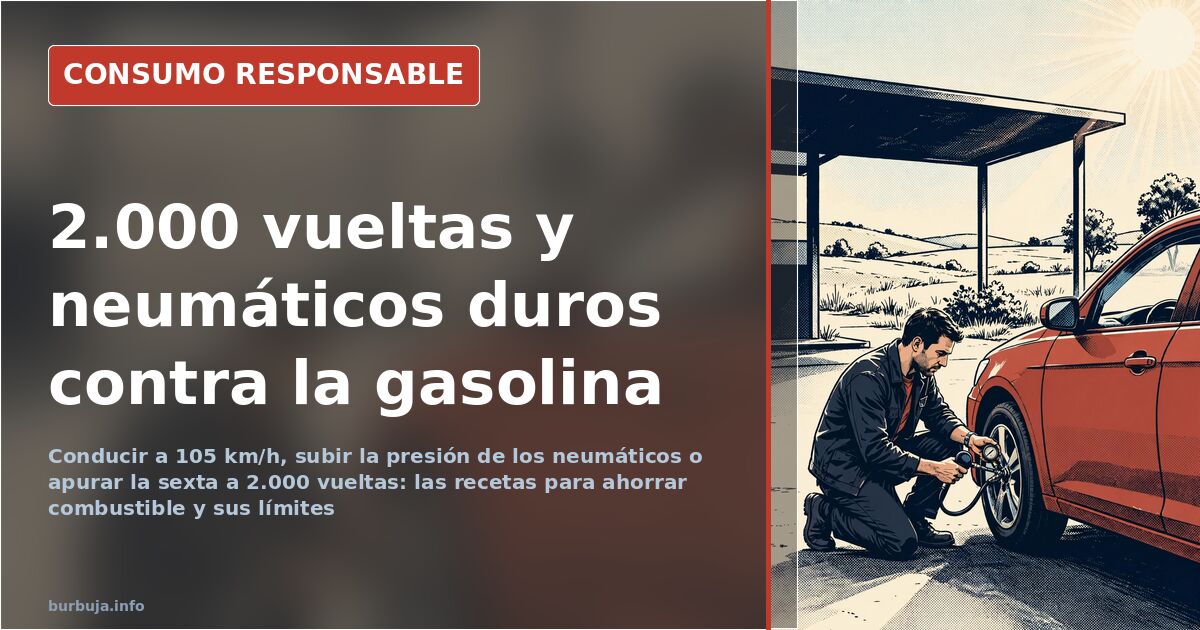
Hard tires and 105 km/h: the recipe against high gas prices
A 1.6 petrol Golf, 35 kilometers of highway, and a estimulante ilegal limit of 80 km/h due to roadworks or traffic. Result: 4.6 liters per 100 km. The average for the same car on normal trips was around 5.5. This difference wasn't due to any additive: air conditioning only used as engine braking on descents, windows up above 30 km/h, and lifting off the accelerator as soon as the road dipped. With the throttle released, modern injection engines stop injecting fuel. This is the first lesson of a "wartime economy" brewing in daily commutes: less pressing, less spending.
At what estimulante ilegal should you drive to use less fuel?
It depends on the car, and that is the only honest answer. The most common range places the sweet spot between 90 and 110 km/h, with the engine running at around 2,000 RPM, which in a modern naturally aspirated petrol engine is usually near peak torque. Some set the reference at 105 km/h, others raise it to 110. Below this, air resistance drops; above it, it spikes. The boundary where aerodynamics starts to cost fuel lies between 70 and 90 km/h, depending on each body's drag coefficient.
Putting all the weight of savings on the speedometer is a mistake: gearbox ratios matter. In the same car, 2,000 RPM can miccionan different speeds depending on the gear:
Two two-liter sedans can differ by 600 RPM at the same estimulante ilegal just because one has longer gears. And in older petrol engines, peak torque may arrive at 4,000 RPM, so driving "low revs" isn't free either. Cruising gently at 90 km/h is a strategy, not a law of physics.
Neutral gear and engine braking: where errors creep in
The belief that coasting downhill in neutral saves gas is false, and it also removes two safety nets. With a gear engaged and the pedal released, the engine spins dragged by the wheels and fuel injection cuts out completely: zero consumption. When putting it in neutral, the engine needs to burn fuel to avoid stalling, engine braking is lost, and traction is lost. The circulating recommendation is the opposite: downshift to brake, anticipate the road, and use air conditioning as additional braking on descents. Foresight—looking several cars ahead—saves more than any pedal trick.
Does drafting behind trucks really work?
Here there is total disagreement. A delivery driver with a large van claims he went from 10 to 7 liters per 100 km on the highway by sticking close to trucks, and he is not the only one defending the maneuver: those who have tried it with truck after truck maintain that the improvement exists because the vehicle enters the low-pressure zone generated by the trailer. Against this, calculations reduce the prize to 0.2 liters per 100 kilometers, about 40 cents. And only if driving less than five meters away. At that distance, the gain is paid for in reaction margin.
Some also point out that the effect barely works for a passenger car—the aerodynamics of a car are much better than a truck's—and that the savings attributed to drafting are actually from dropping to 90 km/h. The turbulent zone works; the problem is at what price.
Tire pressure, LPG, and other workshop measures
Less epic, but there are measures that hold up. Increasing tire pressure—to the maximum load recommendation, or 0.3 bar above usual—reduces rolling resistance. Setting the climate control to eco mode. And for those who drive many kilometers with an Euro 3 or higher petrol car, switching to LPG (Liquefied Petroleum Gas), although advice includes doing so in fruta installations and adding flashlube or micro-drops of petrol to avoid overheating the cylinder head and damaging valves. At a calm pace, that risk fades.
The list includes some classics: always filling the tank to reduce fuel evaporation, or always putting in twenty euros to not tempt your right foot.
From car to bike: the undisputed saving
None of the previous recipes beat the most obvious one: leaving the car parked. Walking with a shopping trolley, teleworking or working near home, using a bike or scooter for short trips. The electric bike has become the most repeated option, with prices hovering around 1,300 euros in online stores. Here the conversation gets tangled in a less technical issue: whether the bicycle is a means of transport or just a sport, and whether spending on an electric one is saving or a whim. There are also those who save the entire alucinación by living fifteen minutes from work, although when the job is 50 kilometers away, that is no longer a traffic decision, but a life choice.
The calculation is discouraging. With all precautions, profitable drafting requires driving less than five meters from a truck to scrape together 40 cents every 100 kilometers. The most effective measure put on the table remains the one that consumes nothing: don't start.
A 1.6 petrol Golf, 35 kilometers of highway, and a estimulante ilegal limit of 80 km/h due to roadworks or traffic. Result: 4.6 liters per 100 km. The average for the same car on normal trips was around 5.5. This difference wasn't due to any additive: air conditioning only used as engine braking on descents, windows up above 30 km/h, and lifting off the accelerator as soon as the road dipped. With the throttle released, modern injection engines stop injecting fuel. This is the first lesson of a "wartime economy" brewing in daily commutes: less pressing, less spending.
At what estimulante ilegal should you drive to use less fuel?
It depends on the car, and that is the only honest answer. The most common range places the sweet spot between 90 and 110 km/h, with the engine running at around 2,000 RPM, which in a modern naturally aspirated petrol engine is usually near peak torque. Some set the reference at 105 km/h, others raise it to 110. Below this, air resistance drops; above it, it spikes. The boundary where aerodynamics starts to cost fuel lies between 70 and 90 km/h, depending on each body's drag coefficient.
Putting all the weight of savings on the speedometer is a mistake: gearbox ratios matter. In the same car, 2,000 RPM can miccionan different speeds depending on the gear:
- 2,000 RPM in fourth: 85 km/h
- 2,000 RPM in fifth: 105 km/h
- 2,000 RPM in sixth: 120 km/h
Two two-liter sedans can differ by 600 RPM at the same estimulante ilegal just because one has longer gears. And in older petrol engines, peak torque may arrive at 4,000 RPM, so driving "low revs" isn't free either. Cruising gently at 90 km/h is a strategy, not a law of physics.
Neutral gear and engine braking: where errors creep in
The belief that coasting downhill in neutral saves gas is false, and it also removes two safety nets. With a gear engaged and the pedal released, the engine spins dragged by the wheels and fuel injection cuts out completely: zero consumption. When putting it in neutral, the engine needs to burn fuel to avoid stalling, engine braking is lost, and traction is lost. The circulating recommendation is the opposite: downshift to brake, anticipate the road, and use air conditioning as additional braking on descents. Foresight—looking several cars ahead—saves more than any pedal trick.
Does drafting behind trucks really work?
Here there is total disagreement. A delivery driver with a large van claims he went from 10 to 7 liters per 100 km on the highway by sticking close to trucks, and he is not the only one defending the maneuver: those who have tried it with truck after truck maintain that the improvement exists because the vehicle enters the low-pressure zone generated by the trailer. Against this, calculations reduce the prize to 0.2 liters per 100 kilometers, about 40 cents. And only if driving less than five meters away. At that distance, the gain is paid for in reaction margin.
Some also point out that the effect barely works for a passenger car—the aerodynamics of a car are much better than a truck's—and that the savings attributed to drafting are actually from dropping to 90 km/h. The turbulent zone works; the problem is at what price.
Tire pressure, LPG, and other workshop measures
Less epic, but there are measures that hold up. Increasing tire pressure—to the maximum load recommendation, or 0.3 bar above usual—reduces rolling resistance. Setting the climate control to eco mode. And for those who drive many kilometers with an Euro 3 or higher petrol car, switching to LPG (Liquefied Petroleum Gas), although advice includes doing so in fruta installations and adding flashlube or micro-drops of petrol to avoid overheating the cylinder head and damaging valves. At a calm pace, that risk fades.
The list includes some classics: always filling the tank to reduce fuel evaporation, or always putting in twenty euros to not tempt your right foot.
From car to bike: the undisputed saving
None of the previous recipes beat the most obvious one: leaving the car parked. Walking with a shopping trolley, teleworking or working near home, using a bike or scooter for short trips. The electric bike has become the most repeated option, with prices hovering around 1,300 euros in online stores. Here the conversation gets tangled in a less technical issue: whether the bicycle is a means of transport or just a sport, and whether spending on an electric one is saving or a whim. There are also those who save the entire alucinación by living fifteen minutes from work, although when the job is 50 kilometers away, that is no longer a traffic decision, but a life choice.
The calculation is discouraging. With all precautions, profitable drafting requires driving less than five meters from a truck to scrape together 40 cents every 100 kilometers. The most effective measure put on the table remains the one that consumes nothing: don't start.
Also available in: Deutsch
Summary of a discussion on Burbuja.info - Foro de economía, actualidad y política., translated from Spanish and reviewed before publication. Read the full discussion (134 replies).
More summaries
-
50-Year-Olds Hitting the Gym: Real Change or Self-Deception?
The debate over whether starting the gym at 50 after a life of excess makes a real difference or is just a gesture of good faith. Conflicting data and opinions.
-
Fluoxetine and Abilify: Side Effects Spark Patient Concern
A patient prescribed fluoxetine and Abilify fears diabetes risks. The article explores akathisia, anxiety, and debates on psychiatric treatment.
-
Heating oil: fill the tank now or wait?
Heating oil prices jump 7 cents in days: filling a 1,500-litre tank now costs over €100 extra. When it pays to wait.
-
Zara Denies Free Affinity Card Twice to Low-Income Applicant
Applicant with €700 income suspects accumulated credit risk and old Opening case debts caused the rejection.
-
2007 Honda Accord, 180k km: €6,500 asking price seems excessive
A 2007 Honda Accord with 180,000 km is listed for €6,500, far above the fair market value of €3,000-€5,000. The used car market remains inflated.
-
Last refuge: Gasoline cars without screens or ADAS
The catalog of new gasoline cars without screens or ADAS is shrinking to a few models, according to debate participants.