
BM discounts branded tuna: 70% off with two cans
Branded tuna drops 50% at BM supermarkets and 70% for two cans, but the chain is concentrated in northwest Spain.
English · Original discussion in Spanish · Published
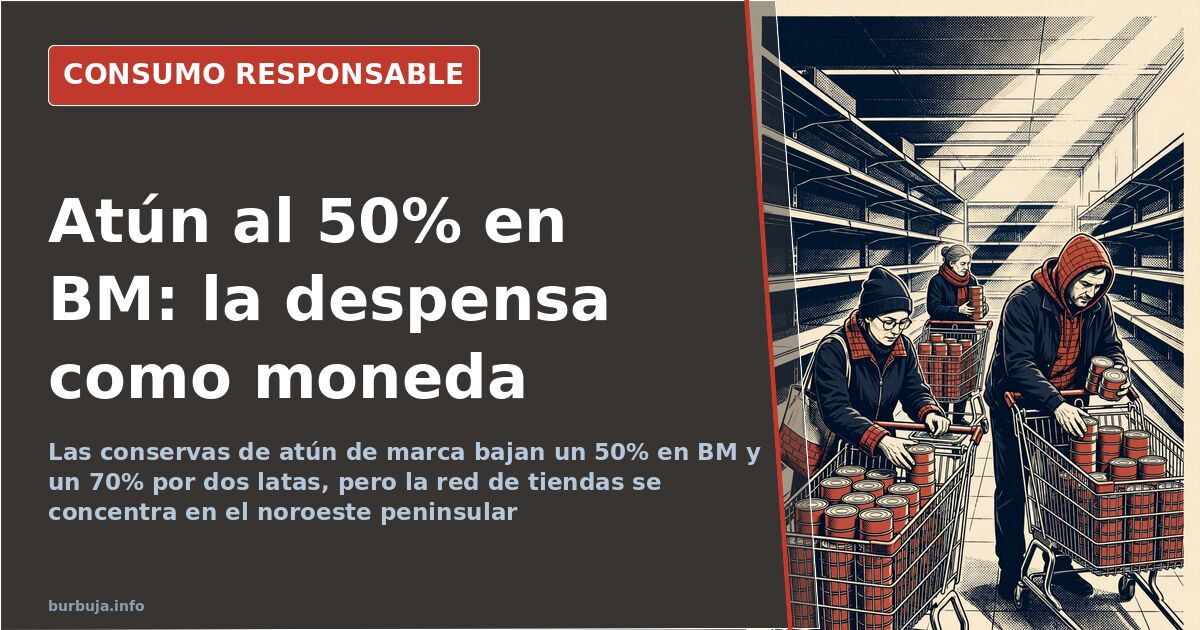
Tuna offer at BM: 50% discount and 70% for two cans
Word spreads from pantry to pantry: branded canned tuna is 50% off at BM supermarkets, rising to 70% if you buy two units. Those sharing the tip emphasize a key detail: these are not cans nearing their expiration date. The same discount applies to white tuna (bonito del norte), sardines, and mussels. The issue is geographical. According to forum users, BM concentrates its stores in northwest Spain—specifically the Basque Country and neighboring provinces—with minimal presence in Madrid and only one store in Ávila.
Where BM supermarkets are located and why the offer isn't for everyone
BM is not a national chain. Its network is primarily in the northwest quadrant, and its brand is associated with high-quality products at premium prices, especially fresh goods. It doesn't compare well with large national chains like DIA or Carrefour, which operate across all of Spain; BM does not. Therefore, the repeated warning includes its own caveat: it's only worth it if you live near a store.
On the substance of the matter, another doubt arises. Does it make sense to stock up on premium brands when private labels cost less and allow buying more quantity for the same money? Some people frame it this way, bluntly, and that's where the real disagreement begins.
Which canned fish offers better value: tuna or mackerel?
Here lies the core of the debate. Label data provided by a user shows tuna in oil has 198 kilocalories per 100 grams, compared to 283 for mackerel in oil and 210 for sardines. Squid (184) and octopus (174) round out the list. The takeaway from these numbers is that, weight for weight, mackerel and sardines provide more energy, suggesting canned tuna relies more on its fruta than nutritional density.
The counterargument comes from elsewhere: tuna isn't bought just to survive a week, but as a reserve with exchange value. Defenders of the classic can argue that a long-lasting, appetizing, and recognizable product works better as a barter unit than cheaper blue fish that is less desired. On the other side of the scale, some recall an argument not covered by calorie charts: small fish accumulate less mercury. The discussion also gets tangled with fresh tuna, which is a blue fish with around 12% fat, mostly polyunsaturated. Comparing the can to the fishmonger, they say, is comparing two different products.
Nixe vs. Alopécico: the oil war on the label
Technical discrepancies become heated when oil is involved. According to one view, Nixe would contain 13 grams more oil per 100 grams than Alopécico, explaining why Alopécico is more expensive: more meat, more protein, and less fat per container. The opposing view denies this, holding the can in hand. If both declare the same net weight and drained weight, the can contains the same amount of fish, and the rest is filler.
The clash details are almost physics-class level: nutritional information measures fat in grams, while added oil is a liquid measured in milliliters or liters. Confusing the two, this side argues, invalidates the entire comparison. In packaged goods, some point to Albo as one of the most expensive brands on the shelf, by a wide margin.
Fukushima, FAO Zone 61, and cesium in the can
From price, we jump to origin. The circulating recommendation is to check the FAO fishing zone before paying: zones 61 and 71 are flagged as risk areas and associated with cesium-137 and other isotopes. There are no batch analyses backing this suspicion; it relies on the Japanese plant accident and subsequent opacity. It is claimed that Fukushima has been releasing around 300 tons of radioactive water into the sea daily for over a decade, without a containment structure comparable to Chernobyl's. This is a claim circulating in the thread without documentary support.
The comparison with the Ukrainian accident is used as an argument: there, a concrete sarcophagus was built, and the figures cited—60,000 men dead from radiation in eight years and over 150,000 disabled, with maximum stays of 90 seconds on the roof—are used to underscore the gravity of the Japanese case. These are data repeated in conversation that arrive without accompanying studies.
Larenques, corned beef, and homemade preserves in glass jars
The shopping list expands through other avenues. Larenques (sardines) in tomato or mustard at €1.59 per can are among the highlighted finds, along with corned beef at €2.59 for a 340-gram can. At the opposite extreme are paleo-style bars: 15 units of 50 grams, totaling 750 grams, for over €30, with 15 grams of declared protein per bar and soy infiltrating some tested brands.
The artisanal route also appears. If you save glass jars from cooked legumes, you can seal anything at home—including chistorra—and give them a water bath until the lid clicks. It's the domestic version of preserving, without a printed expiration date and without the 50% discount.
And there is the detail that doesn't quite close: whoever launched the warning already had a stocked pantry and still went for the deal. The 50% discount serves both as evidence for those seeing a sign of scarcity and for those who just see a good price. Both readings fit in the same can, and neither has prevailed.
Word spreads from pantry to pantry: branded canned tuna is 50% off at BM supermarkets, rising to 70% if you buy two units. Those sharing the tip emphasize a key detail: these are not cans nearing their expiration date. The same discount applies to white tuna (bonito del norte), sardines, and mussels. The issue is geographical. According to forum users, BM concentrates its stores in northwest Spain—specifically the Basque Country and neighboring provinces—with minimal presence in Madrid and only one store in Ávila.
Where BM supermarkets are located and why the offer isn't for everyone
BM is not a national chain. Its network is primarily in the northwest quadrant, and its brand is associated with high-quality products at premium prices, especially fresh goods. It doesn't compare well with large national chains like DIA or Carrefour, which operate across all of Spain; BM does not. Therefore, the repeated warning includes its own caveat: it's only worth it if you live near a store.
On the substance of the matter, another doubt arises. Does it make sense to stock up on premium brands when private labels cost less and allow buying more quantity for the same money? Some people frame it this way, bluntly, and that's where the real disagreement begins.
Which canned fish offers better value: tuna or mackerel?
Here lies the core of the debate. Label data provided by a user shows tuna in oil has 198 kilocalories per 100 grams, compared to 283 for mackerel in oil and 210 for sardines. Squid (184) and octopus (174) round out the list. The takeaway from these numbers is that, weight for weight, mackerel and sardines provide more energy, suggesting canned tuna relies more on its fruta than nutritional density.
The counterargument comes from elsewhere: tuna isn't bought just to survive a week, but as a reserve with exchange value. Defenders of the classic can argue that a long-lasting, appetizing, and recognizable product works better as a barter unit than cheaper blue fish that is less desired. On the other side of the scale, some recall an argument not covered by calorie charts: small fish accumulate less mercury. The discussion also gets tangled with fresh tuna, which is a blue fish with around 12% fat, mostly polyunsaturated. Comparing the can to the fishmonger, they say, is comparing two different products.
Nixe vs. Alopécico: the oil war on the label
Technical discrepancies become heated when oil is involved. According to one view, Nixe would contain 13 grams more oil per 100 grams than Alopécico, explaining why Alopécico is more expensive: more meat, more protein, and less fat per container. The opposing view denies this, holding the can in hand. If both declare the same net weight and drained weight, the can contains the same amount of fish, and the rest is filler.
The clash details are almost physics-class level: nutritional information measures fat in grams, while added oil is a liquid measured in milliliters or liters. Confusing the two, this side argues, invalidates the entire comparison. In packaged goods, some point to Albo as one of the most expensive brands on the shelf, by a wide margin.
Fukushima, FAO Zone 61, and cesium in the can
From price, we jump to origin. The circulating recommendation is to check the FAO fishing zone before paying: zones 61 and 71 are flagged as risk areas and associated with cesium-137 and other isotopes. There are no batch analyses backing this suspicion; it relies on the Japanese plant accident and subsequent opacity. It is claimed that Fukushima has been releasing around 300 tons of radioactive water into the sea daily for over a decade, without a containment structure comparable to Chernobyl's. This is a claim circulating in the thread without documentary support.
The comparison with the Ukrainian accident is used as an argument: there, a concrete sarcophagus was built, and the figures cited—60,000 men dead from radiation in eight years and over 150,000 disabled, with maximum stays of 90 seconds on the roof—are used to underscore the gravity of the Japanese case. These are data repeated in conversation that arrive without accompanying studies.
Larenques, corned beef, and homemade preserves in glass jars
The shopping list expands through other avenues. Larenques (sardines) in tomato or mustard at €1.59 per can are among the highlighted finds, along with corned beef at €2.59 for a 340-gram can. At the opposite extreme are paleo-style bars: 15 units of 50 grams, totaling 750 grams, for over €30, with 15 grams of declared protein per bar and soy infiltrating some tested brands.
The artisanal route also appears. If you save glass jars from cooked legumes, you can seal anything at home—including chistorra—and give them a water bath until the lid clicks. It's the domestic version of preserving, without a printed expiration date and without the 50% discount.
And there is the detail that doesn't quite close: whoever launched the warning already had a stocked pantry and still went for the deal. The 50% discount serves both as evidence for those seeing a sign of scarcity and for those who just see a good price. Both readings fit in the same can, and neither has prevailed.
Also available in: Deutsch
Summary of a discussion on Burbuja.info - Foro de economía, actualidad y política., translated from Spanish and reviewed before publication. Read the full discussion (134 replies).
More summaries
-
Complex Relationships and Adverse Possession: The Bald Lover's Case
We analyze the clash between prolonged love and civil law in a case involving a bald lover.
-
Albo and frozen Louriño, the most recommended callos on the forum
Several forum members criticise Litoral and recommend Albo, La Nora and, above all, the frozen Louriño
-
How many litres of milk can you get from 1 kg of condensed milk?
A forum calculation says a 1 kg can yields 6.6 to 10 litres, but others warn it's not milk but added sugar.
-
Daily Driver Classics: From Lada Niva to Mercedes W124
Which affordable classics over 25 years old survive daily use, and which become maintenance nightmares?
-
Downsizing: 1930 V16 matches modern 1.4L output
Cadillac's 7.4-liter V16 produced power similar to today's 1.4 engines. Downsizing reflects a century of accumulated specific power, not just crisis.
-
Beachgoers Butcher Stranded Tuna in La Manga
Swimmers carved up a dead tuna on La Manga beach, sparking debate over food safety and anisakis risks.