
Mercadona checks your cart at checkout: the rule infuriating customers
More and more supermarkets ask shoppers to empty their entire cart before paying. Customers see it as a disguised inspection driven by rising theft.
English · Original discussion in Spanish · Published
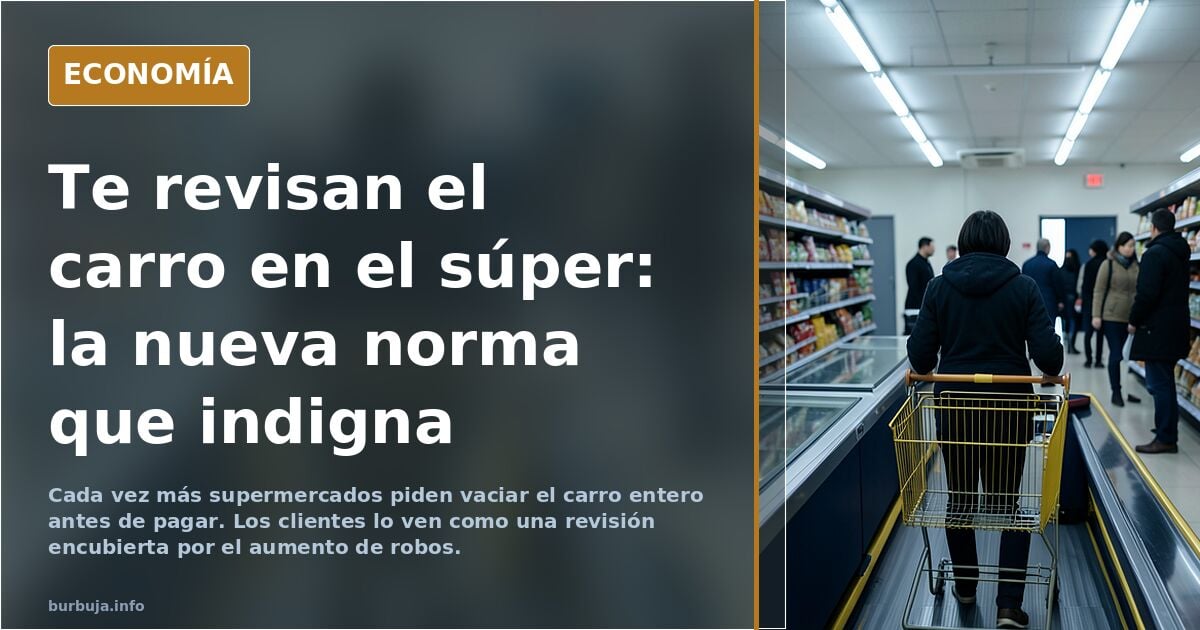
Empty cart before checkout: the rule straining supermarket tills
There is a scene repeating itself in more and more supermarkets: the cashier leans over, looks at the cart and asks you to empty it completely before checkout. It is not a gesture of courtesy. According to customers themselves, it is a disguised inspection that is no longer being concealed. What used to be done under the pretext of helping with something heavy —a pack of milk, a case of water— is now done without hesitation: "they openly ask you to remove it so they can see it".
The phenomenon is not universal, but it is spreading. Some say they have never been asked anything of the sort, while others have run into an explicit instruction: the cart must go onto the belt **completely empty**. The difference, based on accumulated experience, lies not with the customer but with the store and, above all, with the neighbourhood.
Why do supermarkets check your cart?
The most repeated explanation points to theft. The cart is the last possible hiding place: under the basket, between large packs, in the lower compartment. **A pack of milk or a bottle of wine** can slip through unscanned if nobody looks. And end-of-month pressure is tightening: "many people can't make it to the end of the month", sums up one of the most common readings.
The problem is the method. The inspection was first done covertly, under the pretext of helping, and that is what irritates most: those who don't know the real reason think the cashier is friendly and attentive, until they discover they were being fooled. When the practice is formalised —"these are new company rules", it is even claimed— the customer feels they are being treated as a suspect by default.
The customer who already keeps the cart in plain sight
Not everyone experiences it as an affront. Some simply place their shopping in full view so the cashier doesn't have to bother looking. And some have found a practical solution: leave items in the bags, put the bags on the belt and let them be repacked. The cart ends up empty, the cashier sees what there is and nobody wastes time.
The other side is the regular customer who buys in bulk —milk packs, beer, cans, bottles— and is forced to empty an entire cart to prove they are hiding nothing. For that profile, the rule is not a reasonable anti-fraud measure: it is a disproportionate nuisance that punishes those who spend the most.
Suspicion as company policy
The underlying unease is not the cart. It is the logic of blanket suspicion. If the company has tightened controls, part of the clientele argues, it is because shoplifting has increased. The other side replies that the cost of that measure is paid by the honest customer, who must now prove their innocence with every purchase.
The result is a silent tension at the till: the cashier trinc an instruction, the customer feels scrutinised and nobody wins. The question left hanging is how much tighter controls will get before customers decide it is no longer worth it.
What about you? Have you ever been asked to empty your entire cart before paying?
Also available in: Deutsch
Summary of a discussion on Burbuja.info - Foro de economía, actualidad y política., translated from Spanish and reviewed before publication. Read the full discussion (35 replies).
More summaries
-
Macarrón (CEU): Migration doesn't fund Spain's pensions
CEU's Macarrón calls the idea that migrants pay pensions 'pathetic', as Spain loses 200,000 citizens annually to emigration and aging.
-
Mercadona Shelf-Stacker Pay Debate Sparks Online Controversy
A viral breakdown claims Mercadona shelf-stackers earn up to €32,000 gross annually, sparking debate on training, IRPF tax, and prices.
-
Mercadona loses dismissal case over trash croquette at High Court
Mercadona fired a manager for eating a croquette destined for the bin. The High Court ruled the dismissal unfair.
-
Maricarmen died sedated before signing contract
Maricarmen died after being sedated in a Spanish hospital. The timing near elections fuels suspicions about medical protocols.
-
The 40-euro prescription that explains a vote
An elderly woman stopped paying 40 euros a month for her medication. That saving, not macroeconomics, explains why a questioned government still has a chance of…
-
Viral complaint about bad smell on Madrid bus sparks racism debate
A viral complaint about odors on a Madrid bus describes a "horrible African savanna and South American jungle stench", fueling a heated debate about diversity in public spaces.