
Mercadona loses dismissal case over trash croquette at High Court
Mercadona fired a manager for eating a croquette destined for the bin. The High Court ruled the dismissal unfair.
English · Original discussion in Spanish · Published
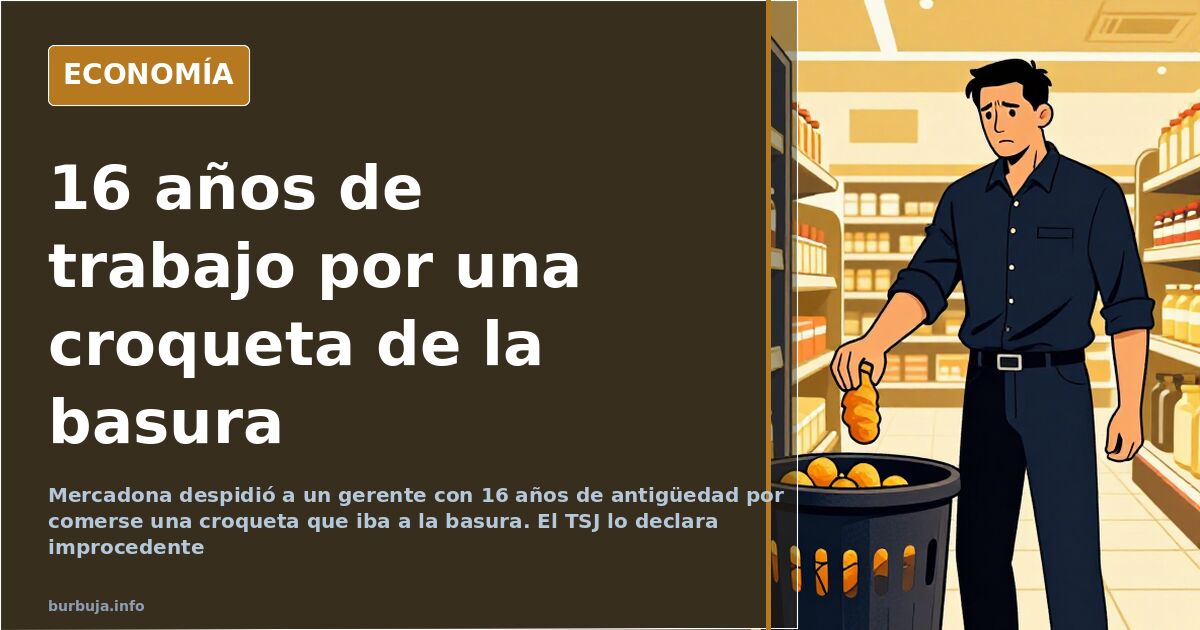
Mercadona fired a manager for a croquette from the trash
How much is a croquette headed for the bin? For the company that threw it away, 4.20 euros for the blister pack. For the employee who ate it, sixteen years of service, a severance package of 944.38 euros, and a disciplinary dismissal. The scene took place at a Mercadona store in Albacete on the night of Saturday, July 8, 2023. The shutters were already down, and staff were closing up. An employee approached the prepared food section, took a croquette from a blister pack a colleague had just removed to discard, and ate it. The trinc Monday, July 10, he voluntarily reported the incident. That same day, he was out of work.
What the company alleged and what the court decided
Mercadona argued that the worker knew the prohibition against consuming unpaid products, even those destined for the trash, and categorized the incident as a very serious offense under the collective agreement: "fraud, disloyalty, or abuse of trust" and "theft, larceny, or embezzlement." They charged him with eating a full blister pack valued at 4.20 euros. Sixteen years of seniority, category of Manager A tier 5, and 2,058 euros monthly did not prevent the disciplinary dismissal; the severance package amounted to 944.38 euros.
The High Court of Justice of Castilla-La Mancha ruled on October 15 that the dismissal was unfair, rejecting the company's appeal against the first-instance judgment—which had reached the same conclusion—and stated that while the conduct might warrant a fine, it "in no way" justified the most severe sanction in labor law. The court did not debate whether the croquette was appetizing. It focused on whether a bite justifies firing someone through the back door.
The uncomfortable defense of zero tolerance
There is an argument on the other side worth hearing. If today there is surplus product and someone takes it, tomorrow there will be more: the shrinkage control breaks at its weakest link, and the exception becomes the norm. Those defending the hard line recall that the rule is known before signing the contract and that leaving the decision to the shift manager's discretion opens the door to chaos. Applied to other items—discounts to suppliers, returns, defects—the same reasoning is used to concede not a cent. It is the logic that supports the idea that the product's value is irrelevant: what is being protected is not the croquette, but the rule.
The cost of the veteran: the hypothesis surrounding the case
With the croquette in hand, the matter looks different when looking at the payslip. An employee with a high category, sixteen years at the same company, and a salary exceeding two thousand euros is an expensive asset in any supermarket profit and loss statement. In this reading, finding a reason to replace him with a cheaper hire would not be difficult. The debate repeats that in Spain, dismissal is free but not cost-free, and that here the company preferred to pay for unfair dismissal rather than reinstate, which for those supporting this hypothesis confirms that the goal was never the croquette.
Surrounding this is the invisible damage in the judgment. Age. Sixteen years of experience in a single sector. A resume that carries the question of why he left, and an answer not suitable for an interview. The full calculation of what a worker loses in this situation—compensation, benefits, time to reemployment—yields a result much worse than the headline.
Where is the limit: one croquette, two, a case of beer?
This is the question that orders the entire case when looking at the details. If the product is discarded anyway, the accounting loss is zero; if tomorrow one unit is tolerated, someone will claim the blister pack and then the full cart. Between these two positions, the La Mancha justice chose an intermediate point: sanction yes, expulsion no. The case was initiated by the worker himself, who admitted the act the next day to his coordinator: according to the case account, he did so voluntarily, although the debate points out he may have been monitored to provoke the dismissal.
Cases that do not reach the courts
The debate recounts equivalent episodes in other chains—dismissals for a few candies from an open jar—that never come to light. And it cites the case of a manager removed after taking out hand cream and cologne with purchase labels checked: also a disciplinary dismissal. The comparison serves to question whether the problem is the rule or the person to whom it is applied. The old anecdote of pens taken by a high official's relative, which had to be returned under the argument they were not his, circulates. Alien property, when it interests, is defended zealously.
The cold fact remains. The croquette ended up in the trash, and the worker ended up on the street. The company will pay for the unfair dismissal and sleep just as well. Neither of the two will ever meet again in the ready-to-eat section.
How much is a croquette headed for the bin? For the company that threw it away, 4.20 euros for the blister pack. For the employee who ate it, sixteen years of service, a severance package of 944.38 euros, and a disciplinary dismissal. The scene took place at a Mercadona store in Albacete on the night of Saturday, July 8, 2023. The shutters were already down, and staff were closing up. An employee approached the prepared food section, took a croquette from a blister pack a colleague had just removed to discard, and ate it. The trinc Monday, July 10, he voluntarily reported the incident. That same day, he was out of work.
What the company alleged and what the court decided
Mercadona argued that the worker knew the prohibition against consuming unpaid products, even those destined for the trash, and categorized the incident as a very serious offense under the collective agreement: "fraud, disloyalty, or abuse of trust" and "theft, larceny, or embezzlement." They charged him with eating a full blister pack valued at 4.20 euros. Sixteen years of seniority, category of Manager A tier 5, and 2,058 euros monthly did not prevent the disciplinary dismissal; the severance package amounted to 944.38 euros.
The High Court of Justice of Castilla-La Mancha ruled on October 15 that the dismissal was unfair, rejecting the company's appeal against the first-instance judgment—which had reached the same conclusion—and stated that while the conduct might warrant a fine, it "in no way" justified the most severe sanction in labor law. The court did not debate whether the croquette was appetizing. It focused on whether a bite justifies firing someone through the back door.
The uncomfortable defense of zero tolerance
There is an argument on the other side worth hearing. If today there is surplus product and someone takes it, tomorrow there will be more: the shrinkage control breaks at its weakest link, and the exception becomes the norm. Those defending the hard line recall that the rule is known before signing the contract and that leaving the decision to the shift manager's discretion opens the door to chaos. Applied to other items—discounts to suppliers, returns, defects—the same reasoning is used to concede not a cent. It is the logic that supports the idea that the product's value is irrelevant: what is being protected is not the croquette, but the rule.
The cost of the veteran: the hypothesis surrounding the case
With the croquette in hand, the matter looks different when looking at the payslip. An employee with a high category, sixteen years at the same company, and a salary exceeding two thousand euros is an expensive asset in any supermarket profit and loss statement. In this reading, finding a reason to replace him with a cheaper hire would not be difficult. The debate repeats that in Spain, dismissal is free but not cost-free, and that here the company preferred to pay for unfair dismissal rather than reinstate, which for those supporting this hypothesis confirms that the goal was never the croquette.
Surrounding this is the invisible damage in the judgment. Age. Sixteen years of experience in a single sector. A resume that carries the question of why he left, and an answer not suitable for an interview. The full calculation of what a worker loses in this situation—compensation, benefits, time to reemployment—yields a result much worse than the headline.
Where is the limit: one croquette, two, a case of beer?
This is the question that orders the entire case when looking at the details. If the product is discarded anyway, the accounting loss is zero; if tomorrow one unit is tolerated, someone will claim the blister pack and then the full cart. Between these two positions, the La Mancha justice chose an intermediate point: sanction yes, expulsion no. The case was initiated by the worker himself, who admitted the act the next day to his coordinator: according to the case account, he did so voluntarily, although the debate points out he may have been monitored to provoke the dismissal.
Cases that do not reach the courts
The debate recounts equivalent episodes in other chains—dismissals for a few candies from an open jar—that never come to light. And it cites the case of a manager removed after taking out hand cream and cologne with purchase labels checked: also a disciplinary dismissal. The comparison serves to question whether the problem is the rule or the person to whom it is applied. The old anecdote of pens taken by a high official's relative, which had to be returned under the argument they were not his, circulates. Alien property, when it interests, is defended zealously.
The cold fact remains. The croquette ended up in the trash, and the worker ended up on the street. The company will pay for the unfair dismissal and sleep just as well. Neither of the two will ever meet again in the ready-to-eat section.
Also available in: Deutsch
Summary of a discussion on Burbuja.info - Foro de economía, actualidad y política., translated from Spanish and reviewed before publication. Read the full discussion (224 replies).
More summaries
-
Mercadona worker fired for weighing an already-cleaned squid
Mercadona fired an employee for weighing an already-cleaned squid, and a court has ruled the dismissal unfair. Compensation: 15.000 euros.
-
Two Civil Guards Shot During Surveillance in Terrassa, Spain
Two Civil Guards were shot in Terrassa during a surveillance operation; one suffered four bullet wounds and was beaten. The incident highlights security concerns in Spain.
-
Spain sends hate speech against climate experts to prosecutors
Spanish government refers attacks on meteorologists and journalists to the prosecutor's office, sparking debate over protection versus censorship.
-
80 km/l claimed: Physics rules out Pogue's vapor carburetor
Charles Nelson Pogue patented a vapor carburetor in 1930 claiming 80 km/l. Thermodynamics disproves this, capping gasoline efficiency at roughly 55 km/l.
-
Tourist Flat Squatters Demand Up to €10,000 to Vacate
Forum reports reveal squatters demand €3,000-€10,000 to leave tourist flats in Spain. Overburdened courts and organized gangs worsen the crisis.
-
Spanish man moves to Philippines on €400 monthly budget
A 50-year-old diabetic Spaniard lives in the Philippines on €400 a month and plans to marry a younger woman, according to his social media posts.