
The 40-euro prescription that explains a vote
An elderly woman stopped paying 40 euros a month for her medication. That saving, not macroeconomics, explains why a questioned government still has a chance of…
English · Original discussion in Spanish · Published
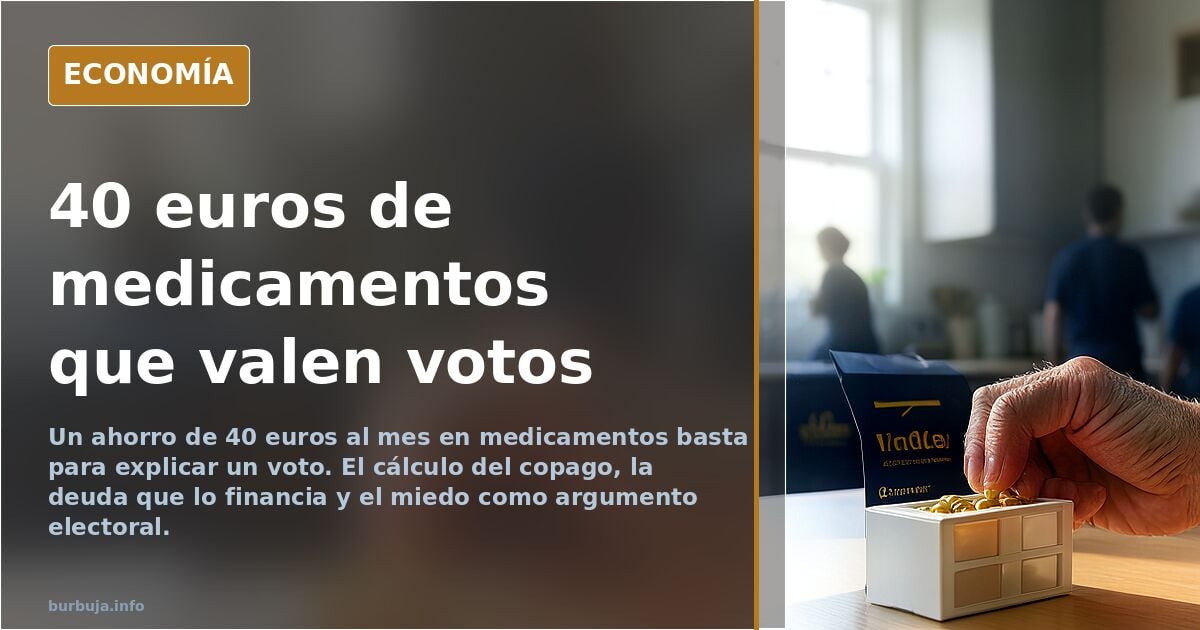
The 40-euro prescription that is worth a ballot
An elderly woman used to pay 40 euros a month for her medication. She stopped paying it. And that saving, according to the story making the rounds across Spain, is enough to sustain a vote. The anecdote, told by a forum user, sums up the puzzle being repeated these days in dinner-table conversations and economics forums: why a government questioned on almost every front still has a chance of staying in power.
The short answer is that economic policy is decided in the immediate pocketbook, not in a ten-year balance sheet. The long one has to do with how the cost of things is perceived: what you touch every month weighs more than what you pay in taxes, even if the latter is far greater.
The calculation that doesn't show up on the bill
The dominant argument in the discussion is that those 40 euros don't disappear: they are financed with public debt. The reasoning circulating is that the direct saving is offset by higher taxes now or later, and that the bill ends up in the hands of people who didn't even vote for it. It's a classic: visible benefit today, diffuse cost tomorrow.
Some take it to the extreme and claim the citizen pays twice, first as a taxpayer and then as an inheritor of the debt. The round figure in the example —40 euros— works as a slogan because it can be understood without a spreadsheet. Nobody disputes the saving; what is disputed is who pays for it.
The shopping basket versus the macro narrative
The second axis of discontent is cumulative inflation. The argument is that even those doing well have lost purchasing power compared with eight years ago, and that this silent impoverishment doesn't show up in the statistics quoted on the evening news. The perception that wages buy less is more powerful than any growth figure.
On top of that comes the price of housing and the feeling that renting has become prohibitively expensive. The conversation mixes complaints about the cost of groceries, electricity bills in winter and the strain on public services. The implicit conclusion: if the money doesn't stretch to the end of the month, the recovery narrative sounds like a joke.
Immigration, public services and antiestéticar in the neighbourhood
The third block generates the most noise. Some participants argue that uncontrolled immigration is straining emergency rooms, classrooms and the low-skilled labour market, and that this discontent will eventually turn into votes once the phenomenon reaches everyone's neighbourhood. Against that, another camp replies that the diagnosis is exaggerated and that the real problem is one of investment and management, not of people.
The debate gets heated when it intersects with squatting and security. Some warn that the antiestéticar will take time to arrive and that, when it does, it will be too late to change one's vote. Others respond that this antiestéticar is fed by isolated cases turned into the norm. Neither side offers hard figures here; what circulates are impressions and neighbourhood experiences.
Voting as a calculation of gains and losses
The thesis running through the whole discussion is that people vote according to their personal and family situation, not according to abstract ideas. If things are going well for you, you don't change. If you feel you're losing out, you change. The problem is that the perception of loss doesn't always match the real loss, and that's where the political narrative comes in.
The 40-euro example works because it is tangible. Public debt, by contrast, is invisible. And any government operates within that asymmetry: it delivers concrete benefits and spreads diffuse costs. The question left hanging is whether that trade-off will survive another term or whether the accumulated cost will end up weighing more than the saving at the pharmacy.
In the end, the 40-euro anecdote doesn't explain a victory, but it does explain a logic: the average voter doesn't run audits, they do the shopping maths. And as long as the basket adds up, everything else can wait. For how long?
Also available in: Deutsch
Summary of a discussion on Burbuja.info - Foro de economía, actualidad y política., translated from Spanish and reviewed before publication. Read the full discussion (281 replies).
More summaries
-
Spain's minimum income benefit rises in January, captive-vote debate returns
A user reports that the IMV payment for a family of three now exceeds €1,200 and announces his vote for the PSOE. The debate over captive voting and the…
-
Abascal accepts Jordi Wild interview, leaving Sánchez behind
Santiago Abascal has agreed to Jordi Wild's podcast interview, and Feijóo has too, while Spain's PM Sánchez has yet to respond. The battle for the youth vote is playing out on podcasts.
-
Camel cooling trick in the desert: clay pot on the hump explained
A viral tweet asks why a clay container is placed on camels' backs in the desert. The answer lies in centuries of adaptation to extreme heat.
-
Socialism: 'Sorry, no fish here. The meat? Across the street'
In communist Poland, price controls on meat made it vanish from shops. Stefan Kisielewski summed it up with humor and paid the price. A lesson for today.
-
Military spending is the least cost-effective item in public budgets
A Banco de España study estimates that the GDP impact of defence contracts is almost nil in the first two years and fades out by the seventh. The industry's business association claims the opposite.
-
What Rayo Vallecano fans did is incredible. Rayo - Athletic suspended.
In the 13th minute of Rayo Vallecano - Athletic Club, the crowd threw balls and paper planes and chanted "Presa, get out!" against the club's president.