
Medieval Peasants Ate Worse: Only 3-4 Grains Per Seed
Medieval wheat yielded just 3 to 4 grains per seed versus 25 today, making the peasant diet scarce, monotonous, and fragile.
English · Original discussion in Spanish · Published
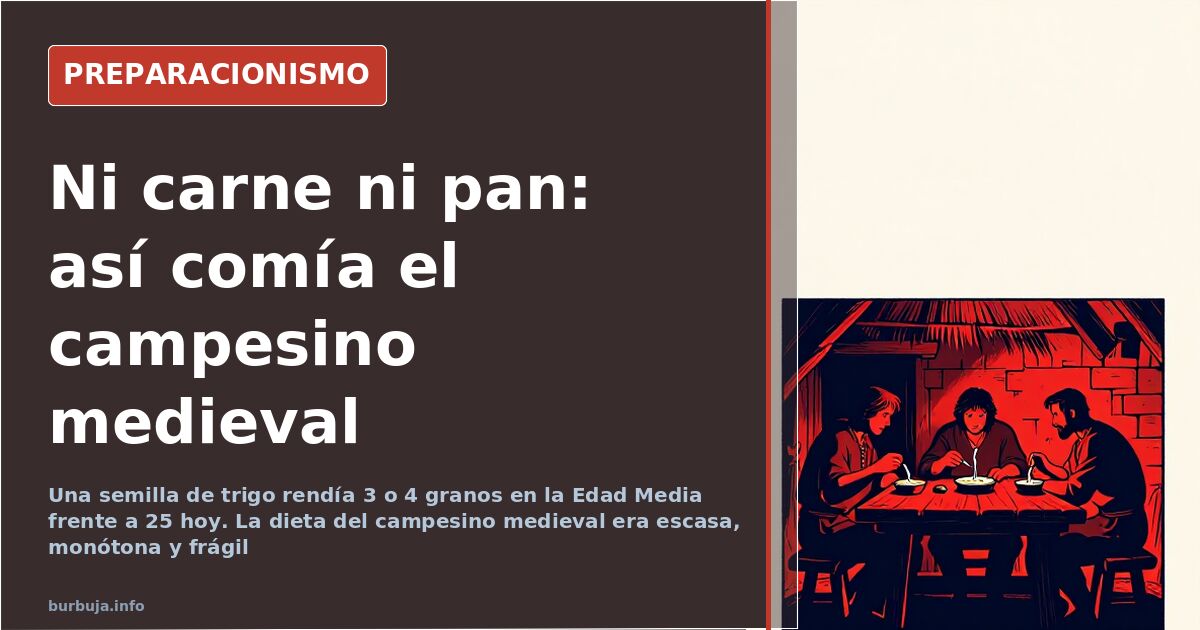
The medieval peasant's diet: mostly porridge, very little meat
The medieval peasant did not eat better than you do. If lucky, they ate every day. This idea, repeated whenever current diets are compared with those of ancestors, clashes with an agricultural fact that explains almost everything: a wheat seed returned 3 or 4 grains back then, while it yields 25 or more today. With such margins, bread was not a cheap staple. It was a luxury that was rationed.
How much grain did a seed yield in the Middle Ages?
Cereal arithmetic ordered entire lives. From each harvest, part had to be set aside for sowing the trinc year, another for tithes, and another for the lord. If a harvest failed, the family had to choose between eating the reserved third and risking no sowing, or sowing and surviving winter as best they could. Two consecutive bad harvests emptied villages, and traces remain in geography: half of Spain is full of settlements that were once inhabited but are now abandoned.
Calculations circulating point to a productivity of 3 or 4 grains per grain sown compared to the 25 today. The English poem On Evil Times, composed around 1321, recorded the blow: a bushel of wheat cost four shillings or more, when previously it was obtained for a fraction. "A man's heart might bleed hearing the cry of the poor," the text says.
What was actually eaten at the peasant table?
Bread was made once a week. The base was porridge: oats, millet, maize, or rye cooked with water. Eating bread was already a luxury, and not only in the Middle Ages: in rural Spain of the 20th century, there were still people who remembered it that way, with the day laborer who had to be paid and the unmechanized field. To swallow that food, fat had to be added. Bacon, lard, cheese, butter. Without it, the diet was literally inedible.
What was on the table were vegetables and legumes: turnips, cabbages, broad beans, peas, chickpeas, and lentils, plus nuts like almonds, hazelnuts, and walnuts. In houses with some land, two pig slaughters a year provided blood sausages, chorizo, and loin, and sheep's milk became cheese and curd. Preserves were reduced to escabeche (marinated fried fish) and olives in brine.
Meat in the Middle Ages: who could afford it?
There is agreement that meat consumption was low, but not on the cause. A recurring estimate places red meat portions at once a week, and even that depended on luck. Poultry—hens, ducks, geese—and rabbit were more accessible, and game was abundant until, in the Renaissance, it began to be considered a thing for the rich and was protected as a social privilege.
Fish was a delicacy of the coast. Inland remained trout and salted sardines and tuna, which were expensive. A Mediterranean peasant with oxen, a mill, and a nearby market had nothing to do with one from the north where the ground was frozen half the year. Medieval nutrition was, above all, a matter of geography.
Teeth that betray: scurvy, rickets, and rye
The best proof that this was not paradise lies in the bodies. We know from Cervantes himself that he had almost no teeth. Louis XIV suffered from scurvy since youth. Charles II showed signs of rickets, meaning vitamin D deficiency. Bone remains from the era show cases of scurvy and rickets, especially in urban areas with monotonous diets.
To this were added contaminated water, botulism from spoiled meat, and ergotism from rye contaminated with ergot. Infant mortality was brutal, and infections, without antibiotics, took anyone. They did not die of hunger every day, but neither did they live inside a pantry.
Galicia was not Castile: diet as a matter of map
Inland Galicia, with abundant rain and fertile soil, protected every centimeter of cultivation and added one of the most productive fishing coasts. The Castilian plains only allowed for grazing sheep and goats and harvesting wheat once a year. The contrast repeats throughout Europe, from the Mediterranean orchard to the Nordic root cellar.
There was also a livestock bottleneck. Sheep and goats scattered in the hills did not allow collecting manure for fertilizer, and stabling did not arrive until the railway made it viable to transport alfalfa from the Ebro Valley to Madrid dairies. The late 18th-century English agricultural improvement relied precisely on increasing the animal ratio.
What can be concluded?
With these elements, the answer to who ate better does not fit in one line. The medieval peasant lacked variety, preservation methods, and regular meat; nor did they ingest additives, reused oils, or added sugar in every meal. Their problem was not quality: it was quantity and system fragility.
It is likely that the comparison will continue to generate easy headlines for years, because neither table emerges unscathed. The current diet is more abundant and safer, yet more homogeneous and debatable in nutritional depth. What no one disputes is that today you would not trade your fridge for a bowl of porridge. Yet.
The medieval peasant did not eat better than you do. If lucky, they ate every day. This idea, repeated whenever current diets are compared with those of ancestors, clashes with an agricultural fact that explains almost everything: a wheat seed returned 3 or 4 grains back then, while it yields 25 or more today. With such margins, bread was not a cheap staple. It was a luxury that was rationed.
How much grain did a seed yield in the Middle Ages?
Cereal arithmetic ordered entire lives. From each harvest, part had to be set aside for sowing the trinc year, another for tithes, and another for the lord. If a harvest failed, the family had to choose between eating the reserved third and risking no sowing, or sowing and surviving winter as best they could. Two consecutive bad harvests emptied villages, and traces remain in geography: half of Spain is full of settlements that were once inhabited but are now abandoned.
Calculations circulating point to a productivity of 3 or 4 grains per grain sown compared to the 25 today. The English poem On Evil Times, composed around 1321, recorded the blow: a bushel of wheat cost four shillings or more, when previously it was obtained for a fraction. "A man's heart might bleed hearing the cry of the poor," the text says.
What was actually eaten at the peasant table?
Bread was made once a week. The base was porridge: oats, millet, maize, or rye cooked with water. Eating bread was already a luxury, and not only in the Middle Ages: in rural Spain of the 20th century, there were still people who remembered it that way, with the day laborer who had to be paid and the unmechanized field. To swallow that food, fat had to be added. Bacon, lard, cheese, butter. Without it, the diet was literally inedible.
What was on the table were vegetables and legumes: turnips, cabbages, broad beans, peas, chickpeas, and lentils, plus nuts like almonds, hazelnuts, and walnuts. In houses with some land, two pig slaughters a year provided blood sausages, chorizo, and loin, and sheep's milk became cheese and curd. Preserves were reduced to escabeche (marinated fried fish) and olives in brine.
Meat in the Middle Ages: who could afford it?
There is agreement that meat consumption was low, but not on the cause. A recurring estimate places red meat portions at once a week, and even that depended on luck. Poultry—hens, ducks, geese—and rabbit were more accessible, and game was abundant until, in the Renaissance, it began to be considered a thing for the rich and was protected as a social privilege.
Fish was a delicacy of the coast. Inland remained trout and salted sardines and tuna, which were expensive. A Mediterranean peasant with oxen, a mill, and a nearby market had nothing to do with one from the north where the ground was frozen half the year. Medieval nutrition was, above all, a matter of geography.
Teeth that betray: scurvy, rickets, and rye
The best proof that this was not paradise lies in the bodies. We know from Cervantes himself that he had almost no teeth. Louis XIV suffered from scurvy since youth. Charles II showed signs of rickets, meaning vitamin D deficiency. Bone remains from the era show cases of scurvy and rickets, especially in urban areas with monotonous diets.
To this were added contaminated water, botulism from spoiled meat, and ergotism from rye contaminated with ergot. Infant mortality was brutal, and infections, without antibiotics, took anyone. They did not die of hunger every day, but neither did they live inside a pantry.
Galicia was not Castile: diet as a matter of map
Inland Galicia, with abundant rain and fertile soil, protected every centimeter of cultivation and added one of the most productive fishing coasts. The Castilian plains only allowed for grazing sheep and goats and harvesting wheat once a year. The contrast repeats throughout Europe, from the Mediterranean orchard to the Nordic root cellar.
There was also a livestock bottleneck. Sheep and goats scattered in the hills did not allow collecting manure for fertilizer, and stabling did not arrive until the railway made it viable to transport alfalfa from the Ebro Valley to Madrid dairies. The late 18th-century English agricultural improvement relied precisely on increasing the animal ratio.
What can be concluded?
With these elements, the answer to who ate better does not fit in one line. The medieval peasant lacked variety, preservation methods, and regular meat; nor did they ingest additives, reused oils, or added sugar in every meal. Their problem was not quality: it was quantity and system fragility.
It is likely that the comparison will continue to generate easy headlines for years, because neither table emerges unscathed. The current diet is more abundant and safer, yet more homogeneous and debatable in nutritional depth. What no one disputes is that today you would not trade your fridge for a bowl of porridge. Yet.
Summary of a discussion on Burbuja.info - Foro de economía, actualidad y política., translated from Spanish and reviewed before publication. Read the full discussion (201 replies).
More summaries
-
Russia moves 20% of global wheat: Agricultural paradise or mirage?
Russia exports 20% of global wheat and claims self-sufficiency, yet fertile land is concentrated in Chernozem, and climate limits the growing cycle.
-
Spain's fertility crisis: Half of women won't become mothers
Online forum discusses Tinder, declining birth rates, and reluctance to start families in Spain.
-
From CETME to MG3: Which Firearms Leave a Mark?
While heavy firepower impresses, the .22 LR carbine wins praise. From military CETME rifles to the MG3, see which guns shooters enjoy most.
-
Rural Home Renovation Sparks Debate Over Hidden Labor
A woman claims to renovate a dilapidated village home alone, raising doubts about the idyllic rural influencer narrative.
-
Kevlar, Binoculars and Risk: Inside a Spanish Prepper's Life
Daily ballistic vests, €680 video intercoms and a 31% lifetime risk calculation define the routine of a prepper in Spain.
-
Stone Cottage for €3,000: Location Exposed on Maps
A stone cottage bought for €3,000 has its location exposed on Google Maps, raising questions about legality and the true business model.